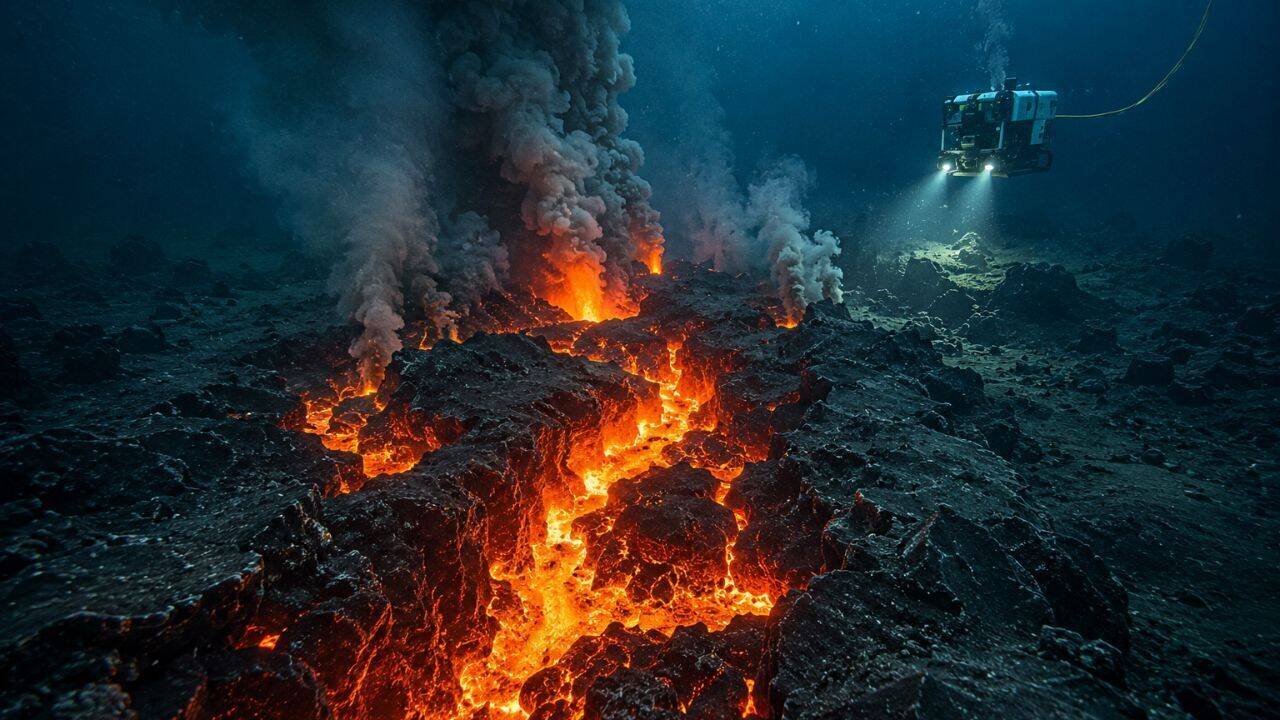

image AI generated
For most of human history, the creation of new ocean floor has been something inferred rather than witnessed. Geologists could map ancient scars on the seabed, measure the slow movement of tectonic plates and study volcanic rock brought to the surface, but the actual process of seafloor spreading remained largely hidden beneath kilometres of water.That changed in April 2024 in a remote part of the southern Indian Ocean. Instruments positioned across a mid-ocean ridge happened to be in exactly the right place when the seafloor began to tear apart. What followed was a remarkable chain of events: earthquakes raced along the ridge, the seabed sank by several metres, magma surged through underground fractures and vast quantities of lava poured onto the ocean floor. According to a study published in Nature on 8 July 2026, titled “Anatomy of a seafloor spreading event captured by in situ seismogeodesy”, researchers captured the first direct, in-situ observation of a complete seafloor spreading episode using a combination of acoustic, geodetic and pressure-monitoring instruments. The findings provide an unprecedented look at one of Earth’s fundamental geological processes, offering scientists new insights into how tectonic plates separate, how magma behaves beneath the seafloor and how new oceanic crust is formed.
How scientists detected the first signs of seafloor spreading in the Indian Ocean
The event occurred along the Southeast Indian Ridge, a tectonic boundary where two oceanic plates slowly move apart. Scientists from the OHA-GEODAMS project had deployed an array of instruments there only two months earlier, hoping to monitor long-term activity along the ridge.As per the study, then, on 26 April 2024, the quiet ended. A swarm of earthquakes suddenly appeared beneath the ridge valley. Rather than remaining fixed in one location, the seismic activity migrated rapidly along the ridge axis over distances of several kilometres. To researchers, the pattern resembled the underground advance of magma forcing its way through cracks in the crust.At the same time, pressure sensors resting on the seabed recorded something equally striking. The valley floor began to sink. Fast. Within hours, more than a metre of subsidence had occurred, and over the following days the total drop reached roughly four metres. The measurements suggested that a large magma reservoir beneath the ridge was emptying as molten rock moved upward and outward through newly formed fractures.
Scientists measured the ocean floor moving more than a metre
The study’s instrument network was designed to measure movement across the ridge itself. Acoustic transponders placed on opposite sides of the valley recorded horizontal shifts exceeding one metre, revealing that the seafloor was physically stretching apart during the event.According to the study, the data point to a combination of processes occurring simultaneously. A magma-filled crack, known as a dyke, propagated through the crust while faults bordering the ridge slipped. Together they produced several metres of extension, an amount equivalent to decades of normal plate movement compressed into a brief geological episode.One of the more surprising findings involved the faults themselves. Traditionally, earthquakes have been viewed as the main way faults accumulate displacement. The observations from this event tell a more complicated story.The researchers concluded that much of the fault movement occurred quietly, without generating large earthquakes. In other words, the seabed was shifting significantly through aseismic slip, a process that releases little seismic energy despite producing substantial deformation.
160 million cubic metres of lava created new ocean floor in the Indian Ocean
The underground activity eventually reached the ocean floor. By comparing detailed seafloor maps collected before and after the event, the team identified extensive new lava flows scattered across the ridge valley. Some deposits exceeded 90 metres in thickness and stretched for several kilometres. The estimated volume was enormous: between 148 million and 160 million cubic metres of lava.As per the study, indirect evidence suggests the eruption began within hours of the initial seismic swarm. Temperature sensors near the seabed detected warming, while hydrophones recorded thousands of distinctive acoustic signals associated with interactions between hot lava and seawater.The eruption appears to have continued for roughly 16 days. During that period, lava was being supplied at an average rate of around nine to ten million cubic metres per day, steadily building fresh oceanic crust on the floor of the Indian Ocean.
Scientists gain a rare real-time view of how Earth creates new crust
Mid-ocean ridges form a global network more than 65,000 kilometres long and are responsible for creating much of Earth’s oceanic crust. Yet the details of how this growth unfolds on human timescales have remained surprisingly elusive.The new observations suggest that seafloor spreading may happen in bursts rather than through perfectly steady motion. Decades of gradual stress can accumulate before being released during short-lived episodes involving magma intrusion, fault movement and volcanic eruption.The study also revealed a wider chain reaction. After activity swept along the ridge, nearby transform faults became seismically active, producing a series of earthquakes that appear to have been triggered by the spreading event.For geologists, the significance extends beyond one eruption in a remote corner of the ocean. The observations provide a rare real-time view of a process that has shaped Earth’s surface for hundreds of millions of years. Instead of relying solely on the geological record, scientists were able to watch a section of the planet manufacture new crust as it happened, from the first migrating earthquakes to the final outpouring of lava on the seafloor. Go to Source