
Monday, July 13, 2026
38.3 C
New Delhi

Science word of the day: Allele, know its meaning, who introduced the term, and its practical applications

Science word of the day: Allele, know its meaning, who introduced the term, and its practical applications

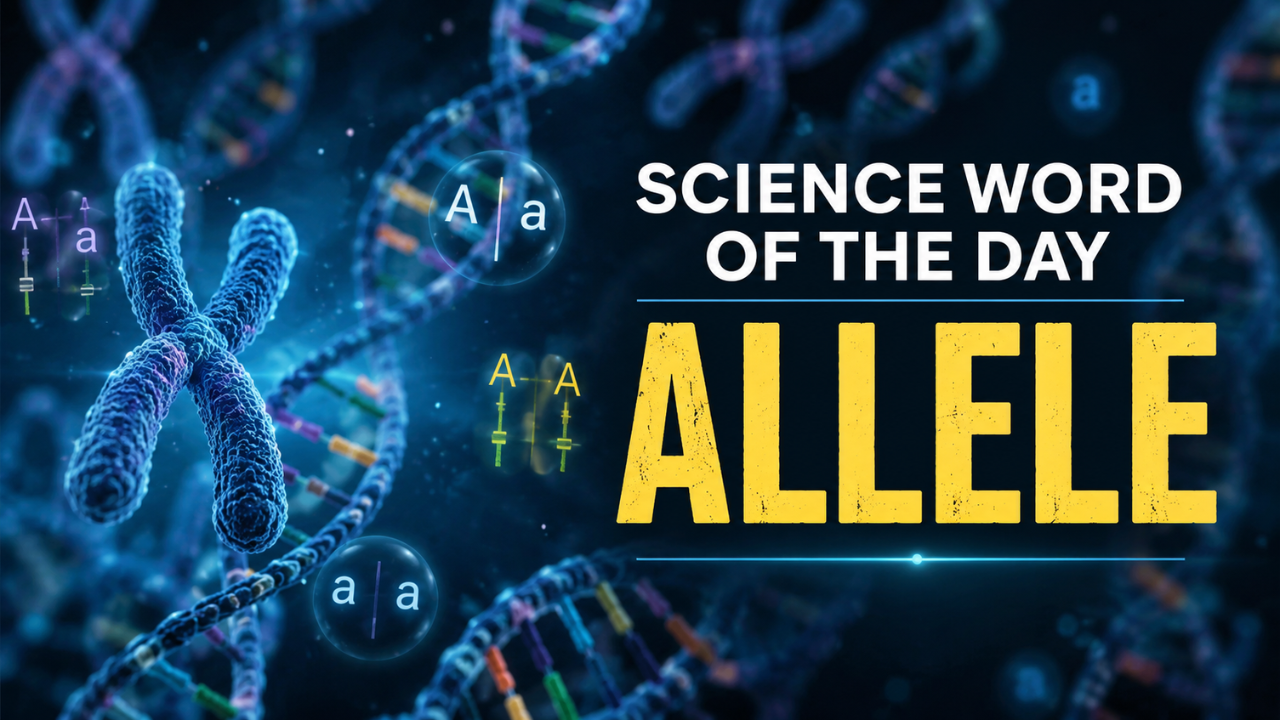
Image: AI Generated

Every living organism inherits a unique combination of traits, from eye colour and blood type to resistance against certain diseases. These characteristics are determined by genes, but genes themselves can exist in different forms. These alternative versions are known as alleles. While one allele may produce a particular trait, another may result in a different version of the same characteristic. The interaction between alleles forms the foundation of genetics, helping explain why siblings can look different despite having the same parents and why some inherited disorders occur. Today, the study of alleles plays a central role in medicine, agriculture, evolutionary biology and forensic science.

What is the definition of the word “allele”

Allele (noun): One of two or more alternative forms of the same gene that occupy the same position (locus) on a chromosome. Different alleles can produce variations in a particular inherited trait.Example: A person may inherit one allele for brown eyes and another for blue eyes, with the brown-eye allele typically being dominant.

How to pronounce the word

Allele is pronounced uh-LEEL.IPA: /əˈliːl/ (British) • /əˈliːl/ (American)The emphasis falls on the second syllable (LEEL). A helpful way to remember it is: “uh-LEEL.” The word comes from the Greek allos, meaning “other” or “different”, reflecting the idea that alleles are different versions of the same gene.

Who introduced the term “allele”?

The term allele (originally allelomorph) was introduced in 1902 by British zoologist William Bateson, one of the pioneers of modern genetics. Bateson coined the word while explaining Gregor Mendel’s laws of inheritance and the different forms that a gene could take. The shorter term allele later replaced allelomorph and became the standard terminology used in genetics worldwide. Bateson’s work helped establish genetics as a scientific discipline and popularised Mendel’s discoveries decades after they were first published.

Where are alleles used?

Scientists study alleles in genetics, medicine, agriculture, biotechnology, anthropology and forensic science.

Examples:

  • Doctors identify disease-causing alleles to diagnose inherited genetic disorders.
  • Plant breeders select favourable alleles to develop crops with higher yields and greater resistance to pests or drought.
  • Forensic scientists compare alleles in DNA samples to help identify individuals during criminal investigations or disaster victim identification.

Practical applications of alleles

Understanding alleles has transformed modern science and healthcare. Genetic testing uses allele analysis to detect inherited diseases such as sickle cell anaemia, cystic fibrosis and Huntington’s disease. In precision medicine, doctors can study a patient’s alleles to choose treatments that are more effective and reduce the risk of side effects. Agriculture relies on favourable alleles to produce crops that are more nutritious, disease-resistant and climate-resilient, while livestock breeding programmes use them to improve animal health and productivity. Alleles are also essential in DNA fingerprinting, ancestry studies, conservation biology and evolutionary research, helping scientists trace family relationships, understand biodiversity and uncover how species have evolved over millions of years. Go to Source
Hot this week

A hidden cave in Norway protected a 75,000-year-old Arctic world until scientists finally uncovered it

Long before the Arctic looked the way it does now, a stretch of Norway’s northern coastline supported an unexpectedly rich mix of wildlife. Read More

Richard Feynman’s unsent love letter to his late wife shows that love doesn’t always end with goodbye

Image: Sotheby’s Image(s): Sotheby’s Image: Sotheby’s Image(s): Sotheby’s Image: Sotheby’s Richard Feynman is remembered as one of the twentieth cent Read More

In 1883, Hawaii introduced mongooses to control rats in sugarcane fields. They soon became a far bigger threat to native wildlife

Back in the late 1800s, Hawaii’s booming sugarcane industry had a serious rat problem. Rats were tearing through the cane fields, cutting into profits, and plantation owners wanted a quick fix. Read More

What Happens If You Spend 10 Minutes In The Morning Sun Every Day?

Show Quick Read Key points generated by AI, verified by newsroom Morning sunlight synchronizes body’s internal clock, enhancing mood. Early exposure improves sleep quality and aids blood sugar regulation. Read More

Too Much AI Slop On LinkedIn? Users Are Turning To Messy, Human Posts For Better Reach

Show Quick Read Key points generated by AI, verified by newsroom LinkedIn content increasingly uses AI, making genuine voices harder. Pangram found 41% long-form LinkedIn posts are AI-generated. Read More

Topics

A hidden cave in Norway protected a 75,000-year-old Arctic world until scientists finally uncovered it

Long before the Arctic looked the way it does now, a stretch of Norway’s northern coastline supported an unexpectedly rich mix of wildlife. Read More

Richard Feynman’s unsent love letter to his late wife shows that love doesn’t always end with goodbye

Image: Sotheby’s Image(s): Sotheby’s Image: Sotheby’s Image(s): Sotheby’s Image: Sotheby’s Richard Feynman is remembered as one of the twentieth cent Read More

In 1883, Hawaii introduced mongooses to control rats in sugarcane fields. They soon became a far bigger threat to native wildlife

Back in the late 1800s, Hawaii’s booming sugarcane industry had a serious rat problem. Rats were tearing through the cane fields, cutting into profits, and plantation owners wanted a quick fix. Read More

What Happens If You Spend 10 Minutes In The Morning Sun Every Day?

Show Quick Read Key points generated by AI, verified by newsroom Morning sunlight synchronizes body’s internal clock, enhancing mood. Early exposure improves sleep quality and aids blood sugar regulation. Read More

Too Much AI Slop On LinkedIn? Users Are Turning To Messy, Human Posts For Better Reach

Show Quick Read Key points generated by AI, verified by newsroom LinkedIn content increasingly uses AI, making genuine voices harder. Pangram found 41% long-form LinkedIn posts are AI-generated. Read More

Musk Vs Altman Reloaded: Apple Lawsuit Triggers Fresh AI Billionaire Brawl On X

Show Quick Read Key points generated by AI, verified by newsroom Apple’s trade secret lawsuit reignited Musk-Altman rivalry. Musk criticized OpenAI on X; Altman retorted sarcastically. Read More

Quote of the day by Sam Neill

Sam Neill, in his official memoir, once talked about the importance of individuality and how important it is to accept yourself for who you are. For many, Sam Neill was a big part of their childhoods. Read More

S. Janaki’s granddaughter Apsara’s emotional farewell is hard to miss

Legendary playback singer S. Janaki was laid to rest with full state honours at her family farmhouse in Kaniyanahundi on H.D. Kote Road in Mysuru on Sunday evening. Read More

Related Articles