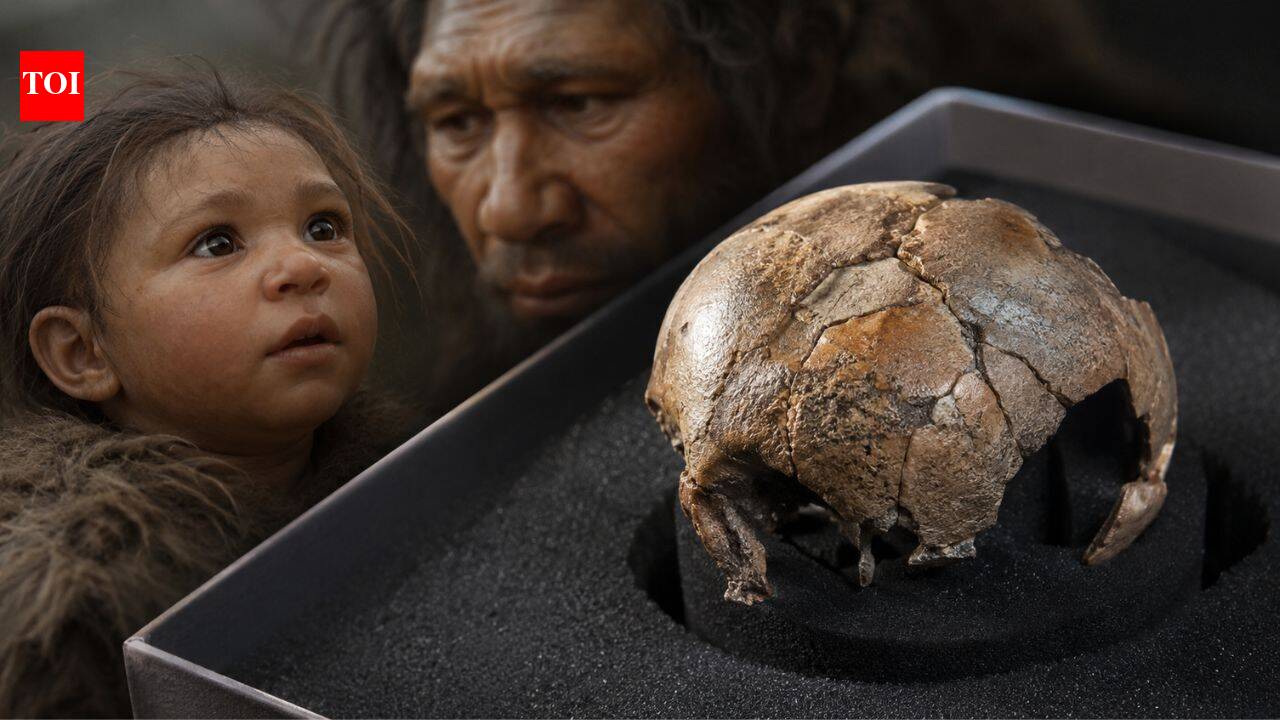

The earliest months of Neanderthal life have remained one of the least understood chapters of human evolution. Fossils from adults and older children have revealed the distinctive features that set these ancient relatives apart, yet remains from unborn babies are extraordinarily scarce. That has made it difficult to determine when the familiar Neanderthal body shape actually began to emerge. A newly examined fossil from southern Germany is now helping to fill part of that gap. By studying the microscopic structure inside tiny fossilised bones without damaging them, scientists have reconstructed the growth of a Neanderthal fetus during the final weeks before birth. Their findings suggest that, at least before birth, Neanderthals followed a pattern of skeletal development that was strikingly close to that seen in modern human babies, with many of their recognisable differences appearing only after they entered the world.
A cave in Germany preserves one of the earliest stages of Neanderthal life
The study published in The Royal Society Open Science, titled ‘Early development of Neanderthals revealed through virtual microanatomy’ revealed that the fossil comes from Sesselfelsgrotte, a rock shelter in Bavaria that has produced one of Europe’s richest collections of Neanderthal remains over several decades of excavation. Although countless bones were recovered during digs in the 1960s and 1970s, a handful of tiny fragments escaped recognition for many years because of their size. Only during later investigations did specialists realise that several of these delicate bones belonged to extremely young Neanderthals. Ancient DNA extracted from one small leg bone has now confirmed that one of the individuals was an unborn Neanderthal, removing long-standing uncertainty about the identity of the remains.The specimen, known as Sesselfelsgrotte 1, is exceptionally unusual. Fewer than ten Neanderthal fetuses or newborn infants have ever been identified, making every discovery valuable for understanding how these ancient humans developed before birth.
Looking inside ancient bones without damaging them
The fetal skeleton survives as just twelve tiny bone fragments, many measuring less than a few centimetres across. Because such material is exceptionally fragile, the research team avoided traditional methods that require cutting into fossil bone.Instead, they relied on high-resolution imaging to create detailed three-dimensional views of the bone’s internal structure. This approach allowed scientists to examine microscopic growth patterns while leaving the fossils intact for future studies, including further genetic analysis.Some of the fragments also showed faint surface marks consistent with digestion by a carnivore, suggesting that scavenging animals may have disturbed the remains sometime after death.
The fossil reveals striking similarities in fetal bone growth
The microscopic images revealed bone tissue typical of a rapidly developing fetus during the closing stages of pregnancy. Blood-rich areas and newly forming bone matched the characteristics commonly observed in modern human babies before birth.There were small differences between parts of the skeleton. Bones from the arms and legs appeared slightly further along in their development than pieces of the skull and jaw. That variation is not unexpected because different parts of the skeleton form in different ways.Long bones begin as cartilage before gradually becoming mineralised, while many bones of the skull develop directly from connective tissue. The subtle variation seen in the fossil may simply reflect those separate biological pathways rather than any uniquely Neanderthal pattern.The researchers say it is too early to conclude that Neanderthal limbs consistently matured ahead of other parts of the body because the evidence comes from a single fetus.
Teeth preserve signs of early childhood health
Alongside the fetal bones, scientists also examined two milk teeth belonging to two separate young Neanderthals from the same site.Inside each tooth, they identified areas where dentine, the hard tissue beneath tooth enamel, had failed to mineralise completely during development. These small defects, known as interglobular dentine, can sometimes indicate that normal mineral formation was interrupted while the teeth were growing.Such changes may be linked with periods of physiological stress, including shortages of vitamin D or calcium, or problems affecting calcium absorption. The evidence cannot identify the exact cause, and the interruptions could have occurred at any point between late pregnancy and the first years after birth, when these teeth were forming.If confirmed, these defects would represent the earliest known evidence of this type of developmental disturbance in Neanderthals.
Earliest months of life set Neanderthals apart
Although the unborn Neanderthal closely resembled a modern human fetus in skeletal development, those similarities did not remain throughout infancy.Previous research has shown that shortly after birth the paths begin to separate. Modern human babies develop the rounded braincase familiar in our species, while Neanderthal skulls retain a longer, lower profile. Scientists believe much of that divergence takes place during the first year of life rather than before birth.The new findings fit neatly with that picture, suggesting that prenatal development followed a shared blueprint before the two groups gradually took different developmental routes during infancy. Go to Source