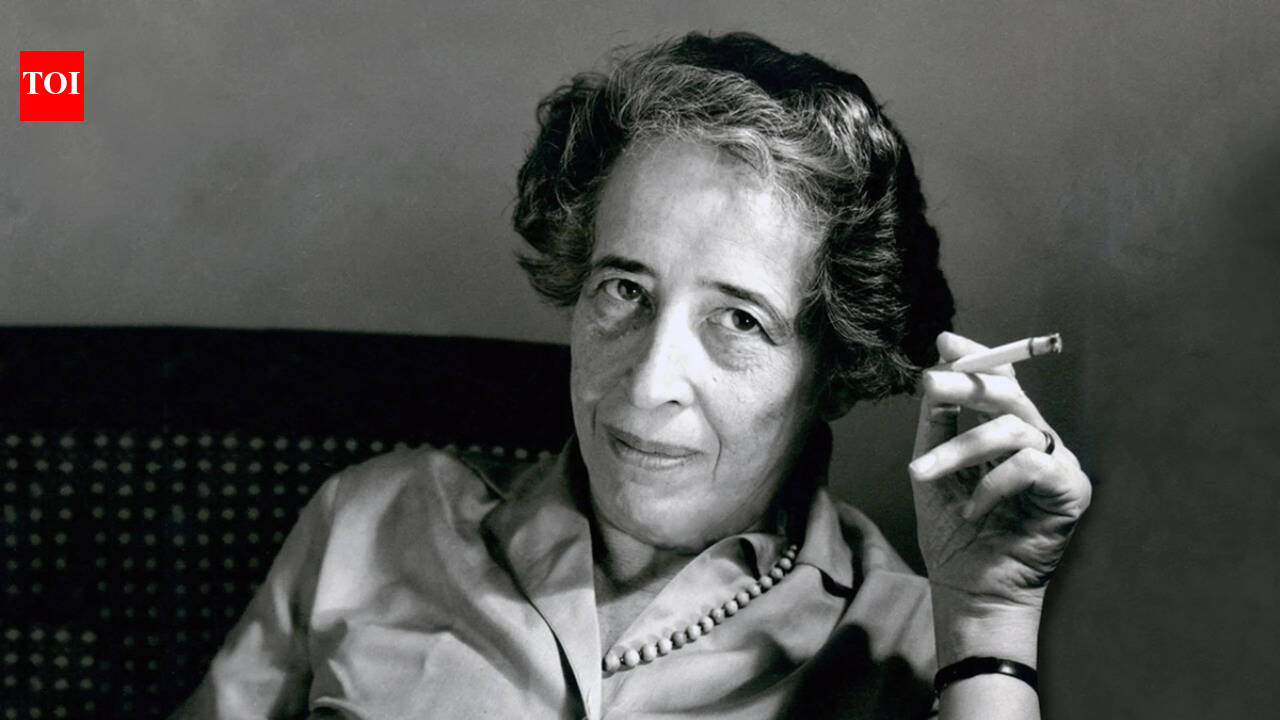

Few political thinkers have left behind a quote as unsettling as this one. At first glance, it appears simple. On closer inspection, it challenges one of the most common assumptions about evil: That terrible acts are mainly committed by obviously wicked people.For Hannah Arendt, one of the twentieth century’s most influential political theorists, the greater danger often came from ordinary individuals who stopped thinking critically about their actions and responsibilities.
Who was Hannah Arendt?
Hannah Arendt (1906-1975) was a German-born Jewish political theorist who later became an American citizen. She was forced to flee Nazi Germany and eventually settled in the United States, where she taught and wrote some of the most important works in modern political thought. Her major books include The Origins of Totalitarianism (1951), The Human Condition (1958), Eichmann in Jerusalem (1963), and The Life of the Mind, published after her death.Arendt never described herself primarily as a philosopher. She preferred to be known as a political theorist. Her work focused on power, freedom, authority, totalitarianism, citizenship and moral responsibility.
The origin of the quote
The quote comes from The Life of the Mind, Arendt’s final major work. In the book, she explored the nature of thinking, judgement and moral decision-making. The original wording is often cited as: “The sad truth of the matter is that most evil is done by people who never made up their minds to be or do either evil or good.” The statement reflects ideas Arendt had been developing for years, particularly after covering the 1961 trial of Nazi official Adolf Eichmann in Jerusalem.
The ‘banality of evil’
Hannah Arendt became famous, and controversial, for introducing the concept of the “banality of evil” in her book Eichmann in Jerusalem. The book was based on the trial of Adolf Eichmann, a senior Nazi SS officer and one of the key organisers of the Holocaust during World War II.She attended the trial expecting to encounter a monster. Instead, she saw a bureaucrat who appeared remarkably ordinary. Eichmann repeatedly argued that he was simply following orders and carrying out administrative duties.Arendt did not mean that Eichmann was innocent. Rather, she argued that evil can become routine when people stop examining the morality of what they are doing. She described him as “terrifyingly normal”, a person whose failure to think critically allowed him to participate in immense crimes.This became the foundation of her theory of the banality of evil.The phrase is often misunderstood. Arendt was not saying evil is trivial. She was arguing that terrible acts are frequently carried out by ordinary people operating within systems that reward obedience and discourage independent judgement.
What did the quote mean?
The quote suggests that many harmful actions are not committed by people who consciously choose evil. Instead, they are committed by individuals who never know what is right or wrong in a given situation.In Arendt’s view, moral failure often begins with passivity or lack of dissent. People follow instructions, repeat slogans, accept group thinking, or prioritise career advancement without considering the consequences of their actions. The absence of moral judgement can become dangerous.For Arendt, thinking itself was a political and ethical act. Citizens had a responsibility to question authority, examine their choices and resist blind conformity.
Why does it matter today?
Arendt’s ideas remain influential because modern 21st century societies depend heavily on large institutions, bureaucracies and technological systems.Her warning applies to situations where individuals claim they were “just doing their job” or “following procedure” while contributing to harmful outcomes. Political scientists, historians and ethicists continue to use her work to examine authoritarian governments, state violence and institutional wrongdoing.The relevance extends beyond politics. Corporate scandals, discrimination within organisations, online harassment campaigns and the spread of misinformation often involve large numbers of ordinary participants rather than a single villain.Arendt’s argument encourages people to ask difficult questions: What am I supporting? What are the consequences of my actions? Am I thinking independently?
Political importance
Arendt’s work has become central to the study of totalitarianism and democratic citizenship.In The Origins of Totalitarianism, she analysed how regimes such as Nazi Germany and Stalin’s Soviet Union used ideology, propaganda and fear to weaken independent thinking. Her research helped shape modern understanding of how democratic institutions can erode when citizens stop participating actively in public life.For political theorists, her work remains a reminder that democracy depends not only on laws and elections but also on citizens capable of judgement and critical thought.
A legacy that endures
Nearly fifty years after her death, Hannah Arendt remains one of the most discussed political thinkers in the world. Her work is taught in universities, cited in debates about authoritarianism and democracy, and revisited whenever societies confront questions about responsibility and complicity. The enduring power of her quote lies in its discomforting message. Most people imagine evil as something committed by others. Arendt suggested something far more challenging: That the greatest danger may come from ordinary people who never pause to decide what they truly stand for.That warning remains as relevant today as it was when she first wrote it. Go to Source