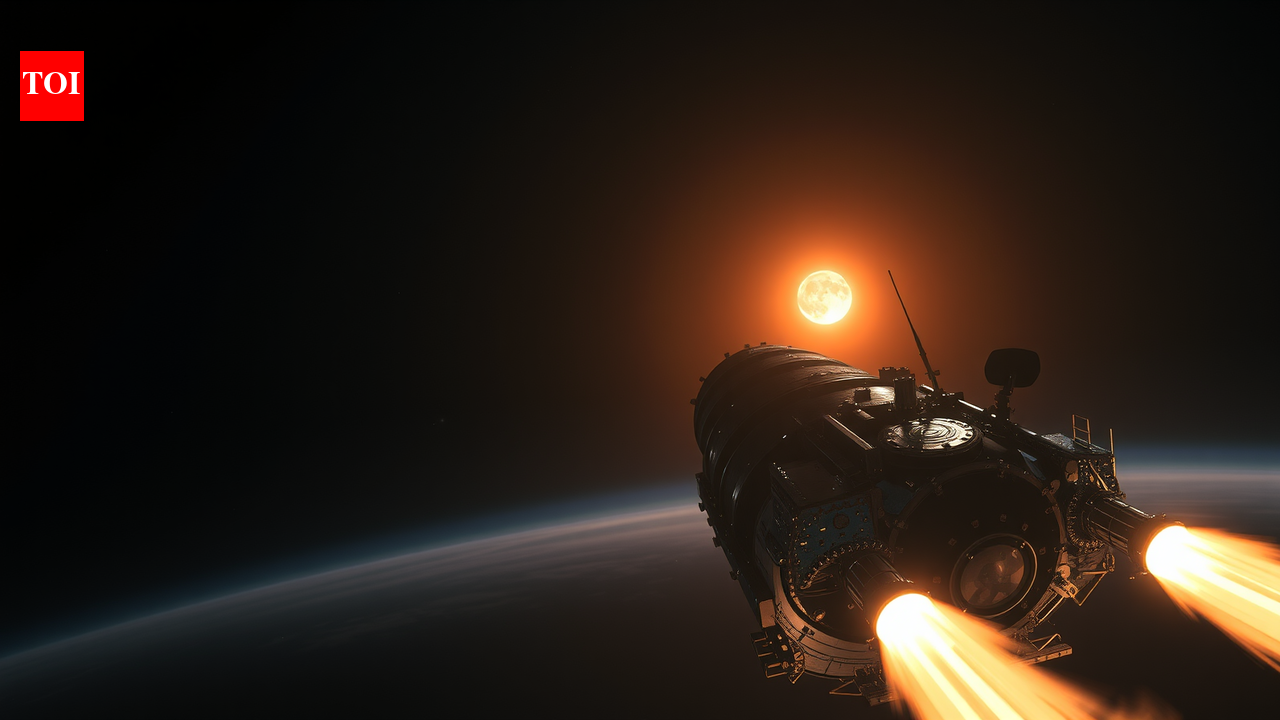

In 1988, the Soviet Union launched two of its most ambitious spacecraft ever built not toward Mars itself, but toward one of its moons, a tiny, oddly shaped rock called Phobos. The mission was unlike anything that had been attempted before. One of the probes was carrying a hopping robot literally designed to jump across the surface of an alien moon. Scientists from 14 different countries were involved. NASA was helping track the spacecraft from Earth. And if everything had gone to plan, the Soviet Union would have made history. Instead, one spacecraft was killed by a single wrong command typed from Earth, and the other went silent just days before its biggest moment. Neither probe ever touched Phobos.
What is Phobos and why did the Soviet Union want to explore Mars’ mysterious moon
Phobos is one of Mars’s two moons, and it is a strange one. It is tiny just about 22 kilometres across, and its origin has puzzled scientists for a long time. Some believed it was an asteroid that Mars had captured with its gravity. Others thought it had formed alongside the planet itself. Either way, studying Phobos up close could reveal important clues about how the Solar System came together. By the mid-1980s, Soviet space planners were looking to go further than simple Mars orbiters and flybys. They wanted to study Mars from orbit, look at how solar wind interacts with the planet, and most ambitiously, actually land something on Phobos. According to NASA’s HEASARC mission archive, the Phobos programme was designed to study both Mars and its moon at the same time, in a way no mission had done before.
The Phobos spacecraft were the largest interplanetary probes the Soviets had ever built
Each of the two spacecraft weighed over 6,200 kilograms when fully fuelled, making them among the biggest interplanetary probes ever launched at the time. They were packed with scientific instruments, cameras, spectrometers, X-ray and gamma-ray detectors, plasma analysers, magnetometers, dust detectors, and more. These were not simple camera ships. They were essentially flying laboratories.What made the mission really special, though, was what the probes were carrying for the surface of Phobos. One of the landers was a standard stationary science platform. The other called PROP-F was something entirely new. Because Phobos has extremely weak gravity (about 2,000 times weaker than Earth’s), a wheeled rover would have just floated away. So engineers designed a robot that would move by hopping, jumping from one spot to another, analysing rocks, magnetic fields, and surface chemistry as it went. It would have been the first hopping robot ever operated on another world.
How one wrong software command ended Phobos 1 before it even reached Mars
Phobos 1 launched in July 1988 and everything looked fine until a routine software upload went wrong. A single incorrect command accidentally switched off the spacecraft’s attitude-control system. That is the system that keeps a spacecraft properly oriented in space, making sure its solar panels stay pointed toward the Sun.Without it, Phobos 1 slowly drifted out of alignment. Its solar panels stopped receiving sunlight. The batteries drained. And that was it the spacecraft went permanently silent, billions of kilometres from Earth, never to be heard from again. It never even reached Mars. It remains one of the most well-known software errors in the entire history of spaceflight, a reminder that in space, a single line of bad code can end a billion-dollar mission in minutes.
How Phobos 2 reached Mars and spent two months sending back valuable science
The second spacecraft launched just days after the first and had far better luck at least initially. After a seven-month journey, Phobos 2 successfully entered orbit around Mars in January 1989. For almost two months, it performed genuinely impressive science. It studied Mars’s dust, the interaction of solar wind with the planet, magnetic fields around Mars, and sent back 37 close-up images of Phobos many clear enough to reveal surface features as small as 40 metres across. For years, these were the best images humanity had of the moon.The mission also contributed to early mineralogical maps of Mars using infrared data and improved scientists’ understanding of how the solar wind strips particles from Mars’s atmosphere over time a process linked to why Mars, which once had a much thicker atmosphere, became the barren planet it is today.
The final days of Phobos 2 and how the mission ended just before its greatest moment
The entire mission was building toward one thing: getting close enough to Phobos to release both landers. The plan was for Phobos 2 to approach within about 50 metres of the moon’s surface before letting the landers go. On March 27, 1989, just days before that was supposed to happen, the spacecraft went completely silent.Investigations later concluded that the onboard computer was the most likely cause of failure, though problems with the radio transmitter may have played a role too. By the time Phobos 2 reached Mars, multiple onboard computers were already having issues, leaving very little backup. Neither lander was ever deployed. The mission ended at the worst possible moment.
What the Phobos mission achieved and why it still matters in space exploration history
Despite both spacecraft failing before they could complete their main goal, the Phobos programme was not a total loss. The science returned by Phobos 2 led to dozens of research papers in the early 1990s and contributed real knowledge about Mars’s atmosphere, magnetic environment, and the surface of its moon. The close-up images of Phobos remained the best available for many years.The mission also stands as a remarkable example of international scientific cooperation during the Cold War, with researchers from 14 nations contributing, and even NASA providing tracking support. It was one of the broadest scientific collaborations of its era.But the Phobos programme also reinforced a painful pattern in Soviet and later Russian planetary exploration: technically impressive spacecraft repeatedly brought down by software faults, electronics failures, or bad luck. Neither the Mars 96 mission nor Phobos-Grunt succeeded in the decades that followed, leaving Phobos as one of the Solar System’s most tempting and least explored destinations. The hopping robot that never got to hop, and the moon that was never touched, remain one of space history’s most haunting what-ifs. Go to Source