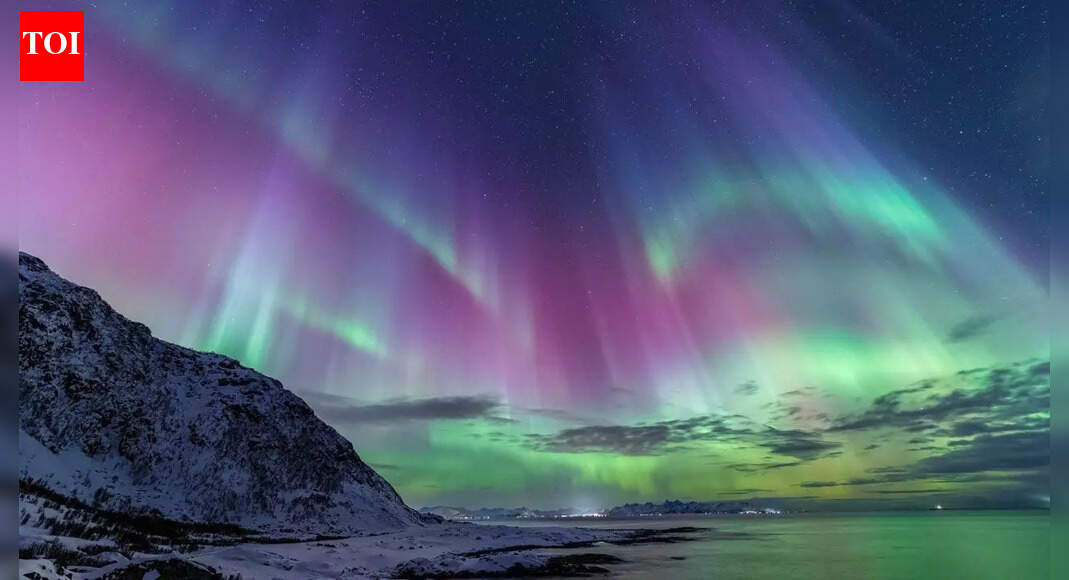

Source: Space.com
A powerful rise in solar activity could push the northern lights far beyond their usual northern zones, creating a rare opportunity for skywatchers across the United States. Scientists are monitoring a strong burst of energy from the sun known as a coronal mass ejection, which sends charged particles racing toward Earth. When these particles interact with the planet’s magnetic field, they can intensify geomagnetic activity and cause colourful auroral displays to expand into lower latitudes. This event may allow vibrant green and purple glows to appear in regions that rarely experience the aurora. Experts emphasise that visibility will depend on cloud cover, darkness, and the strength of the incoming solar disturbance, making the coming days especially promising for observers.
Aurora borealis on December 9: Northern lights forecast amid powerful solar storm
The National Oceanic and Atmospheric Administration’s Space Weather Prediction Centre has reported that a significant coronal mass ejection is heading for Earth on 9 December. A coronal mass ejection releases massive clouds of plasma and magnetised particles from the sun. When these particles reach Earth, they interact with the planet’s magnetic field and can cause large surges in geomagnetic activity.Key effects include:
- Disturbance of Earth’s magnetosphere
- Increased charged particle collisions in the atmosphere
- Expansion of auroral visibility further south than usual
These interactions are what create the colourful light displays known as the aurora borealis.
Best time to view the Northern Lights on 9 December
Auroras are only visible at night because daylight washes out the glow of atmospheric collisions.The most favourable viewing times are:
- Just after sunset
- One to two hours around midnight
- Just before sunrise
NOAA emphasises that the darkest hours of the night usually provide the most vibrant and stable display conditions.
States most likely to see the Northern Lights on 9 December
Based on NOAA’s current projection, aurora visibility may extend into parts of:
- Alaska
- Idaho
- Iowa
- Maine
- Michigan
- Minnesota
- Montana
- New Hampshire
- New York
- North Dakota
- South Dakota
- Vermont
- Wyoming
- Washington
- Wisconsin
Actual sightings will depend on weather, cloud cover and levels of light pollution.
How solar eruptions trigger widespread northern lights displays
The National Oceanic and Atmospheric Administration’s Space Weather Prediction Centre has reported that a significant coronal mass ejection is heading for Earth. A coronal mass ejection involves the release of massive clouds of plasma and magnetised particles from the sun. When these particles reach Earth, they interact with the planet’s magnetic field and can cause large surges in geomagnetic activity.Key effects of a coronal mass ejection include:
- Disturbance of Earth’s magnetosphere
- Increased charged particle collisions in the atmosphere
- Expansion of auroral visibility further south than usual
These interactions create the colourful light displays known as the aurora borealis.
Aurora Borealis visibility: Predicted viewing zones across the United States
NOAA has outlined a predicted “view line” showing the southernmost point where the aurora may appear on the northern horizon. On 9 December, parts of roughly fifteen states fall into or near this zone.However, the agency stresses that predictions are not perfect. Key reasons visibility may exceed forecasts:
- Auroras can be visible up to 1,000 kilometres away
- Strong storms often behave unpredictably
- Atmospheric clarity can significantly widen the viewing area
This means people living south of the forecast line may still catch a faint glow if the event intensifies.
Why the Northern Lights glow during solar storms
The aurora borealis forms when energetic solar particles travel along Earth’s magnetic field lines and collide with gases in the atmosphere. These collisions cause the gases to emit light, creating glowing ribbons in shades of green, red and purple.Important factors influencing auroral colour and intensity:
- The energy of incoming solar particles
- The type of gas they collide with
- Altitude of the collision
- Level of geomagnetic disturbance
During stronger solar events, these interactions become more intense and spread wider across the sky.
Understanding the K-index and why it matters
NOAA is forecasting a K-index score of 5 for 9 December. The K-index measures geomagnetic disturbance intensity on a scale from 0 to 9.What a K-index of 5 means:
- Stronger auroras
- Brighter and more extensive visibility
- Increased chance of sightings in mid-latitude locations
The event is also classified as a G1 geomagnetic storm. Although considered minor, G1 storms are fully capable of producing vibrant auroras, especially under dark-sky conditions.Also Read | Alien signal or atmospheric mystery? NASA reveals truth behind red ‘jellyfish’ lights and sprites over Earth Go to Source