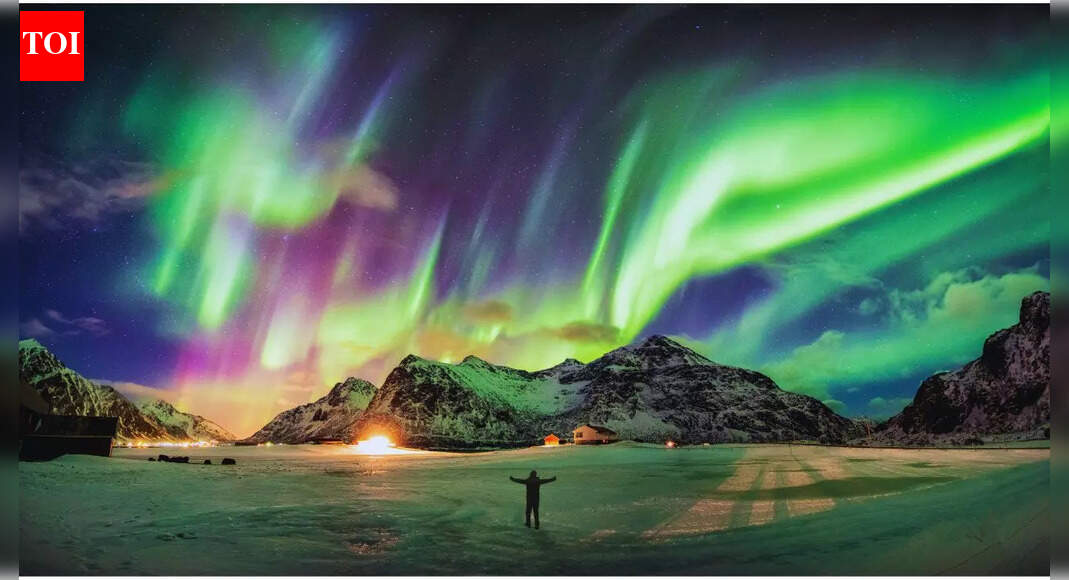

Northern lights may drift across US skies this week: Know where to spot them
Northern skies do not always announce themselves. Most nights pass quietly, even when something distant is shifting above the planet. This week is slightly different. A pulse of solar activity is moving through Earth’s magnetic field, and that change may be just enough to push the northern lights into view across parts of the United States. It is not guaranteed, and it will not look the same everywhere. Some people may see soft colour low on the horizon, others nothing at all. Still, for a short window in early January, the odds tilt a little. Space weather forecasters are watching closely, and so are sky watchers, hoping the darkness offers something unexpected rather than empty for once during the coldest stretch of winter nights.
Which US states are most likely to see the Nothern lights this week
The strongest chances sit far north, as they usually do. Alaska remains the most reliable place, almost separate from the rest of the map when it comes to aurora watching. Parts of:
- Washington
- Montana
- North Dakota
- South Dakota also falls well within the viewing zone for this event.
These areas lie closer to where Earth’s magnetic field funnels charged particles into the atmosphere. NOAA forecasts suggest activity could peak overnight between January 8 and January 9, though timing often slips by hours. In these states, the lights may form brighter arcs or slow-moving curtains rather than faint smudges. Even then, nothing is promised. Auroras are known for appearing briefly and fading without warning.
Can people farther south see anything at all
States a little below the usual aurora belt are not entirely out of luck. Minnesota, Michigan, and Maine often sit on the edge during moderate geomagnetic storms, and this week could be another of those moments. The display in these places is usually subtle. Colour may appear washed out, sometimes closer to grey than green. It often stays low in the northern sky, easy to mistake for a cloud or distant glow. Wyoming, Vermont, New Hampshire, and parts of New York fall into a similar category. For viewers there, seeing the aurora often depends on patience and expectations. Many who do catch it only realise later when photos reveal more than the eye noticed at the time.
What is causing this aurora event
The trigger comes from the Sun, though not in a dramatic, cinematic way. A coronal mass ejection has sent a stream of charged particles outward, interacting with a co rotating interaction region already moving through space. Together, they disturb Earth’s magnetic field just enough to produce a G1-level geomagnetic storm. That rating is considered minor, but minor does not mean invisible. It simply means effects are more local and less intense. Space weather remains difficult to predict with precision. Solar wind speed, density, and direction can all shift suddenly. Forecasts improve as the storm arrives, but uncertainty never fully disappears.
Clouds and city lights change the experience
Even the strongest aurora means little under thick cloud. Cloud cover remains the biggest reason people miss these events, regardless of solar activity. Clear skies matter more than most other factors. Light pollution is the next obstacle. Urban lighting can wash out faint auroras entirely, especially in southern locations. Rural areas, coastal stretches, and dark sky parks offer better odds. Many experienced observers suggest letting your eyes adjust and avoiding phone screens for a while. Cameras often see more than humans do, especially in low light modes. Sometimes the night still looks empty. Sometimes it does not. That uncertainty is part of the pull. Go to Source