
Source: Live Science
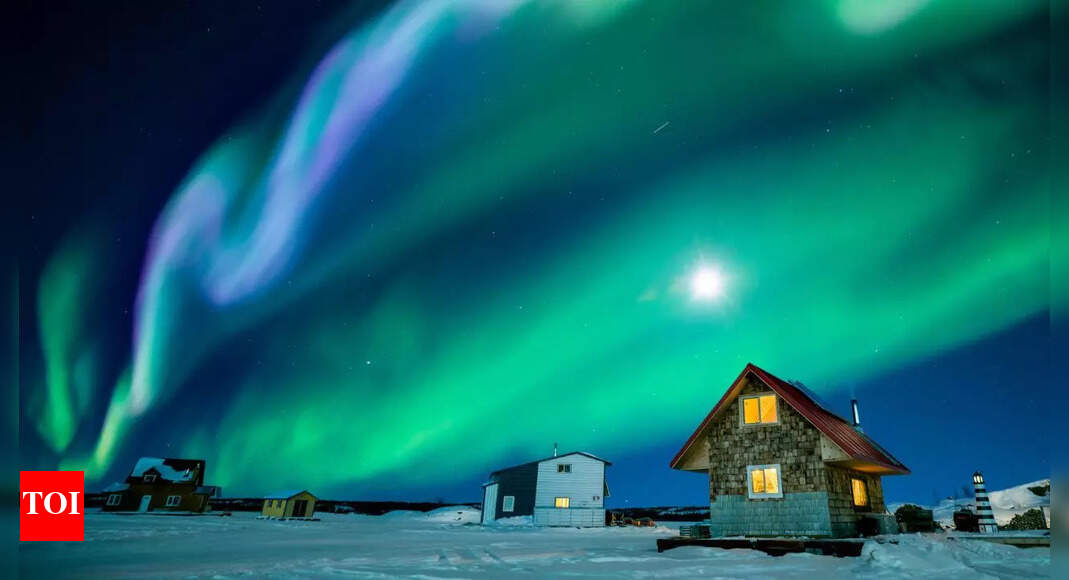
The night sky across the United States is expected to dazzle millions as the Northern Lights, or aurora borealis, become visible in over twenty states from November 11 to 12, 2025. This rare spectacle is fueled by heightened solar activity, including several powerful solar eruptions that send charged particles hurtling toward Earth. As these particles interact with the planet’s magnetic field, they create stunning displays of shifting light in shades of green, pink, and violet. The phenomenon, usually confined to polar regions, may reach as far south as states like Kansas and Virginia, offering a rare opportunity for Americans to witness one of nature’s most captivating and colourful celestial events.
US states could witness the Aurora Borealis tonight: Check the list
The Northern Lights, or aurora borealis, are expected to dazzle skywatchers across the United States tonight, offering a rare opportunity for millions to witness one of nature’s most mesmerising displays. According to the National Oceanic and Atmospheric Administration (NOAA), enhanced solar activity has created ideal conditions for auroral visibility, pushing the colourful phenomenon much farther south than usual. If weather conditions remain clear, shimmering curtains of green, pink, and violet light could illuminate the skies across multiple regions, from the Pacific Northwest to the Northeast. This widespread coverage marks one of the most extensive Northern Lights forecasts in recent years, making tonight a particularly exciting occasion for stargazers and photographers alike.Here’s the list of US states:
- Alaska
- North Dakota
- Minnesota
- Montana
- Wisconsin
- Michigan
- Maine
- South Dakota
- Idaho
- Vermont
- Washington
- New Hampshire
- Wyoming
- New York
- Iowa
- Massachusetts
- Pennsylvania
- Nebraska
- Ohio
- Illinois
- Indiana
When and how to watch the Northern Lights
Timing is crucial for observing the aurora borealis. NOAA’s three-day geomagnetic forecast predicts that activity will peak late in the evening and continue into the early hours of 12 November. The best viewing windows are expected to be between 4 pm and 10 pm EST (2100–0300 GMT) for minor to moderate activity, and between 10 pm and 1 am EST (0300–0600 GMT) for stronger geomagnetic storm levels.During these peak hours, observers may witness luminous arcs or shimmering curtains of light dancing across the northern horizon. In some areas, the lights could stretch overhead in glowing ribbons that shift and ripple as magnetic fields interact.
What makes this Aurora event unique
The combination of multiple CMEs and an exceptionally powerful solar flare makes this event stand out from recent auroral displays. The convergence of these solar bursts increases the likelihood of intense geomagnetic disturbances.Such interactions can create stacked auroras, where layers of colour overlap, giving the sky an even richer appearance. The last time auroras of this strength reached similar latitudes was during strong solar events several years ago. Additionally, solar activity tends to rise and fall in roughly 11-year cycles known as solar cycles. We are currently nearing the peak of Solar Cycle 25, which explains the recent increase in both sunspots and flares that are the main drivers of auroral events.
Understanding the science behind the Northern Lights
The Northern Lights occur when streams of charged particles from the Sun, known as the solar wind, reach Earth and interact with gases in the upper atmosphere. These collisions release energy in the form of light, producing the stunning patterns that dance across the sky.Oxygen atoms are responsible for the green and red colours most commonly seen, while nitrogen produces blue and purple hues. The exact colours depend on which gases are hit and at what altitude the interactions take place.This week’s event is particularly special because several coronal mass ejections (CMEs), enormous bursts of plasma and magnetic energy from the Sun, are headed toward Earth. These CMEs are part of heightened solar activity linked to an X5.1-class solar flare, the most powerful flare recorded so far in 2025. When these charged particles collide with Earth’s magnetic field, they can cause strong geomagnetic storms, expanding the auroral oval and pushing the Northern Lights much farther south than usual.
How geomagnetic storms are classified
Geomagnetic storms are measured on a five-level scale from G1 (minor) to G5 (extreme). These classifications are determined by the strength of the disturbance in Earth’s magnetic field.A G3 storm is strong enough to make auroras visible at mid-latitudes, while a G4 storm can extend the visibility range even farther south and may affect some radio communications and satellite operations. The National Oceanic and Atmospheric Administration (NOAA) has issued a G4 geomagnetic storm watch, suggesting that much of the continental United States could witness the aurora. It is rare for auroras to reach such southern latitudes, making this a potentially historic event for skywatchers.
Tips to improve your chances of seeing the Northern Lights
While space weather determines when the aurora will occur, your viewing experience depends largely on preparation and local conditions. Experts recommend several strategies to increase your odds of seeing the lights clearly.
- Find a dark viewing spot far from city lights and face north for the best view. Light pollution can wash out faint auroras, so rural or elevated areas are ideal.
- Use your smartphone camera as many modern phone cameras are more sensitive to light than the human eye and can detect faint auroras before they become visible.
- Let your eyes adjust to the dark for at least 20 to 30 minutes and avoid looking at bright screens. This allows your vision to adapt to low light and makes it easier to spot subtle colour shifts in the sky.
- Dress warmly because temperatures can drop significantly at night, especially in northern regions. Layered clothing, gloves, and hats are essential for comfort during long viewing periods.
- Be patient. The Northern Lights are unpredictable and can appear suddenly. Staying outdoors for an extended period improves your chances of witnessing the spectacle.
What to do if you miss tonight’s display
If cloudy skies or poor visibility spoil your view tonight, there is still hope. The sequence of solar eruptions means geomagnetic activity could remain elevated for several days. Keep an eye on forecast updates through NOAA’s channels or dedicated aurora-tracking apps, as new opportunities may arise later this week.Even if you miss this particular show, solar activity is expected to stay strong for the remainder of the year, providing additional chances for aurora sightings across mid-latitudes.Also Read | US winter 2025‑26: Complete snowfall forecast, first snow dates, regions most likely to see snow, and what to expect Go to Source