
Source: Taylor & Francis
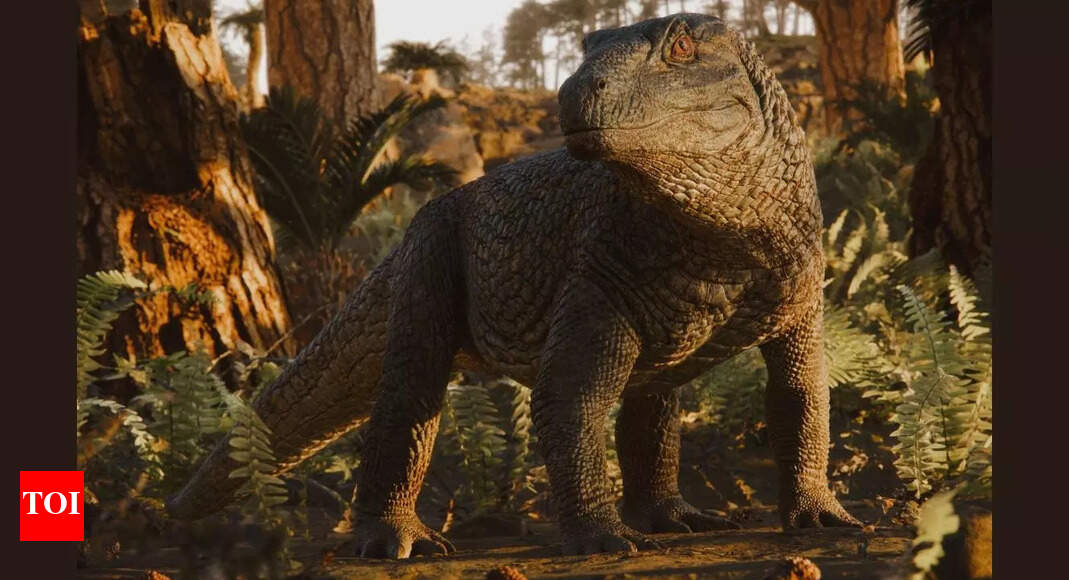
A striking new fossil from southern Brazil is offering a clearer view of how crocodile-line archosaurs evolved long before dinosaurs became dominant. The species, named Tainrakuasuchus bellator, comes from a Middle Triassic layer in Rio Grande do Sul and reveals a medium-sized predator with a slender jaw, recurved cutting teeth and elongate neck vertebrae. Its anatomy points to an agile and specialised carnivore occupying an ecological niche that had been under-represented in the region’s fossil record. The discovery also highlights how diverse early archosaurs already were at this time, and how their evolutionary experimentation unfolded across Gondwana during a period of major environmental and biological change.According to the study describing the specimen, published in the Journal of Systematic Palaeontology, the fossil represents a new pseudosuchian archosaur from the Pinheiros–Chiniquá Sequence in the Santa Maria Supersequence of southern Brazil.
Where and how the fossil was discovered
The remains of Tainrakuasuchus bellator were found at the Posto locality in Dona Francisca, situated within sedimentary layers attributed to the Ladinian age of the Middle Triassic. This part of the Pinheiros–Chiniquá Sequence is known for preserving terrestrial vertebrates from the Dinodontosaurus Assemblage Zone, a horizon that has produced several archosaur and synapsid fossils. The specimen was recovered through controlled excavation followed by careful preparation in the laboratory, where a partial lower jaw, several neck and trunk vertebrae and a portion of the pelvis were exposed. Although the find does not include a complete skeleton, the preserved elements are sufficiently diagnostic to confirm that the animal represents a previously unknown species.The geological context of the site indicates an environment characterised by semi-arid conditions with episodic sedimentation, which is consistent with the broader setting of the Santa Maria Supersequence during the Middle Triassic. These conditions favoured the preservation of isolated but well-mineralised skeletal components such as those found for Tainrakuasuchus.
What the creature looked like and how its skeleton was built
Even with incomplete remains, the anatomy of Tainrakuasuchus bellator provides a detailed impression of the animal’s overall build. The lower jaw is slender and elongated, equipped with sharp, recurved ziphodont teeth suited to shearing flesh rather than crushing bone. This jaw shape suggests a predator that relied on swift, slicing bites rather than brute force. The cervical vertebrae are comparatively long, indicating a flexible neck that may have been useful for rapid strikes or precise movements during predation.The dorsal vertebrae show proportions consistent with a lightly built but stable torso. The ilium is particularly distinctive, featuring a short preacetabular process, an elongated postacetabular process and a straight dorsal margin. This combination of pelvic traits is not common among known pseudosuchians from the region, marking it as an anatomically unique form. Although limb bones were not preserved, comparisons with related taxa suggest that the animal was likely quadrupedal and capable of reasonably agile locomotion.Taken together, the preserved elements point to a predator around medium size for its time, a morphological category that had been comparatively under-documented in the Triassic record of southern Brazil.
Which unique features set Tainrakuasuchus apart
Several anatomical characteristics differentiate Tainrakuasuchus bellator from other archosaurs of the Middle Triassic. Its slender dentary, equipped with recurved teeth possessing well-developed cutting edges, stands out as a key adaptation for flesh slicing. The elongated neck vertebrae add an unusual element to its profile, suggesting that neck mobility may have played an important role in its feeding strategy. The pelvic structure, with its distinctive proportions and margins, further emphasises its uniqueness within early crocodile-line archosaurs.The naming of the species reflects these features. “Tainrakuasuchus” is derived from Guarani terms referring to sharp or pointed teeth combined with the Greek word for crocodile, while “bellator,” Latin for warrior, reflects both the animal’s predatory nature and a cultural tribute to the people of Rio Grande do Sul.These specific features collectively demonstrate that pseudosuchians were experimenting with a wide range of morphologies during the Middle Triassic, challenging earlier assumptions that early archosaurs were relatively uniform in form.
How this fossil could change our understanding of crocodile evolution
A detailed phylogenetic analysis positions Tainrakuasuchus bellator within Paracrocodylomorpha, specifically among poposauroid pseudosuchians. This placement underscores that crocodile-line archosaurs had already diversified into multiple specialised groups by the Middle Triassic. Its closest relative in the analysis appears to be Mandasuchus tanyauchen from the Manda beds of Tanzania, indicating strong biogeographic connections between southern Brazil and eastern Africa during this period.This relationship is consistent with a Gondwanan landmass in which terrestrial vertebrates could disperse widely across connected regions. The discovery therefore helps refine correlations between fossil-bearing units in South America and Africa and supports the interpretation that these faunas were more integrated than previously assumed.
What role did this predator play in its environment?
Tainrakuasuchus bellator adds to the evidence that Middle Triassic ecosystems in Gondwana contained a layered structure of predators rather than being dominated solely by large apex forms. With its specialised jaw, slicing teeth, flexible neck and likely dorsal armour, the species represents a medium-sized carnivore adapted for active predation. Its presence suggests that pseudosuchians occupied multiple trophic roles and were experimenting with different anatomical strategies much earlier than once believed.By documenting this new species, the study broadens the taxonomic and ecological diversity known from the Dinodontosaurus Assemblage Zone. It also provides a clearer understanding of how early crocodile-line archosaurs were evolving across Gondwana, offering a more nuanced view of their adaptive pathways during a formative stage in vertebrate history.Also Read | How interstellar objects reach Earth and where they are most likely to land Go to Source