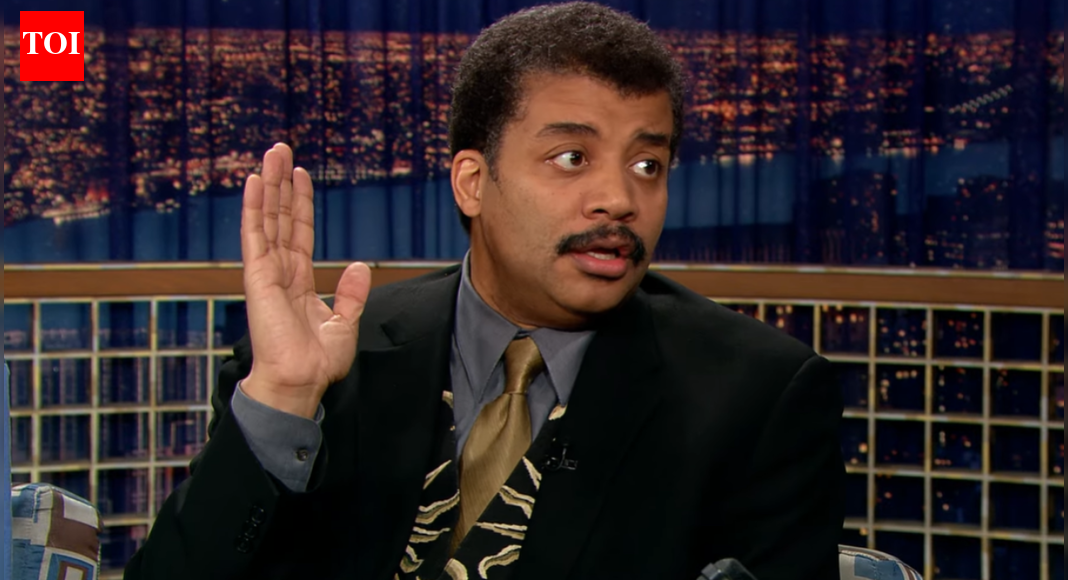

Neil deGrasse Tyson says falling into a black hole would be his ultimate, final cosmic experiment/ image: Youtube
If there were ever a way to choose how to die, Neil deGrasse Tyson once argued that falling into a black hole would be the most extraordinary option available. Not because it would be painless, he is clear that it would not, but because, from the perspective of the person falling in, the laws of physics would briefly allow them to witness the future of the universe unfold before their death. Tyson has made the argument in public interviews, television appearances and in his book Death by Black Hole, framing it as a uniquely violent but scientifically remarkable end.
“It’s the way to go”
Tyson laid out the idea during an appearance on Late Night with Conan O’Brien in 2007, when host Conan O’Brien asked him how dying inside a black hole would actually work. “It’s the way to go,” Tyson said. “I mean if you have your choice of getting hit by a car, dying in a nursing home or falling into a black hole, then the choice is easy for me. Totally.” He explained that the process would begin the moment someone falls feet-first toward the black hole. Because gravity increases dramatically over very short distances near a black hole, the pull on the feet would be far stronger than the pull on the head. “If you go a feet-first dive, your feet approach the black hole faster than your head does because the gravity is stronger at your feet,” he said. “At first, you’re stretching and that kind of feels good initially.”
Spaghettification and what it does to the body
That brief “stretch,” Tyson explained, would quickly turn fatal. As the difference in gravitational force between the feet and the head grows, it eventually overwhelms the molecular forces that hold the human body together. “The difference in gravity becomes greater than the molecular forces that hold your flesh together,” he said. Tyson described how the body would begin to tear apart, snapping into segments and then into smaller and smaller pieces until it becomes what he called “a stream of particles descending down.” Asked whether the experience would be painful, Tyson did not hesitate. He responded with an enthusiastic “yeah.” “It’s worse than that, though, it’s worse because the fabric of space and time funnels you,” he said. “In fact, you’re occupying a narrower and narrower cone of space, so you’re getting extruded through the fabric of space-time like toothpaste through a tube.” The process has a name in physics: spaghettification, a term used to describe how objects are stretched into long, thin shapes by extreme tidal forces near a black hole.
Why he still calls it the “best” option
Despite describing an outcome that is violent, destructive and irreversible, Tyson argues that dying in a black hole offers something no other death does: a front-row seat to the future of the universe. Because of time dilation, a consequence of Einstein’s theory of relativity, time slows dramatically for an object approaching a black hole relative to the rest of the universe. From the perspective of the falling observer, external time accelerates. In practical terms, Tyson has explained, that means a person falling toward the singularity could, in their final moments, watch the universe age rapidly, potentially seeing stars die, galaxies evolve and the distant future unfold, before being destroyed. “If you had to choose,” Tyson has said elsewhere, “why not perform the irreversible experiment of your life.” He has also acknowledged the obvious obstacle to the idea: distance. The nearest known black hole is roughly 1,500 light-years away, making the scenario firmly theoretical rather than practical.
A poetic version of the same idea
Tyson has also explored the idea creatively. During an appearance on The Kelly Clarkson Show, he read a poem that he composed about falling into a black hole:“A feet-first dive into a cosmic abyss where you will not survive and will not miss the chance to understand why.The tidal forces of gravity create a calamity as you are stretched head to toe, and you are asked once more if you are sure you want to go.Your body’s patterns enter one by one, until the event horizon consumes them, and there is no fun to be had at all.”For Tyson, a physicist who has spent his career demystifying the universe, an unsentimental death governed entirely by physics makes sense, serving as a final cosmic experiment, one that offers closure and answers by confronting the laws of nature at their most extreme. Go to Source