
Image: AI Generated
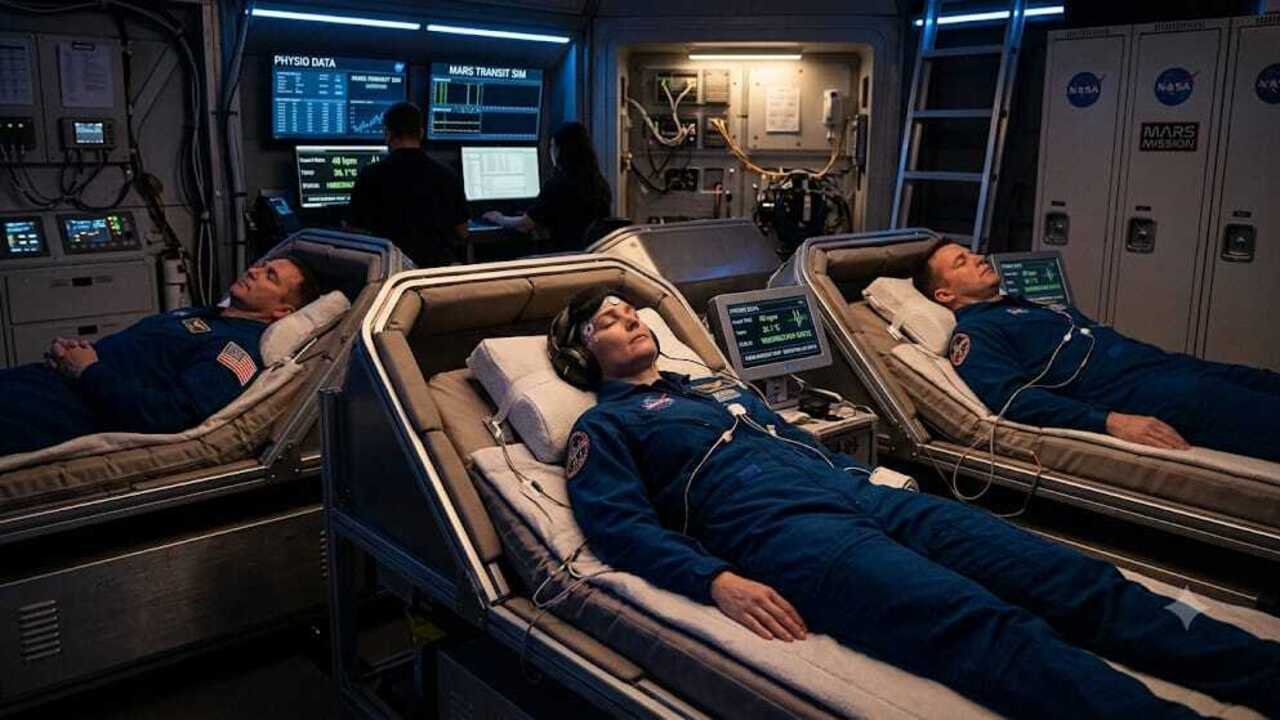
Sending humans to Mars is one of Nasa’s greatest ambitions, but the journey presents enormous challenges. A round trip could take well over a year, exposing astronauts to dangerous cosmic radiation, muscle and bone loss caused by microgravity, psychological stress and the need to carry vast amounts of food, water and supplies. To tackle these obstacles, scientists are investigating a concept that has long belonged to science fiction: placing astronauts into a hibernation-like state during the voyage. Although true human hibernation is still beyond current medical capabilities, NASA-supported researchers, alongside scientists funded by the European Space Agency (ESA), are making steady progress towards developing a safe form of synthetic torpor that could transform deep-space exploration.
Why scientists wanted astronauts to hibernate
Many animals, including bears, bats and ground squirrels, naturally enter hibernation to survive harsh conditions. During this period, their metabolism slows dramatically, they consume very little energy, their heart rate drops and they can survive for months without eating or drinking.According to The Guardian, researchers believe these biological adaptations could help protect astronauts during long-duration space missions. Hibernation appears to defend against several of the biggest hazards of spaceflight, including radiation exposure, muscle and bone deterioration, while also reducing the psychological burden of spending months confined inside a spacecraft.Unlike natural hibernators, however, humans cannot switch into this state on their own. Instead, researchers are attempting to induce synthetic torpor, a medically controlled condition in which metabolism is significantly reduced without causing permanent harm.
How NASA-backed research could make it possible
Nasa has supported research into induced torpor through its Human Research Program, while ESA has also funded multiple projects exploring the technology. Scientists are studying animals that naturally hibernate to understand how they protect their brains, hearts, muscles and DNA despite spending months inactive.One of the most intriguing discoveries involves 13-lined ground squirrels, whose heart rates can slow to just one beat every several minutes while their body temperature falls to around 4°C. Researchers have found that these animals also possess remarkable DNA repair mechanisms and can survive months without food or water without suffering lasting damage.To replicate these abilities in humans, scientists are experimenting with drugs, targeted brain stimulation and non-invasive ultrasound. Since 2023, several research groups have successfully triggered synthetic torpor in animals using ultrasound rather than brain surgery, and ESA-supported researchers hope to begin testing similar approaches in healthy human volunteers.
The benefits could go far beyond Mars
If astronauts could safely spend much of a six-to-nine-month journey to Mars in synthetic torpor, spacecraft would require significantly less food, water and oxygen. Waste production would also decrease, allowing engineers to design smaller, lighter spacecraft capable of carrying fewer supplies. ESA has previously estimated that hibernation could reduce spacecraft living space by roughly one-third, lowering mission costs while improving crew health.The technology could also have major medical applications on Earth. Researchers are exploring whether synthetic torpor could help preserve donor organs for transplantation, reduce damage after heart attacks and strokes, treat neurodegenerative diseases such asAlzheimer’s and Parkinson’s, and even improve cancer treatments by altering how cells respond to therapy. As Italian physiologist Matteo Cerri told The Guardian, the field has “so much therapeutic potential.”
Human hibernation is still years away
Despite the encouraging progress, scientists stress that human hibernation remains experimental. Interest in the concept gained momentum in 2013, when engineers at SpaceWorks Enterprises, working under a NASA Innovative Advanced Concepts (NIAC) grant, proposed using induced torpor to reduce the physical and logistical challenges of long-duration missions to Mars. Their studies suggested that placing astronauts into a low-metabolism state could significantly cut the amount of food, water, oxygen and habitable space required during interplanetary travel, bringing the once science-fiction concept into serious aerospace research.More than a decade later, researchers are still working to turn that vision into reality. No one has yet demonstrated that humans can safely remain in a low-metabolism state for weeks or months before being fully revived without long-term health effects.Scientists must also overcome major medical hurdles, including preventing blood clots, muscle wasting, infections and organ damage, while ensuring astronauts can be awakened safely whenever necessary. Another key challenge is understanding how hibernating animals naturally “switch off” and later “switch back on” their metabolism without suffering lasting damage, one of the biggest unanswered questions in biology.Even so, experts interviewed by The Guardian believe synthetic hibernation could become a reality within the next few decades if current research continues. If that happens, one of science fiction’s oldest ideas may eventually become an essential technology for humanity’s first crewed mission to Mars, and perhaps even journeys far beyond. Go to Source