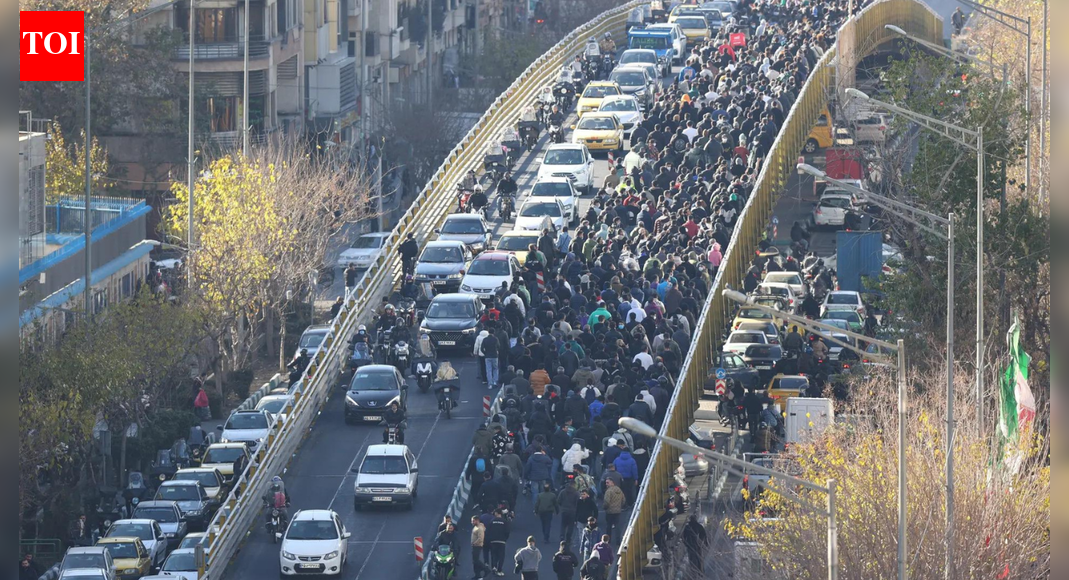


Protesters march in downtown Tehran (AP image)
Iran’s unrest entered its fourth day on Wednesday as large parts of the country ground to a standstill under a government-ordered shutdown. According to news agency AFP, members of Iranian security forces were killed during the protests. Businesses, universities and government offices were closed across 21 of Iran’s 31 provinces, including Tehran, after authorities declared a sudden public holiday. The move was widely seen as an attempt to curb the spread of protests triggered by economic distress and political anger, BBC reported.
Videos shared on social media showed demonstrations and confrontations in multiple cities, including Tehran, Shiraz, Isfahan, Kermanshah and Fasa. Protesters were heard chanting slogans such as “Down with the Dictator” and “Down with Khamenei,” while clashing with security forces.
What sparked the protests
The protests began on Sunday in Tehran’s major markets, where shopkeepers shut their businesses to protest a sharp fall in the Iranian rial, rising prices and worsening living standards. Iran’s currency has lost significant value over the past year, pushing up import costs and fuelling inflation, which official figures place above 50%. By Tuesday, the unrest had spread beyond bazaar merchants to include university students and other groups in cities across the country. Demonstrators also raised concerns over unemployment, water shortages and broader governance issues. The current protests are the most widespread since the 2022 unrest that followed the death of Mahsa Amini in police custody. Amini, a young woman, had been accused by Iran’s morality police of not wearing her veil properly.
Clashes reported in several cities
Footage circulating online showed intense clashes between protesters and security forces in cities such as Shiraz, Isfahan and Kermanshah. In some videos, demonstrators were seen throwing objects and confronting police amid the sound of tear gas. One of the most serious incidents was reported in the city of Fasa, in the southern province of Fars. Videos showed crowds breaking through the gates of a government complex, including the governor’s office, state media IRNA reported. Iranian authorities said parts of the governor’s office were damaged during the unrest. Local judicial officials said four people were arrested and three police officers were injured, while denying reports that protesters were killed. Military helicopters were also seen flying over parts of the city, which opposition groups said was aimed at intimidating residents and preventing the protests from spreading.
Bazaar shutdowns and economic pressure
Markets remained closed in several major cities on Wednesday, including Tehran, Isfahan and Kermanshah, followed by a coordinated strike by merchants.In Tehran, security forces were deployed around key market areas and intersections, while shop shutters remained down. Similar shutdowns were reported in cities such as Tabriz, Shiraz, Hamadan and Yazd. Merchants have said they are willing to bear financial losses to protest what they describe as years of economic mismanagement, sanctions pressure and declining prospects, particularly for young people.
Government response and leadership changes
President Masoud Pezeshkian acknowledged public anger and said his government would listen to the “legitimate demands” of protesters. At the same time, senior officials warned against what they described as attempts to create instability.Prosecutor General Mohammad Movahedi-Azad said economic protests were legitimate but cautioned that damage to public property or security threats would face a “decisive response.”Amid the unrest, Pezeshkian appointed former economy minister Abdolnaser Hemmati as the new head of Iran’s central bank following the resignation of Mohammad Reza Farzin. State media quoted the president as saying the role would be “extremely difficult and complex” given the economic situation.Separately, Supreme Leader Ayatollah Ali Khamenei appointed IRGC Brigadier General Ahmad Vahidi as deputy commander-in-chief of the Revolutionary Guards, a move seen by analysts as a signal of a tougher security posture.Security was tightened around universities and sensitive areas in Tehran, with some institutions shifting to online classes. Authorities said the measures were temporary, though critics said they were aimed at preventing student mobilisation.
- Iran witnessed its fourth straight day of unrest as a government-ordered shutdown brought daily life to a halt across large parts of the country.
- Authorities declared a sudden public holiday in 21 of Iran’s 31 provinces, leading to the closure of markets, universities and government offices.
- The protests began on Sunday in Tehran’s major bazaars after the Iranian rial plunged to record lows, sharply increasing prices and living costs.
- Iran’s currency has lost nearly half its value against the US dollar in 2025, pushing inflation to around 50 percent and worsening economic hardship, Al-Jazera reported.
- Demonstrations spread from shopkeepers to university students and residents in multiple cities, including Tehran, Shiraz, Isfahan, Kermanshah and Fasa.
- Videos widely shared on social media showed protesters chanting slogans against the leadership and clashing with security forces in several urban centres.
- In the western province of Lorestan, a 21-year-old Basij paramilitary officer was killed during violent unrest, while at least 13 others were injured, according to state media.
- In the southern city of Fasa, protesters attempted to force their way into the governor’s office, damaging property and prompting arrests and injuries among police.
- President Masoud Pezeshkian urged unity, blamed foreign economic pressure for the crisis and said the government would listen to the legitimate demands of protesters.
- Iranian authorities warned of a “decisive response” to violence while announcing economic and security measures, including appointing a new central bank chief and tightening controls around universities.