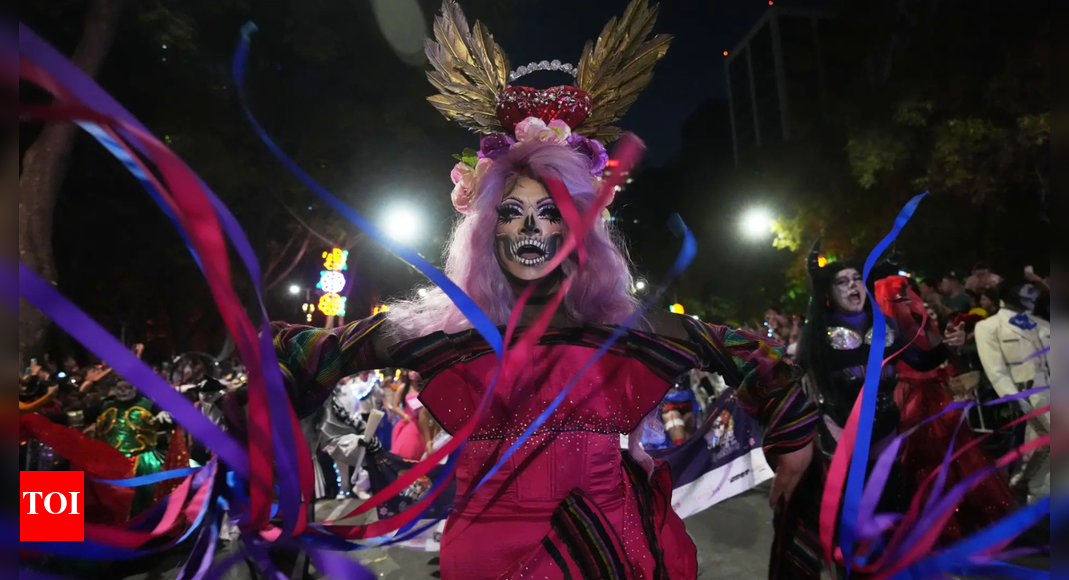

Drag artist Angel Arumir takes part in the annual Day of the Dead Catrina parade (Image credits: AP)
MEXICO CITY: Walking in a pink dress inspired by Mexican folk art with a mermaid-style silhouette, drag artist Angel Arumir adjusts his flower crown on top of his purple wig as he steps into a sea of skeletons. Around him, thousands of people in vibrant costumes and skull-like makeup gather for Mexico City’s annual Catrina parade, a tribute to one of Mexico’s most iconic symbols of the Day of the Dead. The holiday begins October 31, remembering those who died in accidents. It continues November 1 to recall those who died in childhood and then on November 2 celebrates those who died as adults. The Catrina is a skeleton often dressed in elegant clothing that has turned into a symbol of the country’s annual celebration. But Arumir’s collective, Exoticas, is giving their own twist to the Mexican tradition. Exoticas, made up of nearly 200 LGBTQ+ artists, stylists and designers, was one of more than 40 groups marching in this year’s parade. “This day is our chance to show our art and our hearts with dignity,” said Arumir, 42, who has spent nearly two decades performing in drag. “It has been difficult to gain our place in events related to our traditions.” Other groups represent a wide range of social causes, each adding its own rhythm, color and message to the streets. They include mothers demanding justice for Mexico’s disappeared, collectives honoring pre-Hispanic traditions and fans dressed to celebrate their favorite music genres. For Arumir and his fellow performers, the festival offers a rare moment of safety and solidarity in a country where LGBTQ+ people, and especially transgender women, face high levels of violence. More than 80 queer people were murdered in Mexico last year, ranking second in Latin America and the Caribbean to only Colombia for this community, according to Sin Violencia LGTBQ+, a regional network that tracks such violence. Transgender women accounted for 55 of those deaths, said Jair Martinez, a Mexican activist who is part of the network. He noted that discrimination against them has increased in the last five years as they have become more visible. “Before, many of these women worked in clandestine spaces,” Martinez said. “Now they have more exposure in public and that could explain why we’ve seen more violence towards them.” Preparing for the parade is a yearlong labor of love. Between jobs and family responsibilities, Arumir and his team sketch designs, sew costumes and experiment with makeup, channeling their passion for drag and Mexican symbols into every detail. Each dress is unique, with vibrant colors and designs made for the occasion. Some of the costumes carry powerful messages. One performer, Rich Gonzalez, traveled from Tijuana to take part, wearing an outfit that honors members of the LGBTQ+ community who have been killed in the northern Mexican city long haunted by cartel violence. In black and adorned with colorful crosses cascading down the trailing train of a skeleton figure, Gonzalez wears it proudly among friends he made when he first marched last year. Also among those marching is 18-year-old Santiago Mercado, who is participating for the first time. “This is a chance to celebrate our culture in a space where we can keep fighting for our rights,” he said. The Catrina parade is a relatively new tradition. It began in 2014, when makeup artist Jessica Esquivias gathered friends to celebrate Mexican icons and push back against the growing popularity of Halloween imagery on store shelves. What started as a small circle of creatives showing off their craft has grown into one of Mexico City’s biggest pre-Day of the Dead events, drawing tens of thousands of participants and spectators downtown. The Catrina herself was born from satire more than a century ago. The tall skeleton in a feathered hat first appeared in the early 1900s, drawn by artist Jose Guadalupe Posada to mock Mexico’s upper class and its obsession with European elegance, a reminder that death spares no one, rich or poor. Today, the Catrina spirit of defiance finds new meaning in Arumir’s work. “I want Exoticas to be an inclusive space where anyone can join and be themselves in freedom and safety,” he said. As the parade rolls through downtown Mexico City, Arumir and his group dance to traditional Latino pop songs while people crowd the sidewalks, lifting their phones and smiling back at them. Go to Source