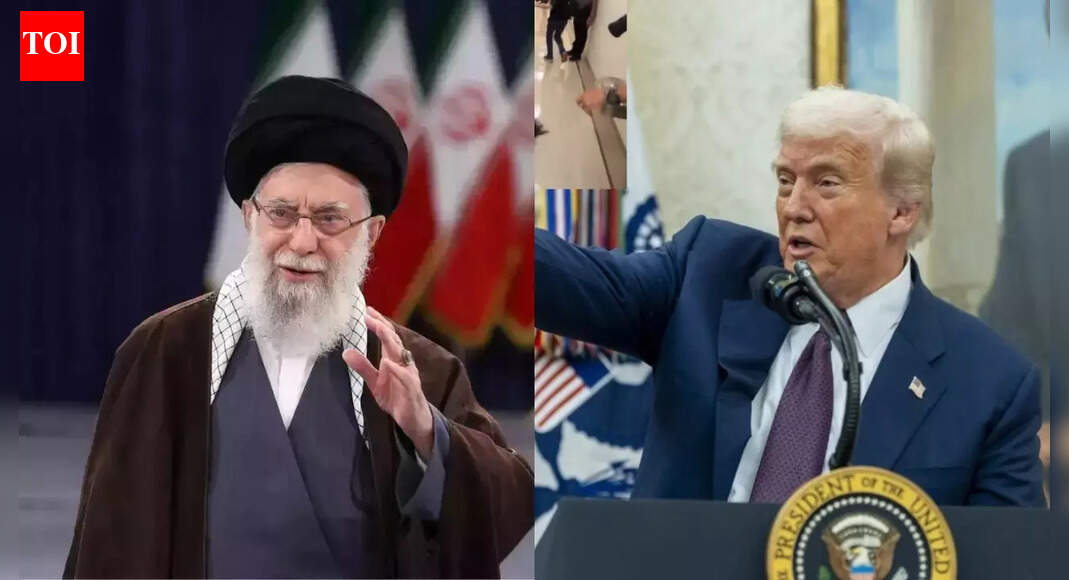

Iran’s attempts to suppress a fresh wave of anti-government protests have been complicated by Donald Trump’s threat to side with demonstrators — a warning underscored by the US capture of Venezuela’s Nicolás Maduro, officials and insiders said on Monday.A day after US President Trump threatened military action, Iran’s Supreme National Security Council held a late-night emergency meeting on Friday to discuss ways to contain nationwide protests with less violence and to prepare for potential strikes, three Iranian officials familiar with government deliberations told The New York Times. Tehran’s options remained limited by Trump’s threats and a long-running economic crisis that deepened after Israel, joined by the US, launched strikes on the Islamic Republic in June in a 12-day war that pummelled several of Iran’s nuclear sites.”These twin pressures have narrowed Tehran’s room for manoeuvre, leaving leaders caught between public anger on the streets and hardening demands and threats from Washington, with few viable options and high risks on every path,” one Iranian official told Reuters.The view was echoed by two other officials and a former Iranian official who remained close to Iran’s decision makers. A second official said that, after US action in Venezuela, some of the authorities feared Iran could be “the next victim of Trump’s aggressive foreign policy”. Iran’s economy has been hammered by years of US sanctions, but its rial has been in freefall since last year’s Israeli-US strikes that mainly targeted nuclear sites, where the West said Tehran worked on nuclear arms. Iran denied this.The protests that erupted in Tehran and spread to some cities in western and southern Iran did not match the scale of unrest that swept the nation in 2022-23 over the death of Mahsa Amini, who died in the custody of Iran’s morality police for allegedly violating the hijab law.But, even if smaller, these protests quickly expanded from an economic focus to broader frustrations, with some protesters chanting “Down with the Islamic Republic” or “Death to the dictator” – a reference to Supreme Leader Ayatollah Ali Khamenei who has the final say in all state matters.That presented a challenge for the authorities, which tried to maintain and nurture the spirit of national unity that emerged during and after the Israeli-US strikes. A third official said worries were growing in Tehran that “Trump or Israel might take military action against Iran, like what they did in June.”Iran, which for years allied itself with fellow oil producer Venezuela, which like Iran suffered under years of US sanctions, condemned Washington’s action in Caracas. It also condemned Trump’s statements about Iran.Iran’s Foreign Ministry spokesperson Esmaeil Baghaei said such statements about “Iran’s internal affairs amount, under international norms, to nothing more than incitement to violence, incitement to terrorism, and incitement to killing”.On Friday, Trump threatened to intervene if protesters faced violence, declaring, “We are locked and loaded and ready to go,” though he offered no details on what actions he might take.The protests threatened what has long been Khamenei’s defining priority: preserving the Islamic Republic at any cost. In a sign of the leadership’s concern, Khamenei on Saturday accused “enemies of the Islamic Republic” of fomenting unrest and warned that “rioters should be put in their place”.Authorities attempted to maintain a dual approach to the unrest, saying protests over the economy were legitimate and would be met by dialogue, while meeting some demonstrations with tear gas amid violent street confrontations.However, at least 17 people were killed in a week, rights groups said on Sunday. Authorities said at least two members of the security services died and more than a dozen were injured in the unrest.The country’s clerical establishment was still coming to terms with the 2025 Israeli and US strikes on Iranian nuclear and military targets. The attacks, which killed top Revolutionary Guard commanders and nuclear scientists, were launched just a day before a planned sixth round of talks with Washington over Tehran’s disputed nuclear programme.Negotiations stalled since the June conflict, even as both sides insisted they remained open to a deal.Washington and its allies accused Iran of using its nuclear programme as cover to develop weapons capability, a charge Tehran denied, saying its ambitions were purely peaceful.Economic grievances remained at the heart of the latest unrest.Widening disparities between ordinary Iranians and a privileged clerical and security elite, compounded by mismanagement, runaway inflation and corruption — factors even acknowledged by state media — fuelled public anger.Witnesses in Tehran, Mashhad and Tabriz reported a heavy security presence in main squares. “You can feel the tense atmosphere in Tehran, but life continues as normal,” said Amir Reza, 47, a carpet shop owner in Tehran’s Grand Bazaar.President Masoud Pezeshkian urged dialogue and promised reforms to stabilise the monetary and banking systems and protect purchasing power.Starting January 10, the govt will provide a monthly stipend of 10,000,000 rials per person (about Rs 580) in non-cashable electronic credit for use in select grocery stores, the semi-official Tasnim news agency reported.For lower-income households, whose monthly salaries barely exceeded Rs 12,450, the measure represented a modest but meaningful boost. The rial lost roughly half its value against the dollar in 2025, while official inflation reached 42.5% in December. Go to Source