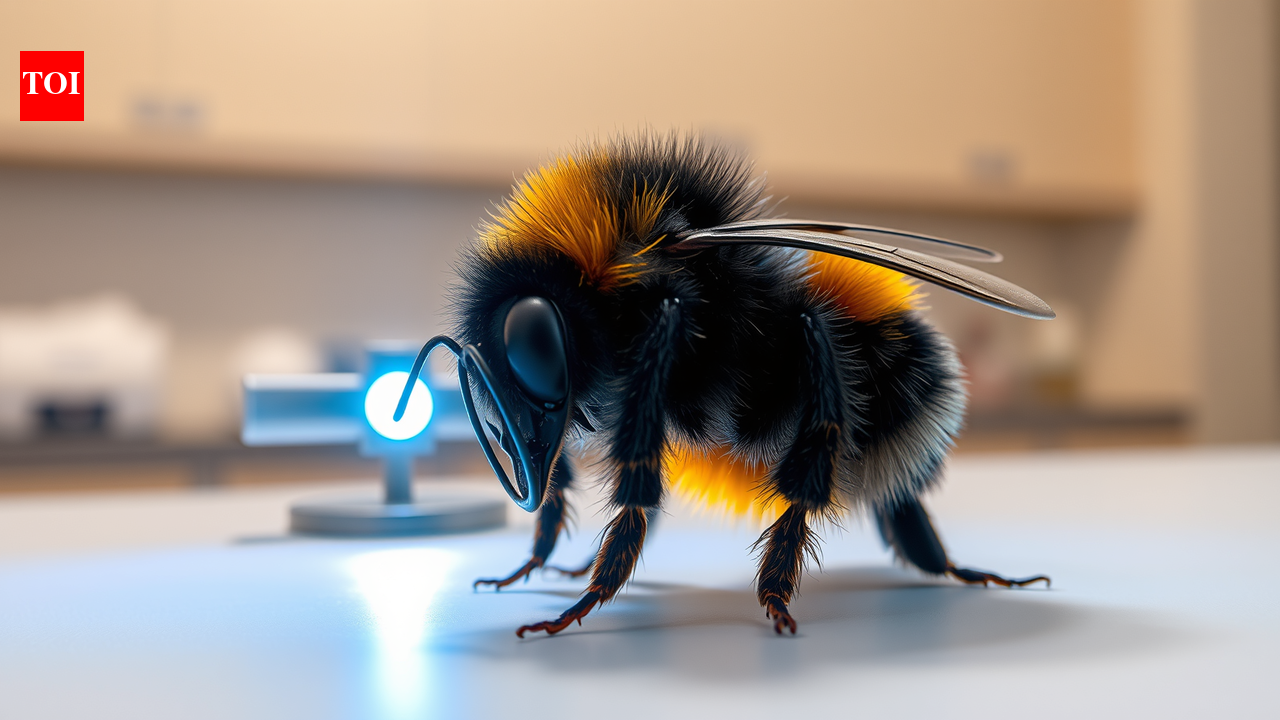

For years, scientists believed that only humans and a handful of vertebrates could tell the difference between short and long durations, a skill as fundamental as reading the dots and dashes of Morse code. But researchers at Queen Mary University of London have turned that assumption on its head, proving that buff-tailed bumblebees can do something previously thought impossible for insects: distinguish between different lengths of light flashes and use that information to find food. These tiny creatures, with brains no bigger than a poppy seed, learned to identify the difference between quick flashes and longer pulses in exchange for a sweet treat. The discovery challenges everything we thought we knew about insect intelligence and suggests that complex time processing might be far more common in nature than anyone previously imagined. It’s a reminder that nature often surprises us when we dig deeper.
The tiny brain’s big secret: How bumblebees learn timing and discrimination
Timing is everything in the natural world. When a hummingbird visits a flower, it needs to know when nectar might return. When a cricket calls to a potential mate, the length of its chirp carries meaning. When an animal flees from a predator, fractions of a second can mean the difference between life and death. Yet how insects actually process these short bursts of time has remained one of biology’s great mysteries. Most researchers assumed their brains simply weren’t wired for such precision.The research team, led by PhD candidate Alexander Davidson and senior lecturer Dr. Elisabetta Versace at Queen Mary University, decided to test whether bumblebees could handle temporal tasks. They chose the buff-tailed bumblebee, Bombus terrestris, a common species found across Europe and introduced to many other parts of the world. What happened next surprised everyone involved in the work. The bees didn’t fail. They didn’t struggle. They learned what scientists thought was impossible.
Understanding the duration discrimination test and light flash experiments
The experimental setup was elegantly simple. Bumblebees were placed in a specially designed wooden nest box kept at a steady temperature on a normal day-night cycle. From this nest, they could access acrylic tunnels leading to an observation area and a testing chamber. Inside the testing room were three small compartments, each facing a monitor displaying bright yellow circles on a dark background.The researchers controlled exactly when these circles blinked on and off. In one set of experiments, they tested whether bees could distinguish between a 5-second flash and a 1-second flash. In another, they tested 2.5 seconds compared to just 0.5 seconds. Each duration was paired with either a sugar solution delicious and rewarding or a quinine solution that tasted bitter and unpleasant. The bees quickly learned to associate one duration with sweetness and the other with something to avoid.Here’s where it gets remarkable: the researchers made sure brightness couldn’t be the deciding factor. They designed some trials where a short flash repeated many times added up to the same total brightness as a single long flash. Even when this potential trick was introduced, the bumblebees continued to choose correctly based purely on how long each flash lasted. They weren’t relying on cumulative light; they were actually processing time with genuine cognitive ability.
Why scientists expected insects to fail this cognitive task
Before this research, the scientific consensus was clear: this task should be impossible for insects. Time discrimination at the scale of seconds and sub-seconds was thought to require a brain of significant complexity. Humans obviously can do it. Vertebrates like macaques and pigeons have shown this ability in previous studies. But insects? Their entire nervous systems contain roughly a million neurons compared to the 86 billion in the human brain.Scientists understood that the ability to process temporal information is crucial for animal activities like foraging, mating and predator avoidance. But they believed insects handled timing through circadian rhythms, the biological clocks that regulate day-night cycles and seasonal patterns. Those operate on the scale of hours and days. How could such mechanisms possibly handle the precision needed to distinguish between a half-second flash and a two-and-a-half-second flash?There was also the issue of evolutionary relevance. Bumblebees don’t encounter blinking lights in nature. They don’t have any natural reason to develop this ability. Unlike some skills that obviously help with survival, this seemed like pure cognitive flourish. If bumblebees could do it anyway, what did that say about how we classified intelligence across the animal kingdom?
The training method: Sugar rewards and behavioural success rates
The training protocol followed a classical conditioning approach. A single bee from each colony was tested per day, maintaining consistency across the research. Initially, the bees were rewarded for choosing the correct duration; their choice was reinforced with sucrose solution. The team kept the bees in this learning phase until they reached a specific threshold: 15 correct choices out of 20 consecutive trials.Only then came the real test. The rewards vanished. The sugary solution was gone, and the bitter quinine remained. Would the bees continue to discriminate between the durations even without the incentive? The answer was a resounding yes. The bees that had been trained to recognise long flashes still chose the long flash more often than chance would predict. The bees trained on short flashes still picked the short flash. They had genuinely learned something, not just memorised a path to sugar, but understood the underlying rule.The researchers tested 41 bees across 10 different colonies. They used a fully counterbalanced design, meaning they trained some bees to expect a reward with the long-duration stimulus and others with the short-duration stimulus. This careful methodology ruled out the possibility that they were simply seeing bees respond to a preferred stimulus type.
What this reveals about insect intelligence and neural efficiency
The implications of this work extend far beyond bumblebees. If a tiny insect brain can handle temporal discrimination at this level, it suggests that neural flexibility is more common than we assumed. This represents the first time time-based visual discrimination has been demonstrated in insects at all, according to the groundbreaking study published in Biology Letters.The real revolution in thinking comes down to efficiency. It’s not just that bumblebees can do this, it’s that they can do it with an incredibly small nervous system. How do bees solve temporal problems without the massive interconnected networks that vertebrate brains possess? What shortcuts does their neural architecture take? Is there something fundamentally different about how small brains handle information that actually makes them more efficient than we’d expect?Engineers looking to create efficient artificial intelligence systems might learn from the way insect brains handle complex information with so few neurons. The bumblebee demonstrates that you don’t need billions of neurons to solve sophisticated problems. Sometimes, elegance comes from simplicity. Go to Source