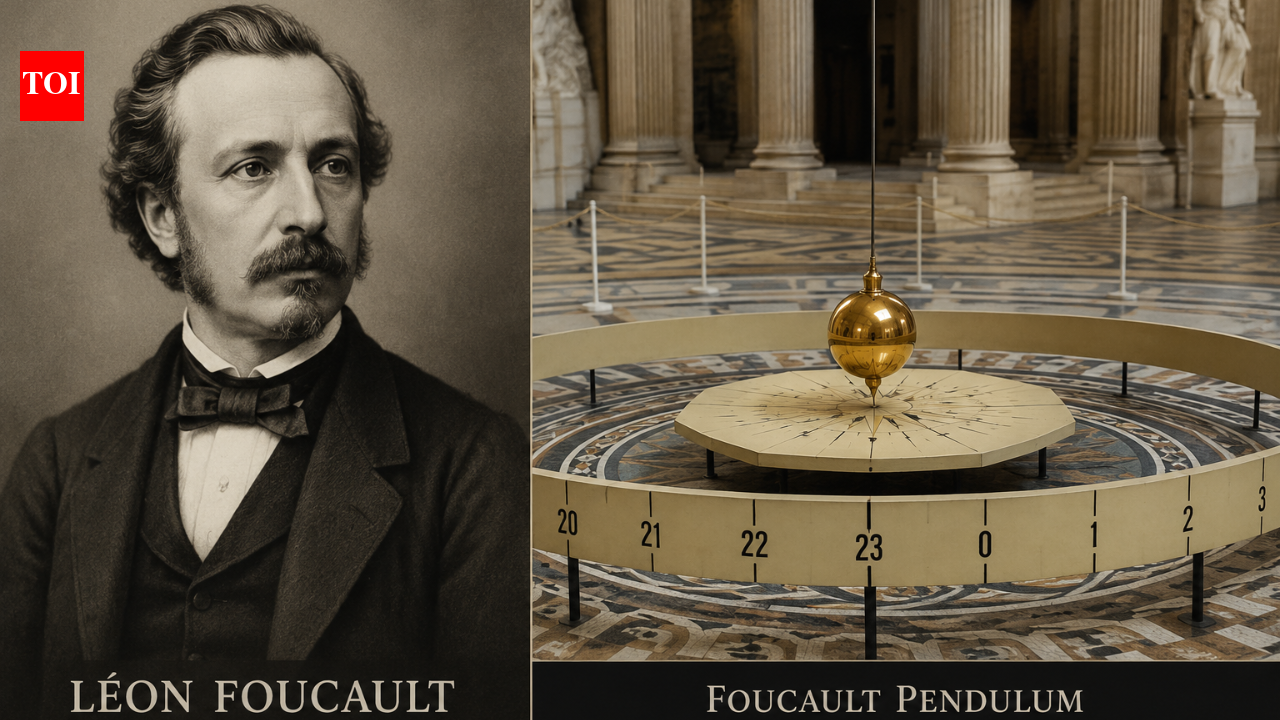

Image: AI Generated
Most of us accept that the Earth rotates because we have been taught it since childhood. We have seen satellite images, watched footage from space and learned about day and night. But imagine living in the middle of the 19th century, when none of that evidence existed.How could you convince an ordinary person that the ground beneath their feet was constantly spinning?In 1851, French physicist Léon Foucault answered that question with remarkable elegance. Rather than relying on complex mathematics or astronomical observations, he suspended a heavy metal sphere from an exceptionally long wire and let it swing. Hours later, something extraordinary seemed to happen: the pendulum appeared to change direction on its own. In truth, the pendulum had barely changed at all. It was the Earth beneath it that had moved.More than 170 years later, Foucault’s pendulum remains one of science’s most beautiful demonstrations. It transforms an invisible planetary motion into something you can stand beside and watch unfold.
Why a freely swinging pendulum appears to change direction without being pushed
At first glance, a Foucault pendulum looks almost disappointingly simple. A heavy bob hangs from a long cable, free to swing back and forth in any vertical plane. Once released carefully, there is no motor, no hidden mechanism and no external force nudging it sideways.Yet anyone watching for long enough will notice the swing gradually appears to rotate.The key is perspective. In an inertial frame of reference, the pendulum continues swinging in almost exactly the same plane. It is the Earth that rotates underneath it. Because we are standing on that rotating Earth, the pendulum’s path seems to shift little by little, even though it is faithfully obeying the laws of inertia.According to EBSCO, when Foucault invited fellow scientists to witness his demonstration at the Paris Observatory in February 1851, his invitation contained a wonderfully understated line:”You are invited to see the Earth turn.”It was an extraordinary claim, and unlike many bold scientific announcements, it lived up to every word. For the first time, people could watch compelling, physical evidence of Earth’s rotation without needing a telescope or an understanding of celestial mechanics.
How Léon Foucault let Paris watch the Earth move
Foucault first presented his experiment to scientists at the Paris Observatory on 3 February 1851. The response was so enthusiastic that he was soon invited to recreate it inside the Panthéon, one of Paris’s grandest public buildings.The scale of the installation was as impressive as the idea itself. A brass sphere weighing around 28 kilograms was suspended from a wire roughly 67 metres long beneath the vast dome. Sand spread across the floor allowed the pendulum to leave a visible trace with each swing.Slowly, almost imperceptibly, the line began to drift.There was no trick. No one touched the pendulum. Instead, visitors were watching the floor rotate beneath it as the Earth carried Paris eastwards through space. Few scientific demonstrations have conveyed such a profound idea with so little apparatus.The rate of this apparent rotation depends entirely on where the pendulum is located on Earth. At the poles, its plane of swing completes a full rotation every sidereal day. At the Equator, there is no apparent rotation at all. Everywhere else, the effect varies according to latitude, following what became known as Foucault’s sine law.It is an elegant reminder that even the simplest experiments can reveal surprisingly deep truths about the universe.
Why the Foucault pendulum still captivates visitors today
Science has changed beyond recognition since 1851. We have orbited Earth, landed probes on distant planets and mapped the cosmos with astonishing precision. Yet despite those advances, museums and universities around the world continue to suspend enormous pendulums in entrance halls and atriums.There is a reason. Today, one of the most prominent Foucault pendulums hangs beneath the Visitor’s Lobby ceiling at the United Nations Headquarters in New York. Gifted to the UN by the Government of the Netherlands in 1955, it serves as more than a scientific exhibit. As its brass bob silently traces its path across the floor, it offers thousands of visitors each year a direct visual reminder that the Earth is constantly rotating.The installation reflects the United Nations’ broader commitment to science, education and international cooperation, demonstrating how a 19th-century experiment continues to spark curiosity in the 21st century. Far from being a historical curiosity, the Foucault pendulum remains one of the clearest and most accessible demonstrations of fundamental physics ever devised.Unlike many scientific concepts that exist only as equations or computer simulations, a Foucault pendulum is tangible. You do not need specialist knowledge to appreciate what is happening. Stay long enough, return an hour later, and the evidence quietly accumulates before your eyes.The experiment also reminds us that some of the most powerful discoveries are not necessarily the most complicated. Foucault did not build a vast machine or invent a revolutionary instrument. He simply asked an old question in a new way.The result became one of the defining demonstrations in the history of physics: a device so deceptively simple that it continues to surprise visitors more than a century and a half after it first swung beneath the dome of the Panthéon.In an age when scientific breakthroughs often emerge from billion-pound laboratories or orbiting spacecraft, there is something quietly satisfying about that. A swinging weight, a long wire and a patient observer are still enough to reveal that the world beneath our feet has never stopped turning. Go to Source