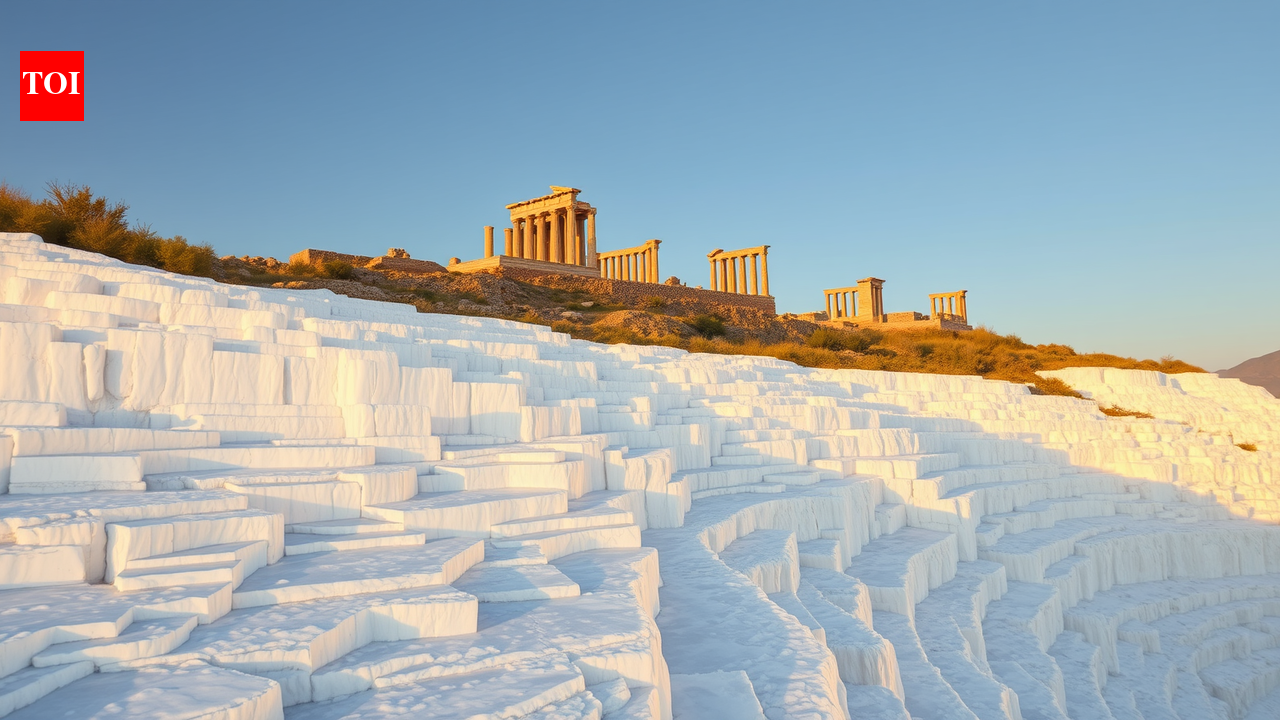

Turkey is home to one of the world’s most extraordinary natural sites. It is called Pamukkale, which means “cotton castle” (also translated as “Cotton Palace”) in Turkish. According to the UNESCO World Heritage Centre, the name comes from the striking, dazzling white landscape formed by calcite-laden spring water flowing down the hillside.Pamukkale sits in Denizli province in south-west Turkey, overlooking the plain of Cürüksu, and rises from a cliff that is almost 200 metres high. Alongside it stands Hierapolis, a Hellenistic spa town founded by the Attalid kings of Pergamon at the end of the 2nd century B.C., on the site of an older cult centre. Together, the two form a single UNESCO World Heritage property named Hierapolis-Pamukkale, inscribed in 1988 and spread across 1,077 hectares.
How Pamukkale’s white terraces were formed
UNESCO describes Pamukkale as an “unreal landscape” created entirely by nature, made up of mineral forests, petrified waterfalls and a series of terraced basins. The process begins with calcite-laden (calcium-rich) water rising from hot springs in the cliff face. As this water flows downhill and cools, it deposits calcium carbonate on the surface, and fresh layers of these deposits give the terraces their dazzling white coating. Over time, this steady deposition has built up step-like terraces and pools along the slope. UNESCO notes that some of these terraces are less than a metre high, while others rise as high as six metres. The combination of these natural formations, along with a complex system of canals that historically carried thermal water to nearby villages and fields, makes the site exceptional. The springs are also the source of a hydraulic system that once extended 70 km north-west to Alaşehir and westward along the valley of the Menderes River.
The ancient city of Hierapolis
Hierapolis was established at the end of the 2nd century B.C. by the Attalid dynasty, the kings of Pergamon, drawn to the site’s natural hot springs. The waters were also historically used for scouring and drying wool. The city was ceded to Rome in 133 B.C. and flourished afterwards, reaching its peak in the 2nd and 3rd centuries A.D., despite being destroyed by an earthquake in 60 A.D. and subsequently rebuilt.Surviving remains from the Greco-Roman period include baths, temple ruins, a monumental arch, a nymphaeum, a necropolis and a theatre. According to UNESCO, the Temple of Apollo was built directly on a geological fault from which noxious vapours escaped, and the theatre, dating to the era of the Roman emperor Severus, is decorated with a frieze depicting a ritual procession and a sacrifice to the Ephesian Artemis. The necropolis at Hierapolis extends over 2 kilometres, offering what UNESCO calls a vast panorama of Greco-Roman funerary practices.Hierapolis later became an important centre for early Christianity. After the emperor Constantine’s acceptance of Christianity and the founding of Constantinople as the “new Rome” in 330 A.D., the town was made a bishopric. It is also recognised as the site of the martyrdom of St Philip in 80 A.D., commemorated by the Martyrium of St Philip, an octagonal building constructed in the 5th century just outside the city’s north-west wall. UNESCO describes its layout, with chapels, polygonal halls and triangular rooms radiating from a central octagon, as an outstanding example of Early Christian architecture.
Why UNESCO recognises Pamukkale and Hierapolis together
Hierapolis-Pamukkale was inscribed on the World Heritage List in 1988 under three criteria. Under criterion (iii), UNESCO recognises Hierapolis as an exceptional example of a Greco-Roman thermal installation built on an extraordinary natural site, where hydrotherapy was combined with religious practice. Under criterion (iv), the site’s Early Christian monuments, including the cathedral, baptistery and churches built between the 4th and 6th centuries, are cited as an outstanding architectural group. Under criterion (vii), UNESCO recognises the sheer visual impact of the calcite-laden waters and the terraced landscape they have created.UNESCO notes that the biggest threat to the site’s integrity comes from the very large number of international tourists it attracts, since tourism is also a major economic resource for the region. A small lake formed by earthquakes and thermal sources near the ancient civil agora, where visitors have historically swum among ancient columns and marble fragments, has been especially vulnerable to biological pollution and erosion.To manage this, the Turkish authorities have taken several protective measures over the years, as recorded by UNESCO. The site was registered as a first-degree natural and archaeological site in 1980, and in 1990 a wider area of around 66 square kilometres was designated a special protected zone. Hotel buildings that once stood on site, along with structures around the thermal pool, have since been removed, and private vehicles are barred from entering except in emergencies. The road that once cut through the south-eastern travertine terraces has been closed, and visitor access to the terraces themselves is now restricted in order to protect the water flow and preserve the colour and structure of the travertine. Designated areas have instead been set aside where visitors can bathe in the hot springs.A Site Management Directorate, set up jointly by Turkey’s Ministry of Culture and Tourism and the Denizli Provincial Special Administration, oversees conservation and coordination at the site today, working alongside an Italian archaeological team that has been excavating Hierapolis since 1957.Pamukkale remains, in UNESCO’s own words, a landscape shaped by nature over an extraordinary span of time, standing today alongside the ruins of a city that has drawn visitors to its waters for more than two thousand years. Go to Source