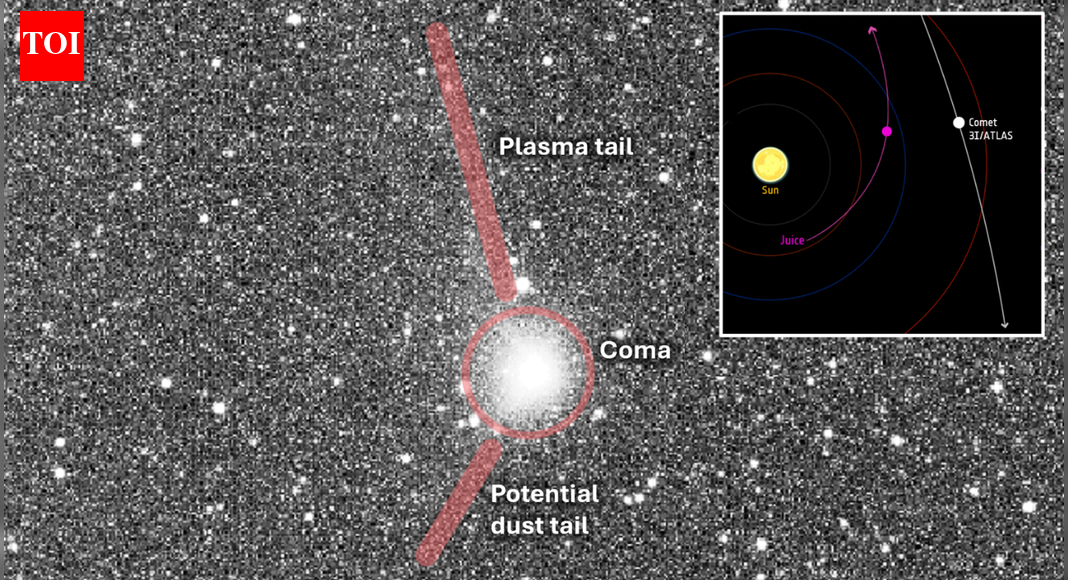

Comet 3I/ATLAS reveals glowing coma, plasma and dust tails from ESA’s Juice mission/ Image: European Space Agency
Harvard astrophysicist Avi Loeb has made a kind of second career out of being the person in the room who refuses to leave “aliens” off the table. With 3I/ATLAS, only the third confirmed interstellar object ever spotted passing through our Solar System, he has been there from the start: following its path, pointing out its oddities, and now arguing that the comet’s light curve looks suspiciously like a “heartbeat”. NASA still calls 3I/ATLAS a comet. Most researchers think its behaviour can be explained with ordinary physics and volatile ice. Loeb agrees that the data are comet-like – but insists that the pattern in its flickering light is interesting enough to treat as a serious question, not something to wave away with a shrug.At the centre of the debate is a simple but strange question: what exactly does Loeb mean by a “heartbeat,” and why does his interpretation diverge so sharply from everyone else’s?
A very strange visitor
Just in case you’ve been under a rock: 3I/ATLAS is the third interstellar object astronomers have caught slipping through our neighbourhood, after ‘Oumuamua and 2I/Borisov. It was first flagged as an oddball because its behaviour did not line up neatly with textbook comet expectations. NASA has confirmed it as a comet, but the object has been seen doing a few things that keep astronomers awake. For a long time it had no visible tail, which is unusual for a comet getting close to the Sun. Reports then described it changing trajectory, slowing down slightly and moving in ways that looked, at least in popular retellings, more like a steered craft than a passive snowball of rock and ice. More recently, imagery from the Hubble Space Telescope and the European Space Agency has painted a more familiar picture, a bright central dot surrounded by a coma and trailing material. ESA’s Jupiter Icy Moons Explorer (Juice), whose navigation camera is designed for pointing the spacecraft rather than doing science, turned briefly away from Jupiter to image 3I/ATLAS in early November 2025. From about 66 million kilometres away, Juice’s NavCam showed the comet with an active coma and hints of two tails: a plasma tail of electrically charged gas and a fainter dust tail made of tiny solid particles. The observation came shortly after the comet’s closest approach to the Sun, when it was in a highly active state, venting gas and dust into space. Hubble captured its own view on 30 November at roughly 178 million miles, showing a bright, compact object drawing closer as it fell inward. On paper, at least, this is what an active comet from another star system ought to look like. The heartbeat complicates that tidy story.
A 16.16-hour pulse
The “heartbeat” is not a sound. It is a pattern in light. A team of researchers spread across Europe and Africa noticed that the brightness of 3I/ATLAS rises and falls in a steady rhythm, with a period of 16.16 hours. NASA’s more recent image release happened to arrive just as reports of the strange variability were circulating, and Loeb seized on the moment.According to reports in The New York Post and to Loeb’s own Medium blog, he is not convinced by the first explanation some analysts reached for, that the 16.16-hour signal is simply the rotation of an oddly shaped nucleus. He argues that this cannot be the case because, as he told The Post, “less than ten percent of the light comes” from the centre. The rest, he notes, is dominated by the surrounding haze. In the Hubble image taken on 21 July 2025, what stands out is not the solid core at all but the diffuse coma, the halo of gas and dust that flares around a comet when it approaches the Sun. “Therefore, the periodic modulation of its light must originate from its puffs of gas and dust that scatter sunlight around it,” Loeb said. “The puffs are periodic, like the blood stream of a heartbeat.”In other words, if the nucleus is not contributing much light, then the regular brightening and dimming, happening almost like clockwork, must be coming from the material being thrown off it, not from the shape of the core itself.
Loeb’s blog: A pulsed coma
In his 30 November 2025 Medium post, titled “Are the Jets from 3I/ATLAS Pulsed Like a Heartbeat?”, Loeb lays out the idea in more detail. He starts with what recent images show: “Over the past month, images of 3I/ATLAS showed multiple jets. If the mass loss in the jets is pulsed periodically, the resulting coma would display periodic variability in its scattering of sunlight.” If 3I/ATLAS is a natural comet, he suggests, there is a straightforward way for this to happen. The comet could have a sunward jet – what’s known as an anti-tail – that only turns on when a particular patch of ice on one side of the nucleus is facing the Sun. “In the context of a natural comet, this can arise from a sunward jet (anti-tail) that is initiated only when a large pocket of ice on one side of the nucleus is facing the Sun. As a result, the coma will get pumped up every time the ice pocket is facing the Sun.”Loeb goes further, spelling out the analogy directly:“This resembles a heartbeat with a puff of gas and dust serving the role of a stream of ‘blood’ through the coma periodically over the rotation period of 16.16 hours.”And he is explicit about what he thinks the periodicity tells us:“At any event, it is clear that the reported periodicity over 16.16 hours is not directly associated with the shape of the nucleus but rather with the collimated jets coming from it out to much larger distances.”In that framing, the heartbeat is a regular brightening and dimming every 16.16 hours. Loeb’s argument is that this timing is likely controlled by jets, not by the bare shape of the nucleus, and that any explanation, natural or artificia, has to deal with that fact.
From jets to thrusters
If the story stopped there, Loeb would simply be emphasising a particular natural explanation. But he has already gone further in interviews and earlier writing. He has previously argued that 3I/ATLAS might be “potentially hostile” and could even be using “braking thrust” as it comes through the inner Solar System, implying some kind of control. He has mentioned “multiple jets” in earlier posts and speculated that, in principle, they could act like advanced artificial thrusters. He has also put numbers on his suspicion. In interviews, Loeb has estimated a 30 to 40 percent chance that 3I/ATLAS is not naturally formed. To keep track of his own sense of risk, he introduced what he called “the Loeb scale”, where zero represents a standard space rock and ten denotes a confirmed artificial origin. He placed 3I/ATLAS at a four. That does not mean he thinks aliens are likely. But it does mean he considers the odds high enough that the possibility should stay on the table.
The more cautious view
Most astronomers are not rushing to join him there. The prevailing view is far more down-to-earth: 3I/ATLAS may simply be rotating like a cosmic rotisserie chicken, with sunlight catching different patches of ice as they turn into view. Those pockets vent gas and dust when heated, producing periodic brightening that looks dramatic but fits comfortably within standard comet physics. In that reading, the object is behaving like any other comet, just one that began life around another star. Dr Matthew Genge, a micrometeorite and cosmic dust specialist at Imperial College London, told Metro that “there’s a periodic brightening of the comet…that’s actually nothing particularly unusual”. If it really is a heartbeat, he added, “then those aliens are really, really, super chill, because that’s incredibly slow.” Genge’s natural picture is not far from Loeb’s cometary one, just without the engineering. As the object rotates, a patch of ice could swing into sunlight, venting gas and dust in a jet. When that patch turns away, the jet weakens. The anti-tail that Loeb and others have talked about, a jet pointing roughly sunward, fits comfortably inside that model. In this view, the heartbeat is the rhythm of heating and cooling on an oddly shaped, spinning lump of interstellar ice and rock. NASA, for its part, has stayed consistent. From the first confirmed images through to its latest photo release in Maryland, the agency’s official position has been that 3I/ATLAS is a comet displaying vigorous, but not supernatural, activity.
Why Loeb wants the questions to stay open
On the natural side, the explanation comes down to physics: how ice is scattered across the surface, how it vents, and how a sunward jet could inflate the coma in a steady rhythm. On the speculative side, the door isn’t fully closed on more exotic possibilities, jets pulsed by some technology we don’t yet understand, though that idea sits firmly in the long-shot column.No one has evidence for that scenario, and Loeb doesn’t pretend otherwise. His point is simpler: when an object arrives from another star and behaves in unexpected ways, it deserves to be examined without rushing it into a familiar box. Whether 3I/ATLAS is merely eccentric or something more unusual, he argues, its oddities are worth keeping in view rather than sanded down to fit a neat category simply because it’s tidier that way. Go to Source