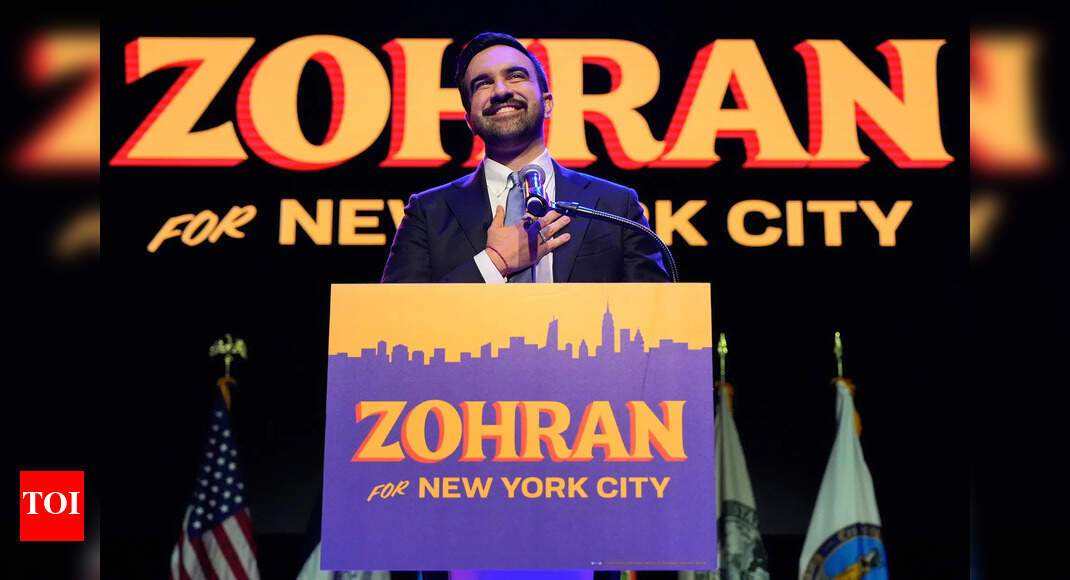

Zohran Mamdani speaks during a victory speech at a mayoral election night watch party, Tuesday, Nov. 4, 2025, in New York. (AP Photo/Yuki Iwamura)
When a politician promises to freeze rents, make buses free, pay childcare workers like teachers, open city-run supermarkets and raise the minimum wage to thirty dollars an hour, you don’t need an economics degree to sense trouble. Zohran Mamdani’s platform reads like a revolutionary dream of economic justice, but economists warn it’s a dream that breaks as soon as numbers meet reality. His goals are moral. His math is magical.
THE BIG FIVE PROMISES
1. The Promise: A rent freeze for roughly one million rent-stabilised apartments.According to economists Rebecca Diamond, Timothy McQuade and Franklin Qian in a 2017 study for the National Bureau of Economic Research titled The Effects of Rent Control Expansion on Tenants, Landlords, and Inequality: Evidence from San Francisco, rent control reduced the city’s rental housing supply by about 15 percent and pushed up rents elsewhere by more than 5 percent. The policy benefited long-term tenants but “lowered overall housing availability and increased city-wide rents.”Why it doesn’t make sense:Rent freezes are price ceilings. They keep prices low but distort incentives. When landlords cannot raise rents even as maintenance costs rise, they stop investing or sell their properties for other uses. Builders avoid entering the market. Over time, the quality of housing declines and the supply of rental units shrinks. In New York, where supply is already constrained by zoning and land costs, a citywide freeze would worsen scarcity and reduce long-term affordability. The short-term political win comes at the cost of long-term dysfunction.2. The Promise: Fare-free city buses for everyone.According to J.S. Perone’s review for the Florida Department of Transportation and a 2023 paper by economists Avner Shilo and Kofi Ofosu-Kwabe, fare-free transit systems often increase ridership but fail to sustain quality or produce significant economic gains. Removing fares means higher demand but not necessarily more capacity.Why it doesn’t make sense:When you make something free, demand rises while the ability to fund it does not. Fare revenue currently covers a significant part of operating costs. Without it, the entire burden shifts to taxpayers. Congestion, wear and maintenance costs increase while budgets strain. Overcrowding and unreliable service eventually drive commuters back to cars, leaving the system poorer and less efficient. It is a subsidy without a sustainable funding loop, confusing access with viability.3. The Promise: Universal free childcare from six weeks to five years old, with childcare workers paid like teachers.According to the Wharton Budget Model (University of Pennsylvania, 2021), universal childcare and preschool programmes financed by debt could reduce U.S. GDP by 0.2 percent by 2051 as fiscal costs outweigh productivity gains. The Institute for Family Studies also found that universal schemes often dilute benefits by subsidising families who can already afford childcare, stretching public funds thin.Why it doesn’t make sense:Childcare is essential but universal free provision is expensive. Raising wages for all providers and guaranteeing coverage to every family multiplies costs into the tens of billions. Returns such as higher labour participation arrive slowly and depend on program quality. If revenue lags, governments resort to waiting lists or quality cuts. The economics are simple: a massive upfront cost with uncertain long-term returns. Targeted support for low- and middle-income parents yields better results at lower risk.4. The Promise: City-run grocery stores in each borough to lower food prices.According to a 2024 Vanderbilt University analysis by John McNeal titled “Public Grocery Stores: Benefits and Challenges,” publicly operated grocery stores struggle with supply chain management, perishables and fiscal sustainability. Economists writing for the Library of Economics and Liberty note that municipal grocers distort competition by using taxpayer funds to undercut private firms, creating inefficiency and reducing consumer choice.Why it doesn’t make sense:Grocery retail is a low-margin, high-volume business. When a city-owned store operates without paying rent or taxes, it gains an artificial advantage that can drive out small competitors. Once private stores close, the city inherits all costs of logistics, staffing and waste management without the incentives that keep private firms efficient. Prices may fall briefly but rise again once the private sector retreats. Public ownership does not fix structural problems like transport or wholesale costs. It just moves the bill to the taxpayer.5. The Promise: Raise the minimum wage to 30 dollars an hour by 2030.According to economists David Neumark and William Wascher in their National Bureau of Economic Research paper Minimum Wages and Employment: A Review of Evidence from the New Minimum Wage Research, most credible studies show higher minimum wages reduce employment among less-skilled workers. The Federal Reserve Bank of San Francisco also found that large wage hikes continue to produce job losses for teens and low-wage workers.Why it doesn’t make sense:Moderate wage hikes can lift incomes, but sharp jumps beyond productivity levels trigger job cuts and automation. If employers must pay 30 dollars an hour for work worth 20 in output, they cut staff, shorten hours or invest in machines instead. The result is fewer entry-level jobs and higher prices. Inflation then erodes real wage gains. Without matching productivity growth or tax relief for small firms, a wage floor that high is more symbolic than sustainable.
WHY THE COMBINATION IS UNSUSTAINABLE
To quote Nobel laureate Milton Friedman, “There’s no such thing as a free lunch.” Mamdani’s platform tries to serve five at once. Each promise creates costs or distortions that multiply when combined. Free buses mean higher taxes, rent freezes mean fewer homes, and wage hikes mean fewer jobs. The fiscal strain of all five would force steep tax rises or push the city into debt.Economically, this is the classic “fiscal illusion,” where citizens believe benefits are free while the real costs appear later in slower growth, higher prices and weaker investment. The history of price controls and universal subsidies, from post-war Britain to modern Venezuela, shows how moral intentions can collapse under unsustainable economics.
THE MORAL VS THE MATH
Supporters call Mamdani a moral economist who places fairness above profit. Economists counter that morality without incentives is unsustainable. Every rent cap discourages builders, every wage hike discourages hiring and every free service invites overuse. The poorest suffer most when the system cracks.As Paul Krugman once wrote, “Good intentions are not enough to guarantee good economics.” Mamdani’s intentions are noble, but his model repeats a century-old mistake — confusing compassion with feasibility.
THE BIG PICTURE
- The goals of affordable housing, decent wages and accessible childcare are legitimate.
- The methods of price freezes, universal subsidies and rapid wage hikes ignore supply limits and fiscal balance.
- The evidence from Diamond, Neumark, Wharton and Vanderbilt shows consistent trade-offs between fairness and functionality.
Mamdani’s economics sounds like justice but behaves like arithmetic denial. It promises equality without efficiency and fairness without feasibility. New York deserves reform that balances heart and head, not policies that promise paradise and deliver scarcity. Go to Source