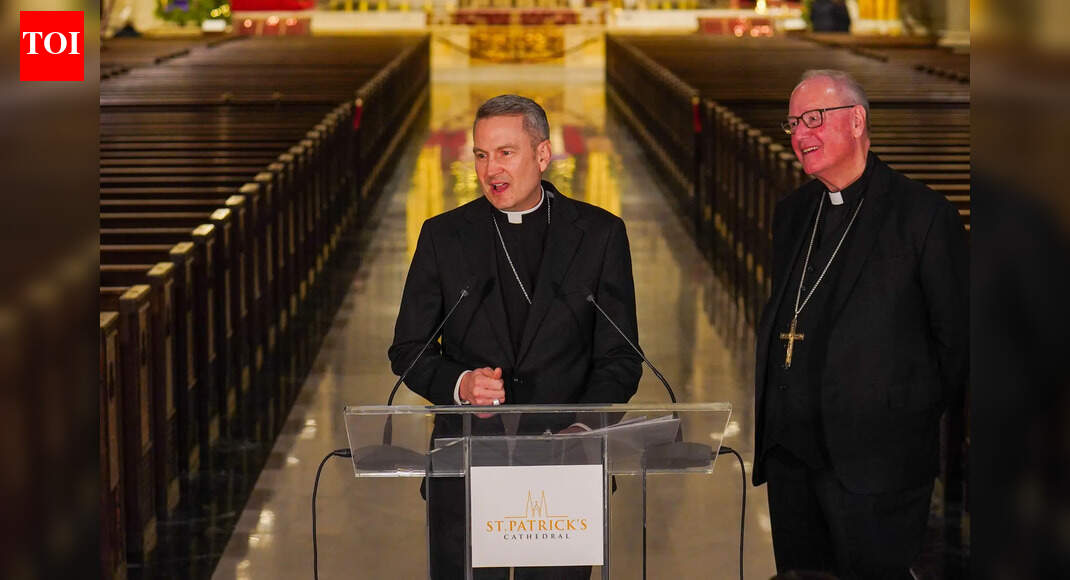

Bishop Ronald Hicks speaks during a news conference, Thursday, Dec.18, 2025 in New York. (AP Photo/Ryan Murphy)
Pope Leo XIV has named Bishop Ronald A. Hicks as the next Archbishop of New York, placing one of the United States’ most influential Catholic archdioceses under new leadership at a moment of institutional transition and political strain. Hicks, 58, currently serves as bishop of Joliet, Illinois. He replaces Cardinal Timothy Dolan, who submitted his resignation earlier this year after turning 75, as required under Vatican rules. The appointment, announced in Vatican City on Thursday, is the most significant US posting made so far by Leo, the first American pope. The New York archdiocese serves roughly 2.5 million Catholics across Manhattan, the Bronx, Staten Island and seven surrounding counties. Hicks inherits leadership as the archdiocese begins implementing a $300 million settlement fund for survivors of clerical sexual abuse, finalised by Dolan shortly before his retirement. Speaking at a news conference following the announcement, Hicks addressed the settlement directly. “As a church, we can never rest in our efforts to prevent abuse, to protect children and to care for survivors,” he said. “While this work is challenging, it’s difficult, it’s painful, I hope it will continue to help in the areas of accountability, transparency and healing.” The fund is intended to cover settlements for most, if not all, of the approximately 1,300 outstanding abuse claims against the archdiocese. It will be financed through budget reductions and the sale of church assets. Dolan had delayed stepping aside while the settlement framework was completed. Vatican practice often allows outgoing bishops to remain in place when abuse litigation or governance issues are unresolved. The leadership change also marks a generational shift. Dolan, a high-profile conservative figure, was a dominant public presence in New York and a prominent voice in national Catholic debates. His tenure included close ties to Republican political figures, including Donald Trump, who appointed him to a Religious Liberty Commission and invited him to pray at his inauguration. Hicks arrives with a different profile. Like Leo, he is Chicago-born and has spent significant time working in Latin America. From 2005 to 2010, he served in El Salvador as regional director of Nuestros Pequeños Hermanos, a church-run programme supporting orphaned and abandoned children across Latin America and the Caribbean. He has also publicly aligned with US bishops critical of the Trump administration’s immigration policies. In November, Hicks endorsed a statement from the US Conference of Catholic Bishops condemning immigration raids, particularly those affecting Chicago. The message, he said at the time, “affirms our solidarity with all our brothers and sisters as it expresses our concerns, opposition, and hopes with clarity and conviction. It is grounded in the church’s enduring commitment to the Catholic social teaching of human dignity and a call for meaningful immigration reform.” Hicks acknowledged his shared background with the pope during interviews following Leo’s election. He said the two men met in person only in 2024, when then-Cardinal Robert Prevost visited one of his parishes in Illinois. “We grew up literally in the same radius, in the same neighbourhood together,” Hicks told Chicago’s WGN-TV. “We played in the same parks, went swimming in the same pools, like the same pizza places.” Christopher White, author of Pope Leo XIV: Inside the Conclave and the Dawn of a New Papacy, said the similarities matter. “He won’t be shy, and at the same time he will also bring a seriousness and willingness to learn that’s likely to help him on a local level,” White said. “It will be different from Dolan’s larger-than-life persona.” Hicks was ordained a priest in Chicago, later serving as dean of formation at Mundelein Seminary before being appointed vicar general of the Archdiocese of Chicago in 2015 by Cardinal Blase Cupich. He became an auxiliary bishop in 2018 and was named bishop of Joliet by Pope Francis in 2020. His experience includes navigating the fallout from a 2023 Illinois attorney general’s report documenting decades of clerical abuse across the state. While the report criticised past diocesan leadership, it noted improvements in safeguarding practices during Hicks’s tenure. Dolan, for his part, welcomed the appointment publicly. “I already love him and appreciate him and trust him,” Dolan said, adding that Hicks was “an early Christmas gift” for the archdiocese. Hicks, standing in St Patrick’s Cathedral as archbishop-designate, struck a measured note. “I accept this appointment with humility and an open heart,” he said. “I ask for your support and your prayers.” He now assumes leadership of a church confronting its past, managing financial redress, and redefining its public voice under the first American pope. Go to Source