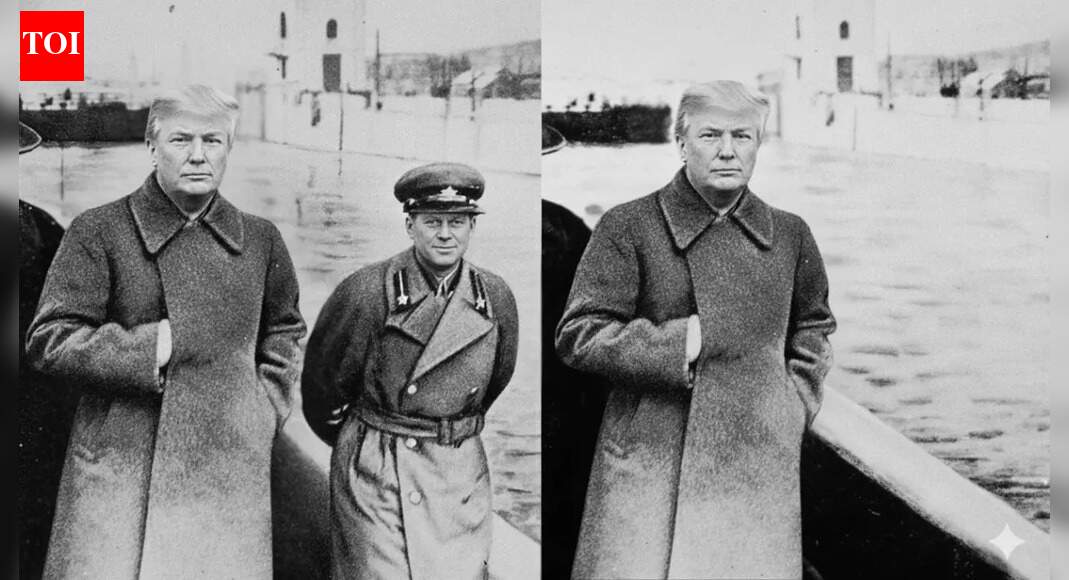

After becoming only the second man in American history to return to the White House after a hiatus, Donald Trump has been hellbent on leaving his mark on Washington. Not merely through policy or executive orders, but through brick, marble and nomenclature. He has pushed to break open the East Wing to make room for a sprawling White House ballroom, floated the idea of remodelling official spaces to better suit “modern presidential entertaining”, stacked cultural institutions with loyalists, and treated Washington less like a capital city than a property portfolio awaiting upgrades. The impulse is familiar: to brand power, to stamp ownership, to make the city remember who was here. It is this same instinct that has now spilled beyond the White House gates and into one of America’s most sacrosanct cultural monuments, with Trump backing the rechristening of the John F. Kennedy Center for the Performing Arts as the Trump–Kennedy Center.
Power, but make it concrete
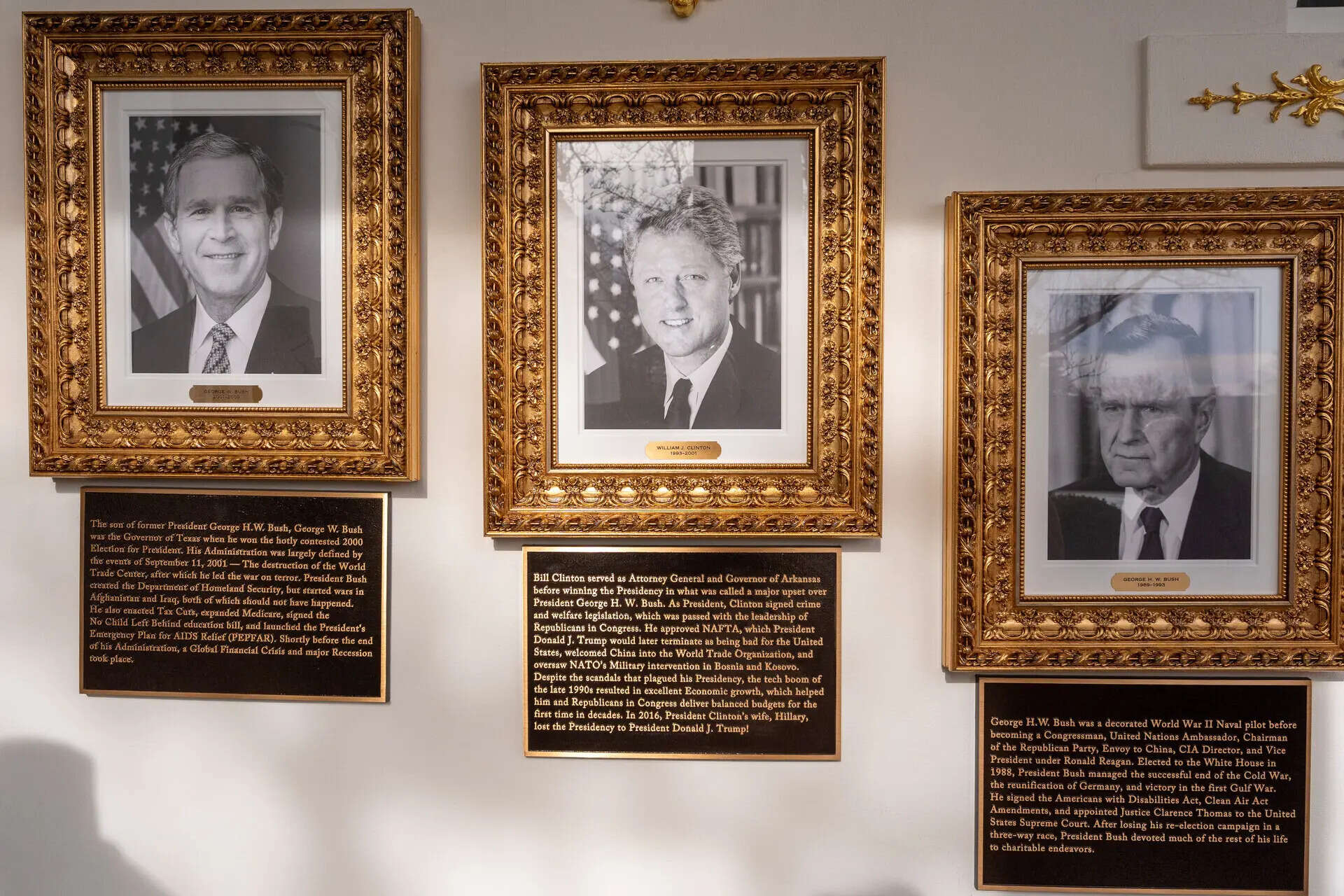
New plaques of explanatory text have been placed underneath presidential portraits on the Colonnade at the White House, Wednesday, Dec. 17, 2025, in Washington. (AP Photo/Alex Brandon)
Donald Trump has never been a president comfortable with abstraction. His idea of power is tactile. You can walk through it, host a dinner in it, point to it from across the street. This is why his second term has been accompanied not just by policy reversals but by an unusual fixation on physical space.The proposed White House ballroom is emblematic. Trump has long complained that the White House is ill-equipped for large-scale entertaining, arguing that modern presidents should not have to rely on temporary tents on the South Lawn. In Trump’s mind, grandeur is not excess. It is evidence. Evidence of success, of authority, of permanence.This is the same instinct that once drove him to plaster his name in gold across Manhattan skylines. Washington, however, has traditionally resisted this kind of personalisation. Presidents come and go; the buildings remain largely unchanged. Trump has never accepted that arrangement. He does not see himself as a caretaker. He behaves like an owner.
The Kennedy Center was never meant to be flexible
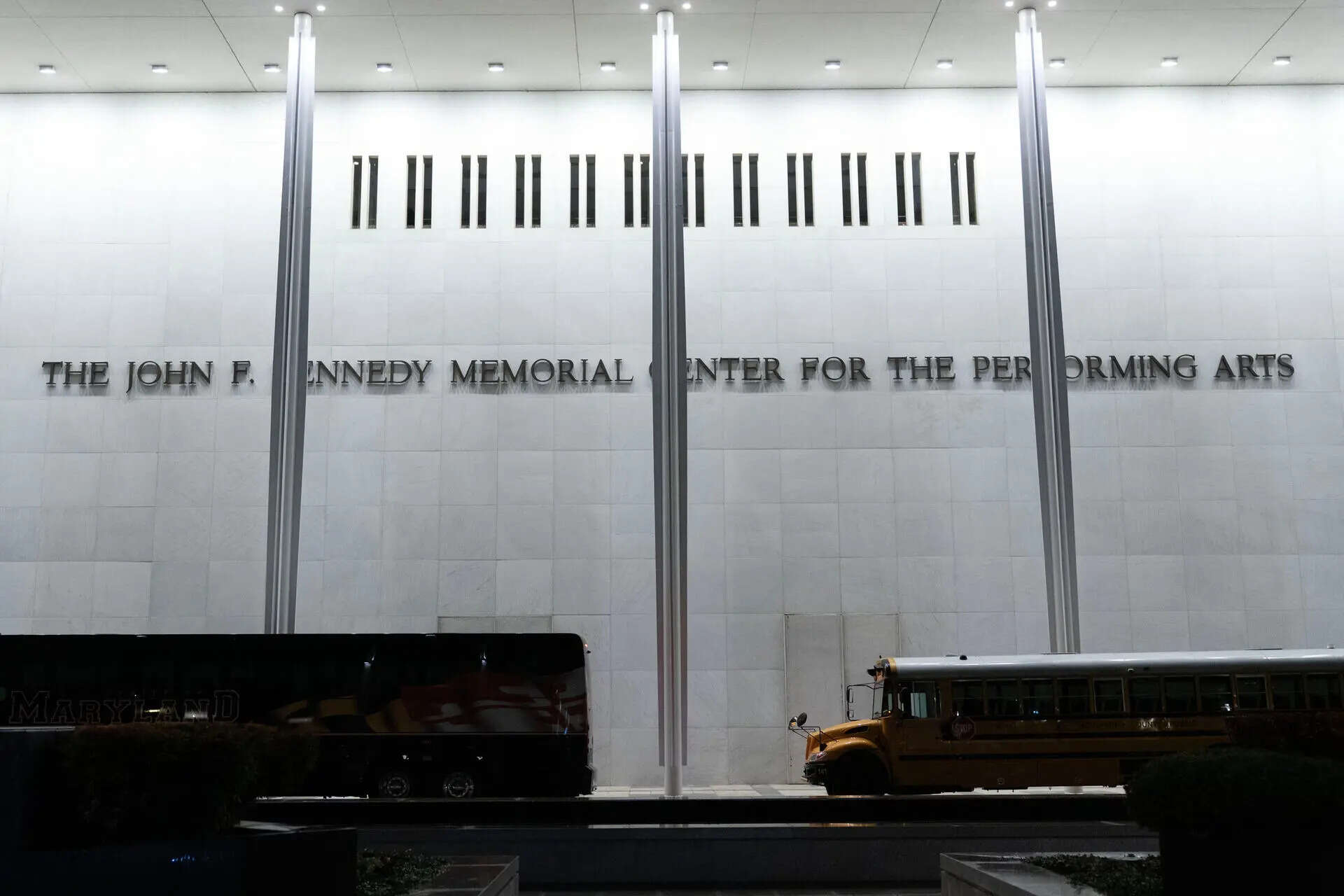
Th eJohn F. Kennedy Center for the Performing Arts is seen in Washington, Thursday, Dec. 18, 2025. (AP Photo/Jose Luis Magana)
The John F. Kennedy Center for the Performing Arts occupies a unique place in American civic life. It is not just a venue. It was established by Congress as a living memorial to a president assassinated in office, explicitly linked to Kennedy’s belief that art was central to democratic life.That context matters. The centre’s name was not the result of philanthropy, branding or convention. It was a deliberate act of national remembrance. The idea was to freeze meaning, not renegotiate it with every new administration.Trump approaches it differently. When asked about the renaming, he framed the issue in transactional terms. “We saved the building,” Trump said, crediting his administration with securing funding and reviving the institution. In his worldview, rescue confers rights. If you fix something, you should be recognised for it.The problem is that memorials are not reward schemes. They are limits. They exist precisely to prevent present power from rewriting past meaning. Adding Trump’s name ahead of Kennedy’s is not a neutral update. It alters the hierarchy of memory. Trump first. Kennedy second. The living eclipsing the dead.
Why the Kennedys reacted with open anger
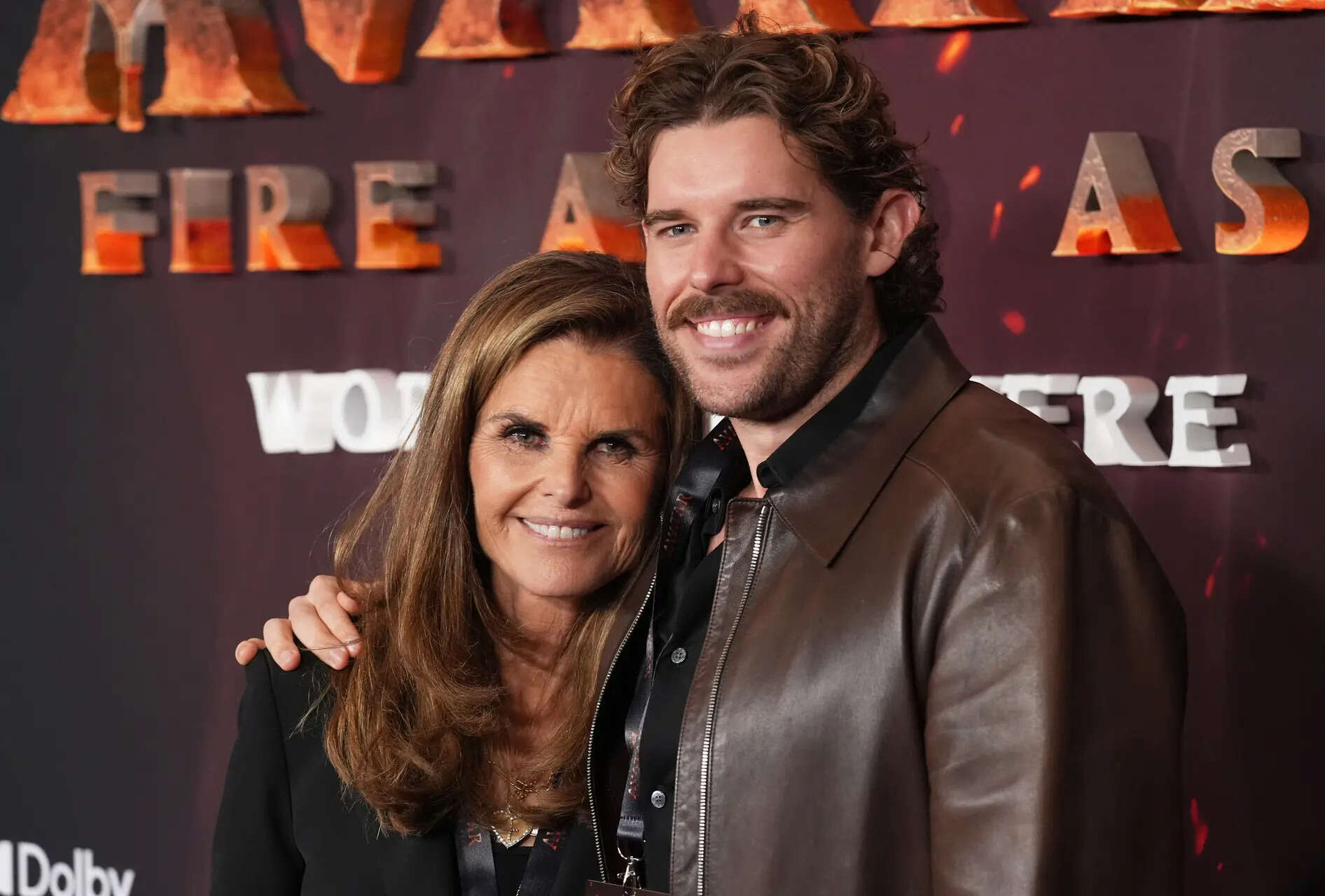
Maria Shriver, left, and her son Christopher Schwarzenegger pose together at the premiere of the film “Avatar: Fire and Ash” on Monday, Dec. 1, 2025, at Dolby Theatre in Los Angeles. (AP Photo/Chris Pizzello)
The Kennedy family’s response has been striking not for its defensiveness, but for its tone. Maria Shriver did not issue a carefully worded statement. She spoke with disbelief. “It’s beyond comprehension to me,” she said, calling the move “beyond wild” and “so bizarre”.At another point, Shriver remarked, “Just when you think someone can’t go any lower, they do”, before urging Americans to “wake up”. There was no nostalgia in her reaction. It was moral outrage at what felt like a violation of an obvious boundary.Joe Kennedy III framed the objection in institutional terms. He pointed out that the Kennedy Center was named by law and that renaming it would be akin to renaming the Lincoln Memorial. The comparison was deliberate. Some names are meant to be untouchable, not because families demand it, but because societies do.The Kennedys are not fighting for relevance. Their name is already etched into American political history. They are fighting because they understand what happens when memorials become malleable. Once you allow power to edit memory, nothing stays fixed.
Culture wars by capture, not cancellation
Trump’s approach to culture has often been misunderstood. He is not a traditional culture warrior intent on defunding the arts or banning expression outright. His method is more effective. He captures institutions instead.By reshaping boards, installing loyalists and asserting personal authority over cultural bodies, Trump turns them into extensions of political power without ever needing to shut them down. The Kennedy Center renaming is the purest expression of that strategy.This is not about programming choices or individual performances. It is about control over context. By altering the name, Trump redefines the building’s meaning without touching what happens on stage. It is culture war by absorption rather than confrontation.The message is subtle but unmistakable. Even institutions designed to stand above politics exist at the pleasure of political power. No symbol is too sacred to be revised.
Legacy as something you can see from the street
For most presidents, legacy is an uncomfortable abstraction. It is shaped by historians, refracted through time, and rarely settles into a single narrative. Trump has no patience for that uncertainty.He prefers legacy that is physical. Names on buildings. Altered skylines. Concrete proof that does not depend on interpretation. Laws can be repealed. Policies can be dismantled. But a name carved into stone creates the illusion of permanence.This is why Trump is drawn to monuments, memorials and architectural changes. They offer something politics rarely does: durability. The Kennedy Center, in this sense, is not a memorial to another president. It is a canvas.Whether the renaming ultimately survives legal challenge is almost secondary. The intent is already clear. Trump does not want to be remembered as a president who governed well or poorly. He wants to be remembered as a figure who altered the landscape.That is what makes this episode so revealing. It is not an outburst or a distraction. It is a distillation of Trump’s governing philosophy. Power must be visible. Legacy must be branded. History must carry your name.The Kennedy family’s resistance is not about protecting a surname. It is about defending the idea that some institutions exist beyond the reach of personal ambition. If memorials can be rewritten by whoever holds office, then memory itself becomes transactional.And in Trump’s Washington, transactions are the only language that matters. Go to Source