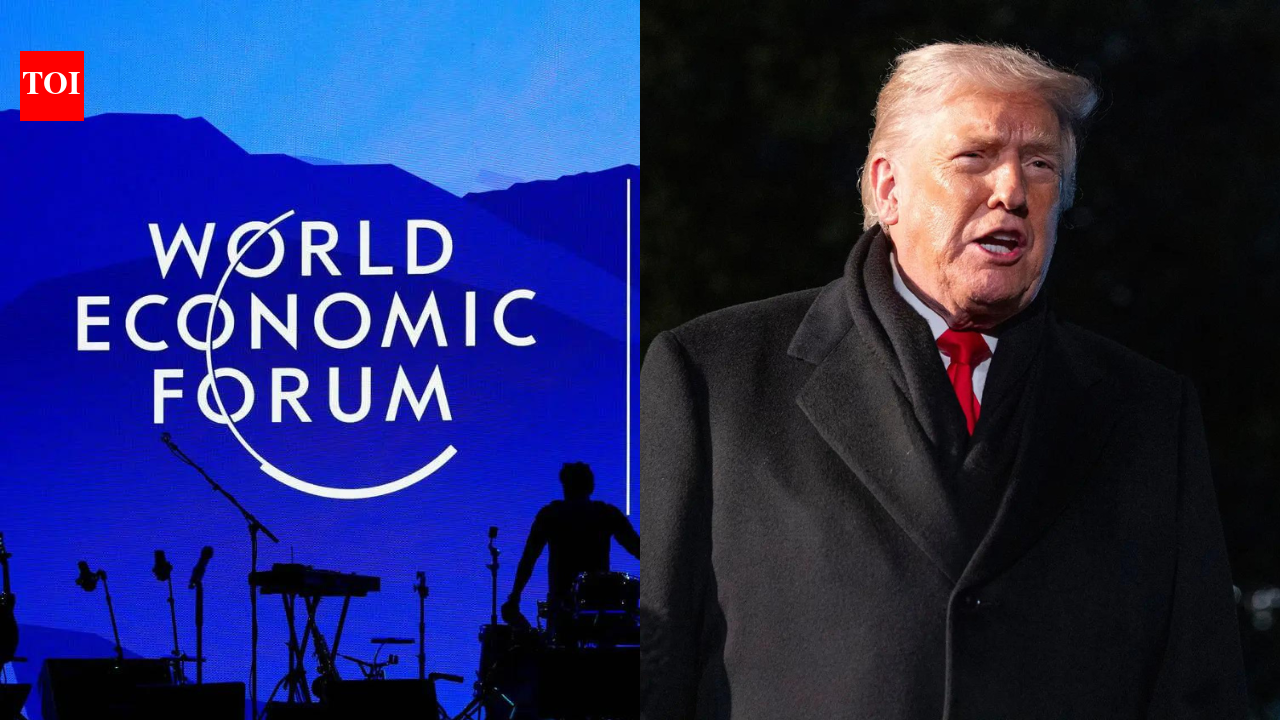


As global leaders, CEOs and financiers gather once again in the Swiss Alps for the annual World Economic Forum, the meeting faces a familiar challenge — how to reconcile its lofty ambitions with its elite optics. But this year, Davos is also confronting two overlapping pressures that threaten to upend the global order, and while US President Donald Trump’s return to centre stage dominates attention, many participants privately acknowledge that the deeper challenge lies elsewhere.Trump, who is set to address the forum today, looms over the summit amid renewed concerns about trade protectionism and geopolitical volatility and his aggressive assertion over wresting control of Greenland. Yet alongside the political uncertainty sits a more structural force reshaping economies worldwide: the K-shaped economy, a widening divide between those who emerged wealthier from the pandemic and those left behind.The term, popularised by economist Peter Atwater, describes a recovery that split along two diverging paths after 2020. While the pandemic initially struck broadly, the rebound did not. Asset owners and higher-income groups saw gains, while lower-income households struggled with inflation, stagnant wages and rising costs. Nearly six years on, the gap has continued to widen. Equity markets remain near record highs despite bouts of volatility. Luxury travel and high-end consumption remain resilient, even as affordability pressures curb discretionary spending for many households. What appears to be a housing crisis for one segment of society has translated into rising home values and balance-sheet gains for another.This divergence has sharpened criticism of Davos itself – long caricatured as a gathering of the global elite arriving by private jet to discuss poverty, inequality and climate change. The disconnect, critics argue, has become more pronounced in the wake of the pandemic and the political backlash that followed, including Trump’s re-election.“Those at the bottom are all too aware of the abundance that exists above them,” Atwater, an adjunct economics professor at William & Mary, told CNN. “But I think that one of the consequences of Covid was that it created blindness at the top… other than a delivery person showing up at the door, the interaction of those at the top and those at the bottom has really diminished, if not evaporated.” Forum organisers and participants are not unaware of the perception problem. Larry Fink, CEO of BlackRock and often described as Davos’ informal convenor, acknowledged the tension in his opening remarks.“Many of the people most affected by what we talk about here will never come to this conference,” Fink said. “That’s the central tension of this forum. Davos is an elite gathering trying to shape a world that belongs to everyone.” Still, critics argue that recognition has not always translated into foresight. Senior business journalist Liz Hoffman wrote this week that Davos has repeatedly misread political and social undercurrents, noting its failure to anticipate Brexit, the rise of MAGA politics, and the populist wave that reshaped Western democracies. She also pointed to moments such as the 2020 gathering, when delegates mingled as Covid-19 spread nearby, and the forum’s brief enthusiasm for the metaverse.The political consequences of economic divergence are no longer confined to any particular country rather, expanding world over. Severe inequality has proven destabilising across regions, with recent unrest in Iran cited by analysts as an example of how prolonged inflation, currency collapse and perceived elite enrichment can ignite social unrest. Against that backdrop, Trump’s presence at Davos – disruptive though it may be – is arguably the more manageable of the forum’s challenges. Trade disputes can be negotiated, alliances recalibrated. The structural divide represented by the K-shaped economy is far harder to resolve and far less forgiving.“You can’t sustain this level of overt wealth without there being consequences,” Atwater warned. “What I think those at the top miss is that any added weight of vulnerability could easily be the tipping point… We are a straw away from something being unleashed.”For a forum that prides itself on anticipating the future, the question hanging over Davos this year is whether it can move beyond acknowledging inequality to addressing it meaningfully – before political and social forces outside the conference halls do it instead. (With inputs from CNN) Go to Source