
Image: Canva
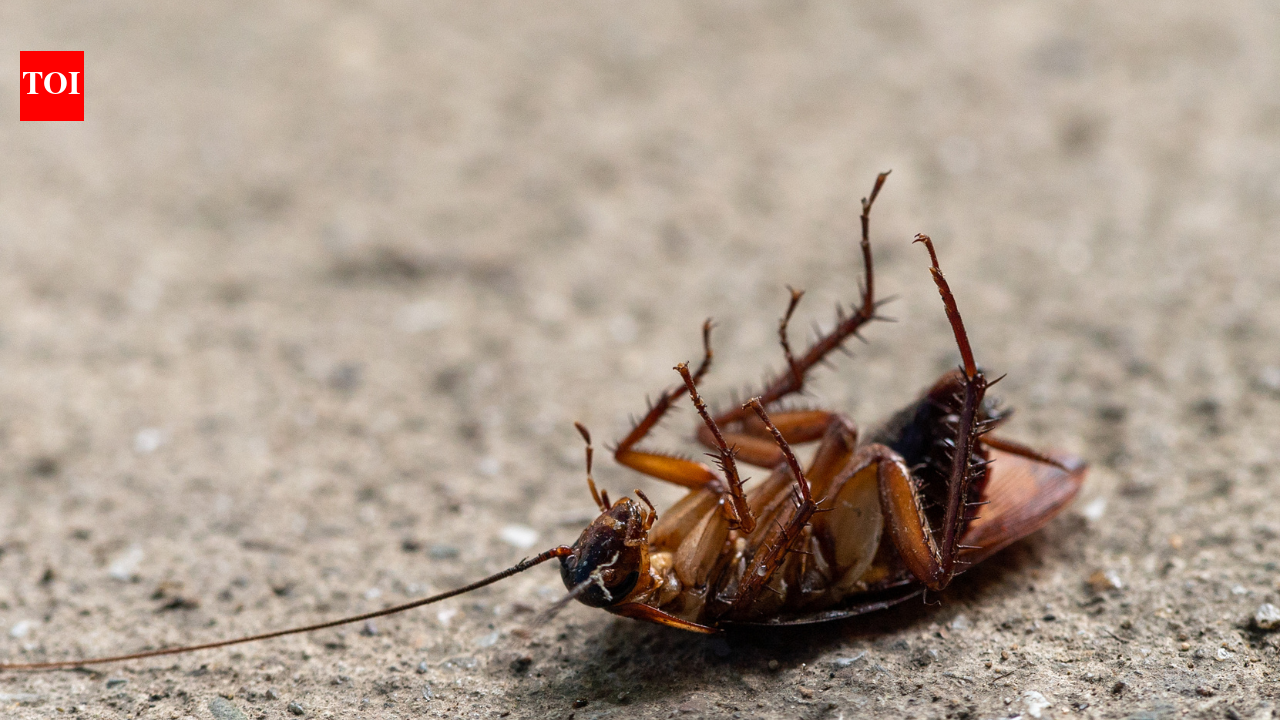
Few creatures have earned a reputation for resilience quite like the cockroach. It can survive extreme temperatures, withstand surprisingly high levels of radiation compared with humans and squeeze through impossibly narrow gaps. Yet perhaps its most astonishing ability is surviving for days after losing its head. While the idea sounds like an urban myth, it is firmly grounded in insect biology. Unlike mammals, cockroaches do not rely on a single organ to control breathing or circulate oxygen throughout the body. Instead, their unique anatomy allows many vital functions to continue even after decapitation. Scientists say the insect ultimately dies not from the injury itself, but because it can no longer drink water, making dehydration the final cause of death.
Cockroaches don’t die immediately after losing their heads: Here’s why
According to Science ABC, a cockroach can survive for about a week after losing its head because its body functions very differently from that of mammals. Unlike humans, which depend on the brain to control breathing and blood circulation, a cockroach’s nervous system is distributed throughout its body. Clusters of nerve cells, known as ganglia, allow many basic functions, including movement and reflexes, to continue without direct input from the brain. The insect also has an open circulatory system, meaning its blood, known as haemolymph, does not flow through a network of pressurised blood vessels. As a result, losing its head does not trigger the catastrophic blood loss that would quickly prove fatal in mammals. According to the University of Florida, the neck opening also seals naturally through clotting, further limiting fluid loss. They breathe through spiracles, small openings on their bodies, and can still move and perform simple actions while headless.
How does a headless cockroach continue to breathe?
One of the biggest reasons a cockroach survives decapitation is that it does not breathe through its mouth or nose. Instead, oxygen enters the body through tiny openings called spiracles, located along the sides of the thorax and abdomen. These openings connect to a branching network of tubes known as the tracheal system, which delivers oxygen directly to tissues throughout the body.Because breathing does not depend on the head or brain, the insect continues to respire even after decapitation. Insects distribute oxygen directly through this tracheal network rather than transporting it in blood as mammals do, allowing essential tissues to remain supplied with oxygen independently.
Why does a headless cockroach eventually die?
Although the injury itself is not immediately fatal, a headless cockroach cannot survive indefinitely. Without its mouthparts, it is unable to eat or drink, and dehydration becomes the limiting factor.According to entomologists, cockroaches are capable of surviving for extended periods without food because of their relatively slow metabolism. Water, however, is essential. After several days, the insect eventually dies from dehydration rather than from the loss of its head. Under cooler and more humid conditions, survival may even last slightly longer.
What makes cockroaches among the most resilient insects on Earth?
Cockroaches have existed for hundreds of millions of years and have survived dramatic environmental changes that eliminated countless other species. Their success stems from a combination of biological adaptations, including a tough exoskeleton, highly efficient sensory organs, rapid reproduction and an ability to feed on a remarkably wide variety of organic materials.Scientists continue to study cockroaches because many of their survival mechanisms have inspired research into robotics, biomechanics and resilient engineering systems. Their distributed nervous system, for example, has influenced the development of robots capable of continuing to function even if individual components fail.
Could studying cockroaches improve future robotics?
Cockroaches are more than household pests, they have become valuable models for engineers designing robots capable of operating in challenging environments. Their flexible exoskeleton, rapid reflexes and ability to navigate narrow spaces have inspired search-and-rescue robots intended to move through collapsed buildings and disaster zones where larger machines cannot reach.Researchers at institutions including the Nanyang Technological University have developed cockroach-inspired robots that mimic the insect’s movement and resilience. By understanding how cockroaches coordinate movement using a distributed nervous system, scientists hope to create more adaptable robots for emergency response, planetary exploration and environmental monitoring. Go to Source