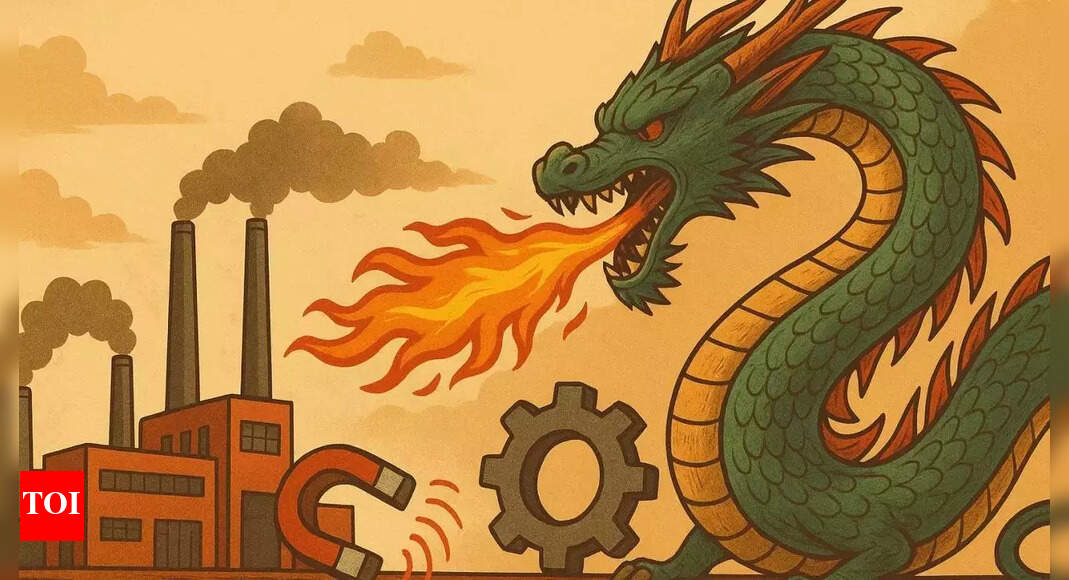


AI generated image
The trade conflict between the US and China shows no signs of easing, with both sides digging in, hoping they can endure the economic pain longer than the other.The dispute has once again thrust a group of metals known as rare earth elements into the global spotlight.China dominates every stage of the rare-earth supply chain, controlling nearly 70% of global mining and producing as much as 90% of the world’s processed rare earths.A report published by the International Energy Agency this week noted that such “high market concentration” would leave global supply chains in strategic sectors — such as energy, automotive, defense and AI data centers — “vulnerable to potential disruptions.”Earlier this month, Beijing tightened control over the rare-earth supply. Starting December 1, foreign companies anywhere in the world will need approval from the Chinese government to export products containing even trace amounts of rare-earth materials that originated in China or were produced using Chinese technology.The move came in response to the US expanding the list of Chinese firms denied access to most-advanced US semiconductor chips and other technologies. China’s decision has stirred concerns over possible supply shortages that could disrupt production of other products such as electric vehicles, defense equipment and renewable energy systems.US Trade Representative Jamieson Greer criticized Beijing’s new measures as “incredibly aggressive” and “disproportionate,” while EU trade chief Maros Sefcovic called them “unjustified and harmful.”Both the US and the EU are in talks with the Beijing to ensure adequate rare-earth supplies for their firms.
Why are rare earths so important?
Rare earth elements have become an integral part of modern life thanks to their unique physical, magnetic and chemical properties. They are key to making magnets that retain their magnetic properties indefinitely without the need for external power.The metals are essential ingredients in all kinds of high-tech goods, including smartphones, laptops, hybrid cars, wind turbines and solar cells, among other things.There are important defense applications as well, such as jet fighter engines, missile guidance systems, antimissile defense, space-based satellites and communication systems.Despite what their name implies, rare earths aren’t particularly rare and are moderately abundant in the Earth’s crust, some even more plentiful than substances like copper, lead, gold and platinum.However, they are seldom found in high concentrations to be extracted economically. Besides China, deposits of rare-earth metals can be found in countries like Canada, Australia, the US, Brazil, India, South Africa and Russia.Rare earths are typically divided into two categories according to the separation process: light rare earths and heavy rare earths. China has a near monopoly particularly over the processing of heavy rare earths.According to Benchmark Mineral Intelligence, a UK-based pricing and data research firm for energy transition minerals, Chinese firms account for as much as 99% of global heavy rare-earth processing
Why do other countries struggle to boost rare earth supply?
The United States was once self-sufficient in rare earths, but over the past two decades, China has emerged as a dominant player in their production. China’s stranglehold on these critical materials was evident even a decade ago.Many have long suspected Beijing could use it as a bargaining chip in its geopolitical spats. In 2010, China cut off rare-earth exports to Japan over a territorial conflict, exacerbating concerns.At the height of a US-China trade dispute in 2019, during Donald Trump’s previous term as US president, Chinese state media suggested that rare-earth exports to the US could be cut in response to American measures.Chinese President Xi Jinping at the time called the elements “an important strategic resource.”But efforts to reduce reliance on Chinese rare earths have so far made little headway.
US seeks to boost rare-earth production
To counter China’s dominance, the Trump administration is attempting to strike deals with partners to secure rare earth supplies. But experts say the real challenge to diversify away from Chinese rare earths lies in scaling up refining and processing capacity.”The first thing the United States needs to do is prioritize the midstream, and that’s the processing and refining piece,” Karl Friedhoff, an expert at the Chicago Council on Global Affairs, said in a blog published Oct. 16.”Without control of the midstream, we have the raw minerals, but we still have to send them to China to be processed,” he said, underlining the need to set up processing plants and refineries in other countries.This, however, would come with a “whole host of problems, especially on the environmental side,” he added.
What are the challenges?
China’s dominance of rare-earth production came at a heavy environmental and social cost.The mining involves environmental and human health hazards, as all rare-earth ores contain radioactive elements such as uranium and thorium, which can contaminate air, water, soil and groundwater.The challenges also include setting up processing plants that comply with strict environmental regulations in Western countries, which could prove more costly and time-consuming.Rare-earth processing is also extremely energy and water-intensive, which could trigger public opposition in the areas where such facilities are planned.It is also technically complex and China maintains a strong technological lead with decades of experience, trained personnel and an industrial ecosystem that is hard for others to replicate.According to a report published by the US-based Center for Strategic and International Studies (CSIS) in July, China holds “unmatched technical expertise in rare earth processing, especially in solvent extraction” — a critical and complex step in rare earth element separation.”Western companies have struggled due to limited workforce capabilities, research and development, and environmental regulations,” the report said.Diversifying away from Chinese rare-earth supplies, the report added, will require not only new mines outside of China but also new refining facilities, skilled labor and economic incentives for companies, including price stability and secure purchase agreements with downstream industries such as automotive and defense.The authors of the CSIS report urged the US to develop a strategy to rebuild rare-earth technical expertise and establish processing hubs. This, however, which would require “more than just securing competitively priced raw material feedstock” to become cost-competitive.”It also requires reliable access to low-cost energy, efficient transportation infrastructure, advanced processing technologies, and affordable, skilled labor,” they noted.Even if all the required measures were put in place, the commodity experts think China would continue to dominate the sector in the near future.But “without swift and coordinated action,” the CSIS report underlined, “the window to counter China’s entrenched dominance will continue to narrow, placing critical technologies, industries, and security interests at ongoing risk.” Go to Source