
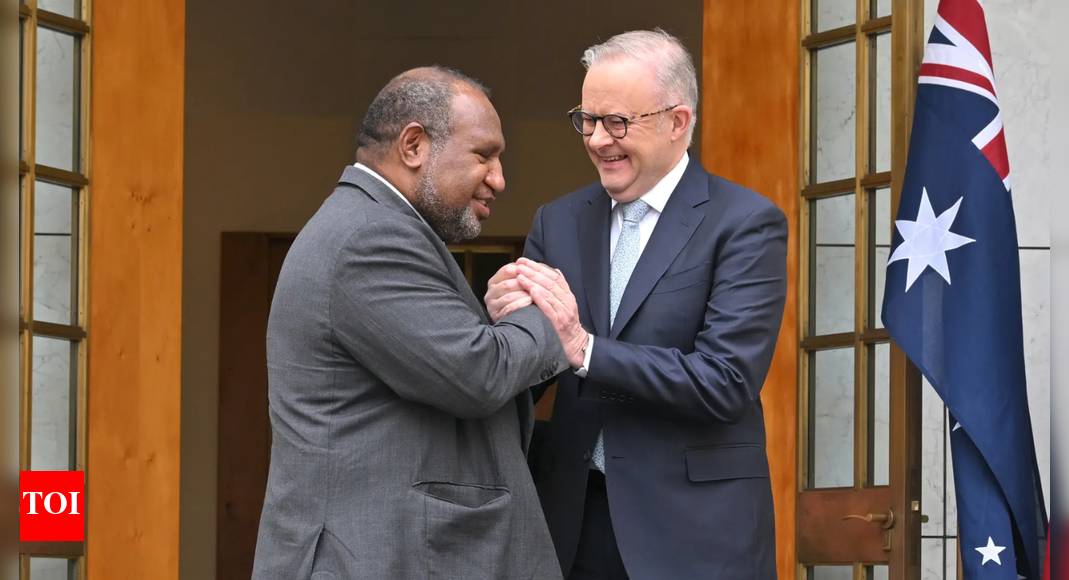

Australia’s Prime Minister Anthony Albanese shakes hands with Papua New Guinea’s Prime Minister James Marape (Image credits: AP)
MELBOURNE: The leaders of Australia and Papua New Guinea signed a major bilateral defense treaty Monday that China believes targets it unfairly. Australian Prime Minister Anthony Albanese and his Papua New Guinea counterpart James Marape described the agreement as a mutual defense treaty that will enable unprecedented integration of their defense forces and military personnel. It is Australia’s only alliance-level security pact other than the ANZUS Treaty signed with the United States and New Zealand in 1951. It is the first such treaty for Papua New Guinea, Australia’s nearest neighbor and former colony. The treaty would take effect after it was ratified by the Parliaments of both countries. Albanese said it was a great honor for Australia to have its nearest neighbor become its newest ally. “This treaty contains a mutual defense obligation similar to Australia’s ANZUS Treaty commitments, where we declare that in the event of an armed attack on either of our countries, we would both act to meet the common danger,” Albanese told reporters at a joint press conference with Marape at Australia’s Parliament House. “Both our nations have also agreed not to undertake any activities or enter into any agreements that would compromise the implementation of this treaty,” Albanese added. After Marape and Albanese signed a joined statement supporting the treaty’s core principles last month, the Chinese Embassy in Papua New Guinea issued a statement saying such a bilateral pact “should not be exclusive in nature, nor should it restrict or prevent a sovereign country from cooperating with a third party for any reason.” “It should also refrain from targeting any third party or undermining its legitimate rights and interests,” the embassy posted on social media. Marape said Monday the treaty did not erode Papua New Guinea’s dominant foreign policy: friends to all, enemy to none. “This is not a treaty that sets up enemies but consolidates friendships and China, we’ve been transparent, we have told them that Australia … has become our security partner of choice and they understand,” Marape said. Marape said the treaty consolidated Papua New Guinea’s security partnership with Australia “with no intent of creating enemies elsewhere.” The United States and Australia have both increased military ties in recent years with Papua New Guinea, which is seen as a strategically important partner in countering China’s growing influence in the Pacific. The security relationship is a balancing act for Papua New Guinea, which also seeks closer economic cooperation with China. Australia has stepped up efforts to bolster relations with island nations in the region since 2022, when Beijing struck a security deal with Solomon Islands that has raised the prospect of a Chinese naval base being established in the South Pacific. Outside Australia and New Zealand, Papua New Guinea, Fiji and Tonga are the only South Pacific island nations with militaries. Australia is negotiating a bilateral defense pact with Fiji. Three Pacific island nations have changed their diplomatic recognition from Taiwan to Beijing since 2019 as China’s influence in the region has grown. The US and its allies are particularly concerned by China’s growing sway in security through police training in Fiji, Kiribati, Samoa, Solomon Islands and Vanuatu.
 "Two teenage friends killed in Cranford hit-and-run; 17-year-old charged with murder")
 "Explained: Why Nakamura threw Gukesh’s king into the crowd at Checkmate: USA vs India")
