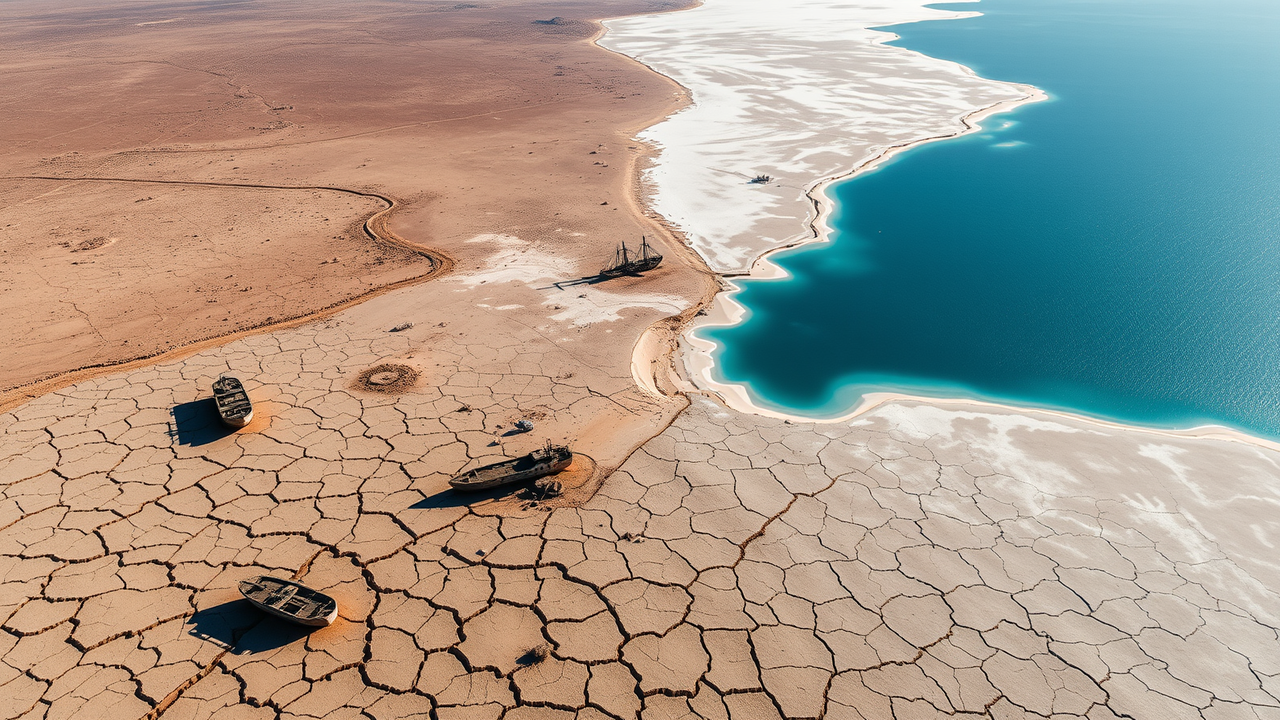

In 1960, the Aral Sea ranked among the largest lakes on the planet, spreading across the border of what is now Kazakhstan and Uzbekistan. Within a single human lifetime, most of it was gone. Soviet planners had redirected its two feeder rivers to irrigate cotton fields across Central Asia, and by the 1980s the lake was receiving almost no fresh water at all. What followed was one of the most dramatic environmental collapses of the twentieth century, a inland sea that split into pieces, turned toxic with salt and pesticide residue, and left fishing fleets stranded miles from any shoreline. Yet one corner of that story took an unexpected turn when a modest dam brought part of the sea back to life far faster than anyone predicted.
How Soviet cotton planning drained the Aral Sea
The Aral Sea depended entirely on the Amu Darya and Syr Darya rivers, which carried snowmelt down from distant mountains into a lake with no natural outlet. Starting around 1960, Soviet planners diverted large volumes of this water to irrigate cotton across present day Uzbekistan, Turkmenistan and Kazakhstan. According to NASA Earth Observatory, the Aral Sea was receiving about 50 cubic kilometres of fresh water each year as recently as 1965, a figure that fell to zero by the early 1980s as the rivers were drained before they ever reached the lake.
A lake that split into pieces as it shrank
As inflow disappeared, the Aral Sea began to fall and split. Documentation from NASA’s World of Change series describes how the lake broke into a northern and southern sea, with the southern portion further dividing into eastern and western lobes that stayed only loosely connected before separating entirely by 2001. Water levels in the eastern lobe fluctuated through the 2000s depending on drought conditions, and by August 2009, NASA imagery documented that virtually nothing remained of what had once been the lake’s largest lobe.
Salt, disease and stranded ships left behind
Every bit of water that evaporated left its dissolved salts behind, steadily raising the concentration in what remained. According to research published by geographer Philip Micklin in Lakes and Reservoirs Research and Management, drought conditions across the Amu Darya basin meant almost no water reached the Aral Sea in 2007, and none flowed into it at all in 2008 and 2009, causing the southern sea’s eastern lobe to nearly vanish. The retreating shoreline stranded entire fishing fleets on dry, cracked lakebed far from any remaining water, images that came to symbolise the scale of the disaster for the wider region.
How the Kok-Aral dam brought part of the sea back
Rather than attempt to restore the entire lake, a project backed by Kazakhstan and the World Bank focused only on saving the smaller northern portion, still fed by the Syr Darya river. According to the World Bank’s own account of the project, the roughly 8-mile Kok-Aral Dam was completed in August 2005, designed to allow more than 29 cubic kilometres of water to accumulate in the northern sea while a sluice gate periodically released excess water toward the largely dried southern basin. Masood Ahmad, the World Bank’s task team leader on the project, said at the time that after decades of studies without action, the project had finally begun producing measurable results.
Results that outpaced original expectations
The recovery exceeded what planners had projected. A later World Bank press release reported that the volume of the Northern Aral Sea had already risen by 68 per cent by 2008, just three years after the dam’s completion, while salinity fell by half and annual fish production more than tripled compared with pre dam levels. These improvements allowed local communities around the town of Aralsk to return to fishing as a source of income after decades of economic hardship following the original collapse.
A restoration effort that continues today
Work on the northern sea has not stopped at the original dam project. According to World Bank project documentation, a further North Aral Sea Development and Revitalisation Project aims to keep improving water resource management in the Syr Darya basin, alongside restoring wetlands and supporting fisheries, agriculture and tourism in the surrounding Kyzylorda region. Meanwhile, satellite monitoring from the European Space Agency shows that the southern basin remains a mostly dry expanse now known as the Aralkum Desert, underscoring how the two halves of the same lake have followed entirely different paths since the dam was built.
Why the Aral Sea remains a cautionary tale
Taken as a whole, the story of the Aral Sea illustrates both how quickly a large body of water can be lost to short-term planning decisions and how targeted intervention can still reverse part of that damage when applied consistently over time. The northern sea’s recovery offers a rare example of ecological restoration succeeding faster than expected, even as the far larger southern basin remains a stark, dry reminder of what the entire lake once looked like before the rivers that fed it were diverted away for good. Go to Source