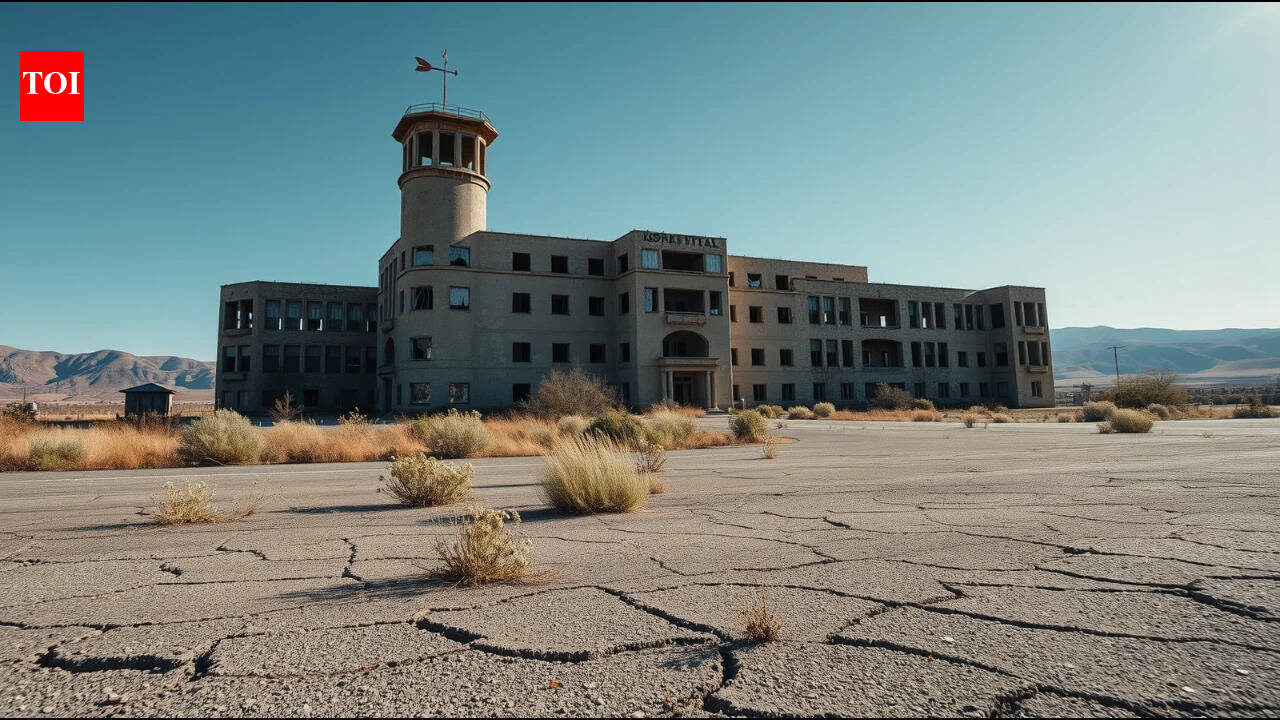

Representative Image of the abandoned hospital buildings in Eagle Mountain (AI-generated image)
On the southeastern edge of Joshua Tree National Park sits Eagle Mountain, once a thriving company town of roughly 4,000 people, now one of California’s largest and best preserved ghost towns. Founded in 1948 by industrialist Henry J Kaiser to house workers for the adjoining Eagle Mountain iron mine, the town featured wide landscaped streets lined with more than 400 homes, a shopping centre, schools, a bowling alley and a fully staffed hospital serving the mining community and their families. When the mine closed in 1983 after 35 years of continuous operation, the town emptied out almost overnight, leaving behind an unusually intact snapshot of postwar American company town life, right down to the hospital that once treated its residents.
How Eagle Mountain came to exist in the first place
According to a boundary study prepared by the National Park Service, the Kaiser Steel Corporation operated the Eagle Mountain Mine from 1948 to 1983, extracting iron ore to supply its steel mill in Fontana, California, roughly 180 kilometres to the west. During this period, Eagle Mountain became the largest iron mine in the western United States, eventually producing four large open pits, each stretching between one and two miles in length. Kaiser built the townsite specifically to house the mine’s workforce, connecting the remote desert location to the Fontana mill via a purpose-built 51-mile railroad that carried iron ore to the Salton Sea for onward shipping. On August 17, 1977, the mine celebrated shipping its 100 millionth ton of iron ore, a milestone that marked the peak of a mining operation that had, just a few years earlier in 1975, recorded its highest ever annual production of more than 350,000 tons.
Why the town’s healthcare system became historically significant
Beyond the mining operation itself, Eagle Mountain holds a specific place in American healthcare history. Kaiser implemented a fully integrated medical care system for his mine workers at Eagle Mountain, providing comprehensive on-site healthcare as a standard part of employment, an approach that closely mirrored similar programmes Kaiser had already established at his other industrial operations across California. This model of prepaid, employer-based integrated healthcare went on to form the direct foundation of Kaiser Permanente, which has since grown into one of the largest managed healthcare organisations in the United States.For the town’s residents, this meant Eagle Mountain functioned as a largely self-contained community, with its own hospital, schools ranging from elementary through high school, a shopping centre and recreational facilities including a baseball diamond, all built to support a workforce that, at its peak, numbered around 4,000 people living in more than 400 company-built homes.
Why the mine, and the town, eventually shut down
Eagle Mountain’s decline followed a familiar pattern for American mining towns dependent on a single industry. By 1980, the workforce had already shrunk to around 750 employees, down significantly from the town’s peak years. On November 3, 1981, Kaiser Corporation announced it would phase out both halves of its Fontana steel operations and the entire Eagle Mountain Mine over the following years, citing a combination of environmental compliance costs and cheaper steel imports undercutting domestic production.The town’s remaining infrastructure shut down in stages. The grocery store closed in October 1982, the final high school class graduated in June 1983, and the post office, which had operated continuously since 1951, closed that same year, marking the effective end of Eagle Mountain as a functioning residential community.
What happened to Eagle Mountain after the mine closed
Rather than being demolished, much of Eagle Mountain’s infrastructure remained standing, largely untouched, in the decades that followed. According to a 2020 press release from the Bureau of Land Management, the site became the subject of a prolonged legal dispute after a 1999 land exchange transferred portions of the surrounding federal land to Kaiser Eagle Mountain Inc, part of an unsuccessful proposal to convert the former mine site into a large-scale landfill and recycling centre. Following litigation initiated in 1999 by the National Parks Conservation Association, a federal court ordered those lands reverted back to Bureau of Land Management control, a process the agency confirmed was finalised in December 2020.A portion of the former townsite was also repurposed in 1988 as the Eagle Mountain Community Correctional Facility, a privately operated prison that used several of the town’s existing buildings, including its former bowling alley and cafe, before that facility itself was permanently closed in 2003.
Why Eagle Mountain remains a notable historical site today
What sets Eagle Mountain apart from many other American ghost towns is how recently it was inhabited and how much of its original built environment has survived intact as a result. Its relatively short lifespan and comparatively brief period of abandonment have left the town remarkably well preserved by ghost town standards, offering a rare, largely undisturbed look at what a mid-century American company town, complete with its own hospital, schools and integrated healthcare system, actually looked like while it was still a living, functioning community. Today, the site remains under Bureau of Land Management administration, sitting quietly on the edge of one of California’s most visited national parks, its empty streets and abandoned hospital standing as physical remnants of both a vanished mining industry and the healthcare model it inadvertently helped create. Go to Source