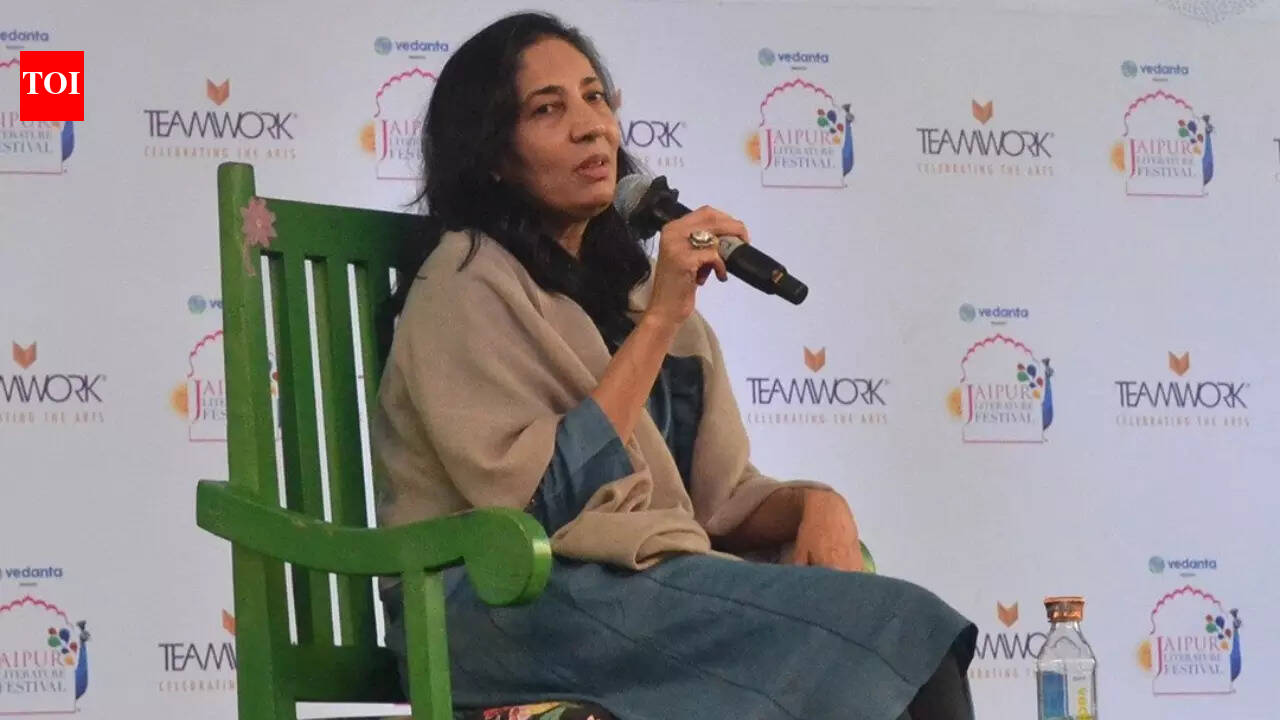

Indian American author Kiran Desai said the current moment in the United States may serve as a “wake-up call” and a “real lesson in empathy” for Indians, as fear around immigration hardened into daily life.Speaking in an exclusive interview with New India Abroad on the sidelines of the Kerala Literature Festival in Kozhikode on January 24, Desai said the atmosphere confronting immigrants should prompt deeper reflection within the diaspora.“I think a lot of the Indian diaspora was very concerned about a secular democracy being intact in the United States but was not so concerned about it in India,” she said. “So now I’m wondering if this is a bit of a wake up call, which would be a good thing. I mean, this may be a real lesson in empathy, I think.”Desai, whose novel ‘The Loneliness of Sonia and Sunny’ was recently shortlisted for the Booker Prize, said she found the present moment in the United States “very disconcerting” as immigration rhetoric hardened and fear entered daily life. She said her reflections were both personal and political, rooted in her long life in the US and her work as a writer shaped by movement across cultures. Desai, who lived for years in Jackson Heights, Queens, one of New York City’s most immigrant-dense neighbourhoods, said, “I experienced this hateful rhetoric against migration and as Zohran Mamdani said, you know, it’s a country made by immigrants, powered by immigrants and as he said, New York City is now a city led by an immigrant,” she said.From her apartment window, Desai said, the national debate felt immediate. “I could see a lot of that vibrancy subtracted and a lot of fear,” Desai said. “That is what disconcerts me the most is the entry of fear into the landscape because I know that when it comes to democracies that, you know, it’s sort of the beginning of the end when people are too scared to speak and are staying home and there’s an atmosphere of fear.”Desai cautioned against seeing the US in isolation, pointing to similar currents elsewhere. “There’s been a lot of anti-migrant, immigrant rhetoric in India too and a lot of fear here as well,” she said. “So one has to see it also in global perspective. It’s happening everywhere. It leaves migrants and minorities feeling very vulnerable and certainly the Indian diaspora too.”She said the sense of instability reshaped how immigrants understood both their adopted country and the one they left behind. “Then the ground sort of shifts under your feet, doesn’t it?” she said. “Because you think you’ve immigrated to a country and then all of a sudden you lose that little sense of belonging that you were beginning to develop.”Drawing on remarks she made earlier at the festival, Desai linked migration to the solitary labour of writing and agreed with the idea that both could unsettle identity. “I think the vocabularies overlap, you know, migration, translation, many perspectives, a sense of moral ambiguity, fluidity,” she said. “And migration and the artistic language also, you know, it’s very compatible.”She described a writer’s life as one of constant movement between worlds. “As an artist, you’re also constantly occupying different worlds,” Desai said. “So in a way, being an immigrant, it’s a wonderful thing to be both an immigrant and a writer.”“Loneliness, solitude is again very compatible to an artistic life,” she said. “And it’s also absolutely an essential part of the vocabulary of immigration and migration.”Asked about expectations placed on diaspora writers, Desai said pressure to simplify always existed. “People want that countries want a simple narrative,” she said. “They want one book on the shelf.”She cited the value of complexity and syncretism, referring to a line in her Booker-shortlisted novel: “in India, stories grow on trees.”She also said literary openness in the US was under strain. “That is also now a little bit under attack because books are being taken off the bookshelves, you know, as we know,” she said.Desai welcomed the emergence of younger political voices defending immigrants, including Zohran Mamdani. “Well, I’m so glad he’s young and has the confidence of youth and will speak out against Trump’s policies, will speak up for immigrants, minorities,” she said. “I mean, you know, there seems to be no respect for the immense amount of work immigrants do.”Looking around her neighbourhood, she said the reality was visible every night. “These are people who work all day and all night,” Desai said. “So I’m so proud and happy that we have somebody from our part of the world—in fact, half from our part of the world, half of it—who is speaking up for us.” Go to Source