
Image: Frontiers in Environmental Archaeology
High in the Spanish Pyrenees, at an altitude where steep slopes and rocky terrain still make access difficult today, archaeologists have been investigating a cave that appears to have drawn people back again and again over thousands of years. Known as Cova del Sardo, the site has yielded evidence of prehistoric expeditions, early copper mining activities, and a collection of puzzling artefacts that include green mineral stones and the tooth of a child. Individually, these finds may seem unremarkable. Together, however, they are helping researchers reconstruct a story that began around 5,500 years ago, when communities ventured into the mountains for reasons that are only now becoming clear.
A child’s tooth points to repeated visits deep inside the Pyrenees cave
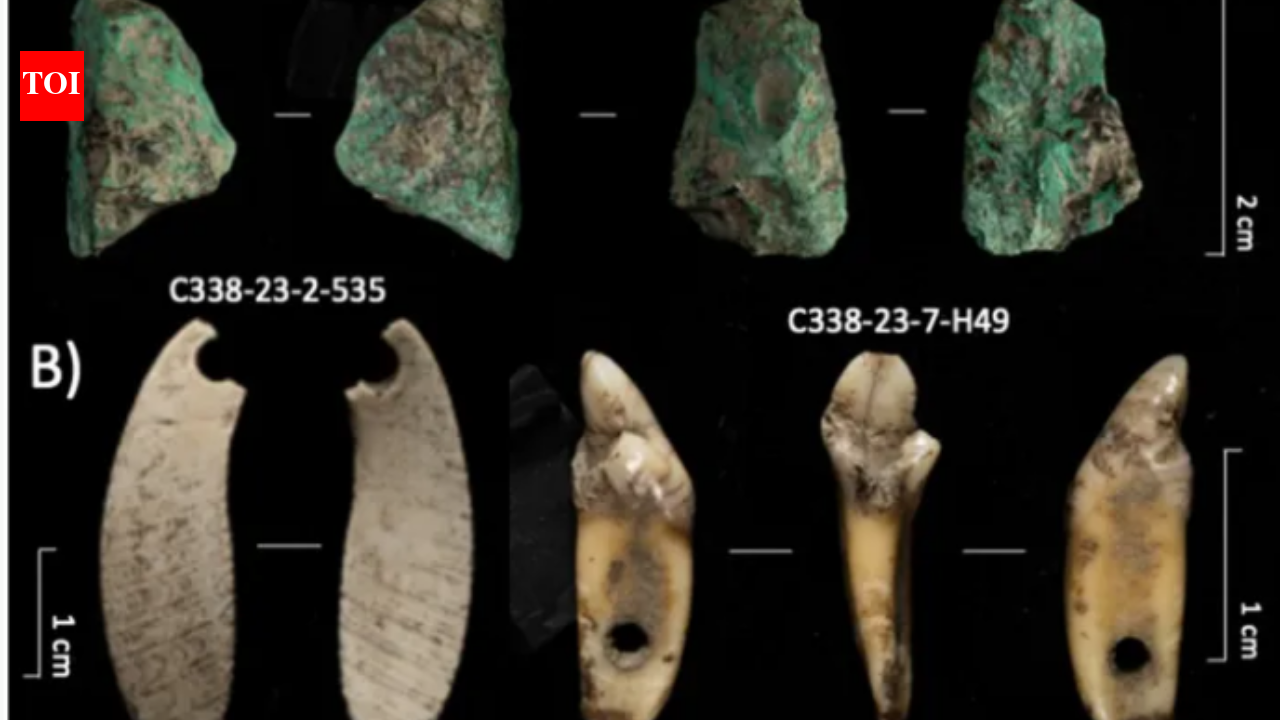
One of the most intriguing discoveries was a deciduous, or milk, tooth belonging to a child. Human remains are relatively rare at the site, making the find particularly significant.The tooth was not recovered from a formal burial. Instead, it appeared among evidence suggesting that different groups repeatedly entered the cave over centuries. Researchers believe the cave was more than a temporary shelter. The presence of human remains, however limited, raises the possibility that some parts of the cave may have held a symbolic or funerary importance that has yet to be fully understood. According to a 2026 study, ‘Beyond 2,000 meters, first evidence of intense prehistoric occupation in the Pyrenees’ in Frontiers in Environmental Archaeology, the archaeological record suggests intermittent human activity stretching across several prehistoric periods rather than a single occupation event.
Strange green stones reveal evidence of prehistoric copper mining
The cave also produced fragments of green-coloured minerals associated with copper deposits. These stones immediately attracted attention because they may represent some of the earliest evidence of copper prospecting or extraction in the region.Researchers identified traces of malachite and other copper-bearing minerals, materials that prehistoric communities would have recognised because of their distinctive green colour. While large-scale mining operations were still centuries away, the evidence suggests people were already exploring mountain environments in search of valuable resources.The study proposes that these mineral deposits may have been one reason groups repeatedly travelled into the high Pyrenees despite the challenges posed by the landscape.What makes the discovery particularly important is that it pushes back evidence for human engagement with copper resources in this part of the Iberian Peninsula.
Hidden burials could still lie undiscovered
The combination of a child’s tooth, isolated human remains, and unusual artefacts has led researchers to consider another possibility: that parts of the cave may contain undiscovered burial areas.The authors stop short of claiming that a cemetery exists within the cave. However, they note that the available evidence is consistent with activities that extended beyond resource extraction alone.Caves across prehistoric Europe often served multiple functions. They could act as shelters, ritual spaces, landmarks, burial places, or locations associated with valuable natural resources. Cova del Sardo may have fulfilled several of these roles at different times.
A mountain cave that still guards its secrets
What emerges from the research is not a story of a single event but of generations returning to the same remote location. Some may have come searching for copper-rich minerals. Others may have used the cave for activities that left only faint traces behind.A solitary child’s tooth and a handful of green stones are now helping archaeologists piece together those journeys. Yet many questions remain unanswered. Why did people continue climbing to this isolated cave? What drew them there repeatedly? And are there still undiscovered chambers holding evidence of burials or rituals hidden beneath the mountain?For now, the cave keeps some of its secrets. But with every excavation season, archaeologists move a little closer to understanding why this remote corner of the Pyrenees mattered so much to people living more than five millennia ago. Go to Source