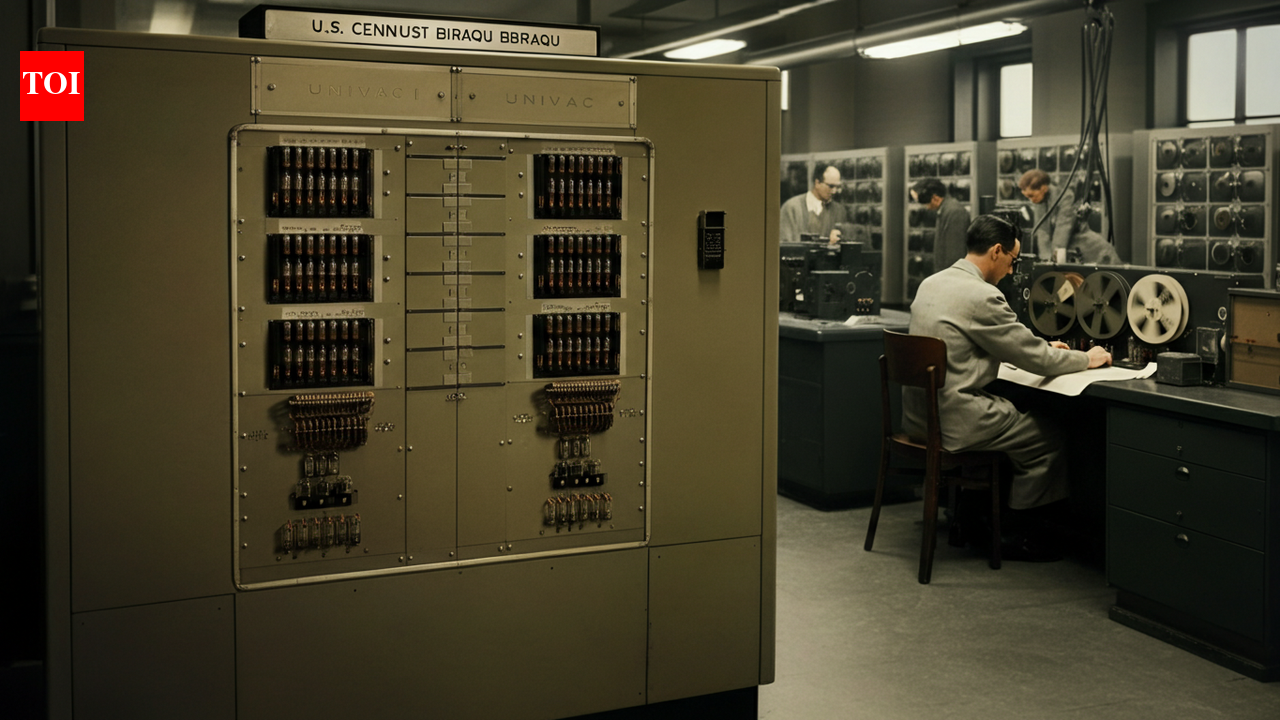

This year marks 75 years since one of the most important machines in computing history was switched on for the very first time. On June 14, 1951, the UNIVAC I, short for Universal Automatic Computer, was formally dedicated at the U.S. Census Bureau’s offices, just months after the agency had signed a contract for the machine on March 31, 1951. Built by the same engineers behind the wartime ENIAC, UNIVAC I was the first computer in America designed and sold for commercial, non-military use. It would go on to become a household name, famously predicting a US presidential election on live television. Here’s a look back at the machine that helped kick off the modern computing era.
What was UNIVAC I, the world’s first commercial computer
For decades before UNIVAC I arrived, the U.S. Census Bureau had relied on updated versions of Herman Hollerith’s 1890 electric counting machines to process census data, all the way through the 1940 census. While these machines could tabulate punch cards faster than counting by hand, they were nowhere near capable of handling the growing volume of data the Bureau dealt with every decade.That changed during World War II, when the War Department began exploring electronic digital computers to process ballistic calculations, work that eventually led to the construction of ENIAC in 1946. The engineers behind ENIAC quickly realised their creation had peacetime potential too. According to the Census Bureau, this realisation eventually led to UNIVAC, effectively an updated version of ENIAC, designed specifically for tabulating large amounts of business and administrative data rather than complex scientific calculations.Unlike ENIAC, UNIVAC was built from the ground up as a commercial product, one that any government agency or large company could, in theory, purchase and put to use. The finished computer was a massive piece of engineering, filling an entire room and requiring a dedicated cooling system to manage the heat generated by its thousands of internal components.
How Eckert and Mauchly built UNIVAC I for the US Census Bureau
UNIVAC I was designed by J. Presper Eckert and John Mauchly, the same engineering duo responsible for ENIAC. During the ENIAC project, Mauchly held discussions with Census Bureau officials about possible non-military uses for electronic computers. In 1946, the pair secured a study contract from the National Bureau of Standards to explore what a computer built specifically for the Census Bureau might look like, work that eventually produced the specifications for the Universal Automatic Computer.Construction took several years, and according to the Computer History Museum, the finished machine was built around plug-in modules, with twelve chassis mounted in each section, three sections forming a bay, and thirteen bays making up the sides of the central computer. Alongside the main unit, Eckert and Mauchly introduced the Uniservo magnetic tape drive, the first tape drive built for a commercially sold computer, which could read and write data roughly ten times faster than the punch-card systems it was meant to replace.The finished UNIVAC I passed its Census Bureau tests in 1951, with one official later testifying that the machine had never been found to be in error.
UNIVAC I’s famous 1952 election prediction made computers a household name
UNIVAC I might have remained a niche government tool if not for a single night in November 1952. For the presidential election between Dwight D. Eisenhower and Adlai Stevenson, the television network CBS borrowed a UNIVAC I unit, the fifth ever built and originally constructed for the U.S. Atomic Energy Commission, and used it to predict the result live on air.According to the Computer History Museum, opinion polls at the time favoured Stevenson, but UNIVAC’s early calculations pointed firmly toward an Eisenhower landslide. CBS initially hesitated to broadcast such a lopsided prediction and asked engineers to double-check the numbers. By the end of the night, the original prediction turned out to be essentially correct, and Eisenhower won in a landslide.The broadcast was a turning point for public awareness of computing. For the first time, millions of ordinary Americans watched an “electronic brain” make sense of real-world data on live television, and the name UNIVAC briefly became a generic term many people used for any computer at all.
The legacy of UNIVAC I, 75 years on
UNIVAC I’s success at the Census Bureau also led to other innovations. To speed up data processing, which was still bottlenecked by punch cards, scientists from the National Bureau of Standards and engineers at the Census Bureau developed FOSDIC, the Film Optical Sensing Device for Input to Computers, completed in 1954. According to the Census Bureau, FOSDIC could read pencil-filled circles on questionnaires and convert them directly into computer-readable data stored on magnetic tape, and was first used for a full decennial census in 1960.Over the following years, dozens of UNIVAC systems were installed across government and industry, with the last units remaining in operation into the 1970s. While the machines themselves have long since been retired, their basic ideas, stored programs, magnetic tape storage, and computers built for everyday business tasks rather than just scientific research, remain at the heart of how computers work today.Seventy-five years on from its dedication, UNIVAC I is remembered not just as a piece of hardware, but as the moment computing stopped being a wartime experiment and became part of ordinary public and administrative life, a reminder that many of the conveniences taken for granted today trace their roots back to a single machine switched on three-quarters of a century ago. Go to Source