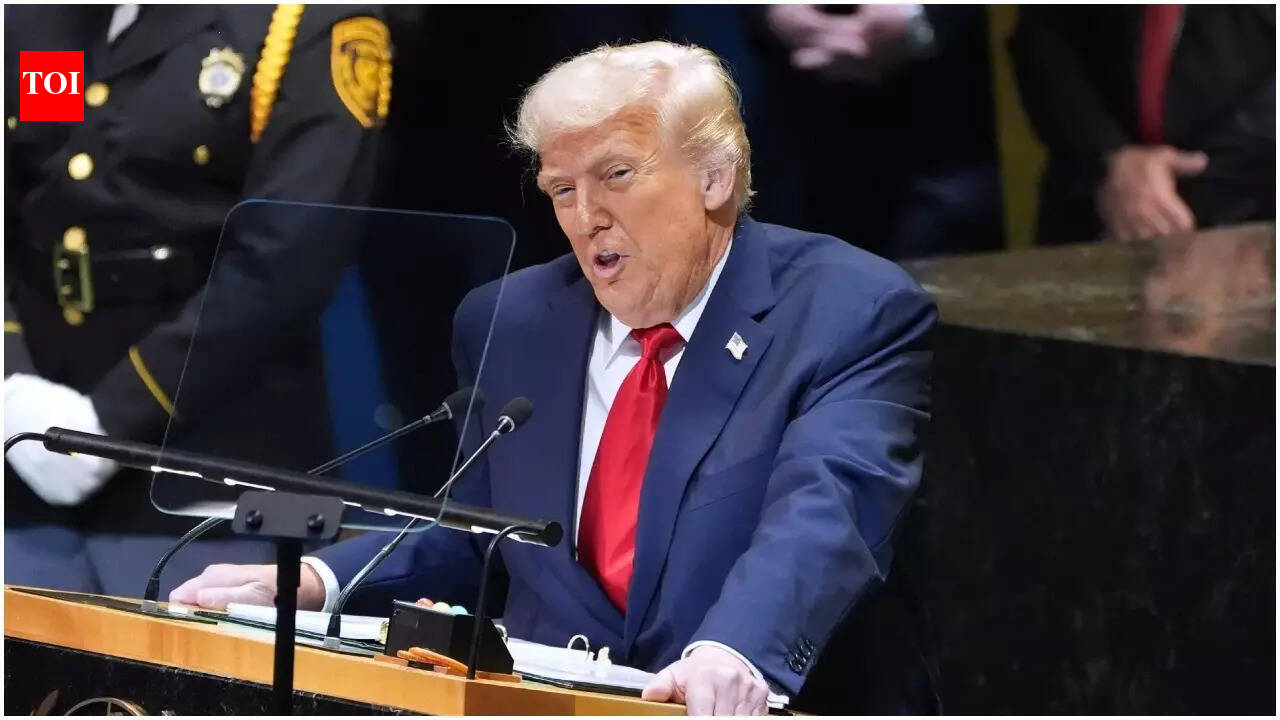

A Carnegie survey found that 71 percent of Indian Americans disapproved of how Donald Trump handled his overall job as President in his second term.The 2026 Indian American Attitudes Survey (IAAS), conducted in partnership with YouGov, found that only 29 percent of the 1,000 Indian American adults surveyed strongly or somewhat approved of how Trump handled his job as President, New India Abroad reported.The findings, when compared to data from a nationwide YouGov poll from Dec. 2025, revealed that Indian Americans were substantially more critical of Trump than the overall US population.The report came one year into President Donald Trump’s second term and found that the community was reassessing its political and social position amid tensions in US-India relations, domestic policy shifts, and rising reports of online hate speech targeting the community.Large majorities also disapproved of Trump’s handling of key policy areas. The survey found that 64 percent disapproved of his immigration policy, 68 percent disapproved of his handling of the domestic economy, and 70 percent disapproved of his international economic policy, including trade and tariffs. In many cases, respondents expressed strong disapproval rather than mild opposition.Evaluations of his management of US-India relations were also negative. Fifty-five percent disapproved of Trump’s approach to relations with India, 20 percent approved, and roughly one-quarter reported no opinion, suggesting limited foreign policy salience in electoral decision-making.Indian Americans continued to identify disproportionately with the Democratic Party, but attachment weakened since 2020. Democratic identification declined to 46 percent, while Republican affiliation increased modestly to 19 percent. Independents accounted for 29 percent of respondents. Ideologically, 32 percent identified as moderates, the largest single bloc, placing the community largely at the centre of the political spectrum.Economic issues dominated policy priorities. Twenty-one percent cited inflation and prices as their most important issue, followed by jobs and the economy at 17 percent. Health care and immigration were the only other issues registering in double digits, while foreign policy concerns remained comparatively low.Experiences of bias remained widespread. Twenty-seven percent believed Indian Americans faced “a lot” of discrimination in the United States. About half reported having personally experienced discrimination in recent years, most commonly based on skin colour, country of origin, or religion. Since the start of 2025, one in four respondents reported being called a slur.Respondents also reported frequent exposure to online racism, with nearly half saying they encountered anti-Indian content on social media regularly. Nearly one-third said discrimination concerns led them to avoid political discussions online, and roughly one-fifth reported modifying travel, public expression, or civic participation out of fear of harassment. However, the share reporting direct, personal experiences of discrimination did not significantly change compared to prior survey waves.Many respondents said discrimination altered how they spoke, lived, or participated in public life, though most did not plan to leave the United States. While 14 percent said they frequently considered relocating abroad, a majority continued to recommend the country for employment, reflecting continued belief in economic opportunity.The survey also found that reactions to symbolic political events reflected ideological divides more than identity-based solidarity. Sixty-eight percent expressed enthusiasm for New York City Mayor Zohran Mamdani’s election, largely on ideological grounds. Public remarks by Vice President JD Vance regarding religion and marriage drew negative responses linked to concerns about religious inclusion and representation.Collectively, the findings indicated that one year into Trump’s second term, anxieties about discrimination and the shifting political environment coexisted with continued belief in opportunity in the United States.The full study was fielded between Nov. 25, 2025, and Jan. 6, 2026, and had a margin of error of ±3.6 percent.The report, authored by Sumitra Badrinathan of American University, Devesh Kapur of Johns Hopkins-SAIS, Andy Robaina of Carnegie Endowment for International Peace, and Milan Vaishnav of Carnegie Endowment for International Peace, built on earlier IAAS waves conducted in 2020 and 2024 and examined partisan identity, vote preferences, policy priorities, evaluations of political leaders, and experiences with discrimination. Go to Source