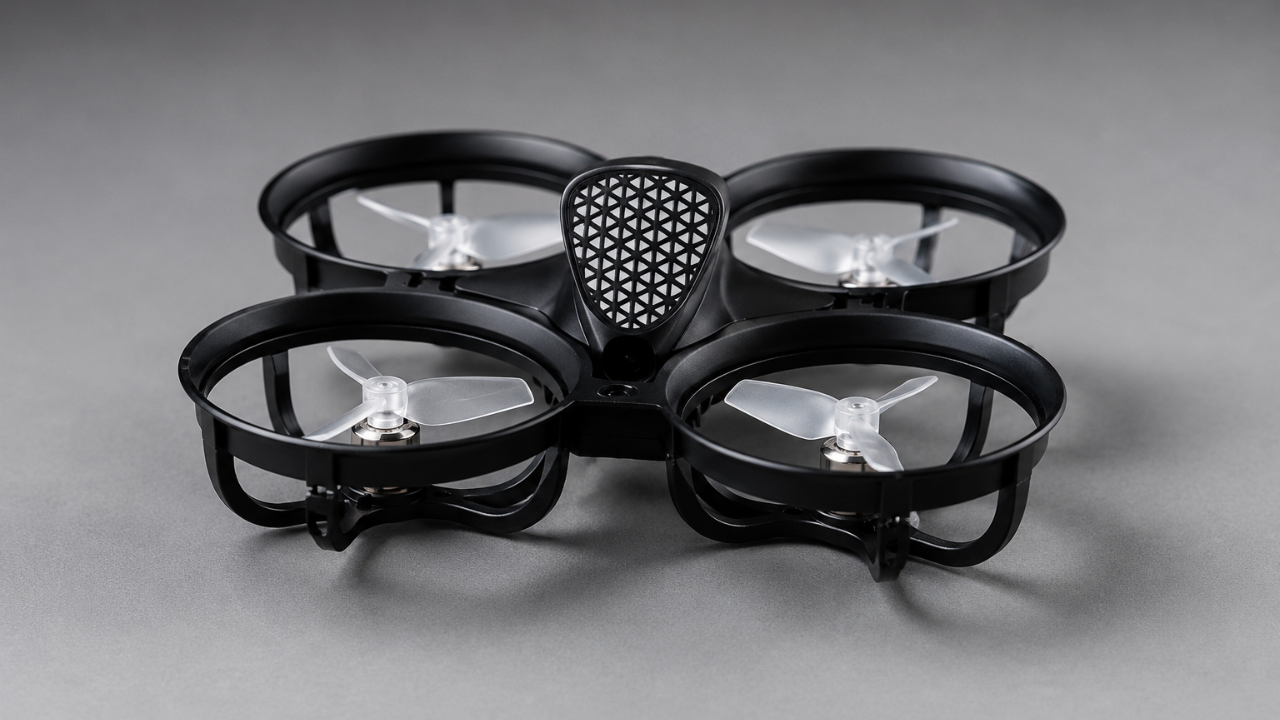

A palm-sized AI drone weighing just 40 grams has achieved an engineering first by autonomously hunting and killing a flying insect in mid-air, paving the way for a new approach to mosquito control. Developed by US startup Tornyol, the tiny drone successfully detected, tracked and intercepted a flying moth during a controlled indoor demonstration without direct human control. The milestone represents an early step towards the company’s ambitious goal of deploying autonomous drones capable of hunting mosquitoes, which spread deadly diseases such as malaria, dengue and Zika. While the technology is still in its experimental stage, its creators believe it could eventually provide a chemical-free way to reduce mosquito populations and help save hundreds of thousands of lives every year.
How the tiny drone achieved the first autonomous mid-air insect kill
The demonstration involved a palm-sized quadcopter weighing only 40 grams. After detecting a flying moth, the drone automatically tracked its movement, adjusted its flight path and intercepted the insect in mid-air without manual piloting. Tornyol says this is the first successful autonomous airborne insect interception by a micro-drone.The test, however, was conducted indoors using a hardware-in-the-loop setup. External motion capture cameras tracked the drone while an offboard computer processed much of the flight data before transmitting commands back to the aircraft. The company says future versions will carry out all sensing and computing onboard.Instead of relying mainly on cameras, Tornyol’s drone uses ultrasonic sonar similar to the sensors found in vehicle parking systems. It emits ultrasonic waves and listens for echoes reflected from flying insects.The system also combines miniature microphones with custom software to analyse subtle Doppler shifts produced by insect wingbeats. According to the company, these unique wingbeat signatures allow the drone to detect and track tiny insects that would be difficult to identify using conventional vision systems alone.
The goal is to identify and target mosquitoes
Tornyol says its technology is designed to recognise mosquitoes by analysing their distinctive wingbeat frequencies. The company believes the system could eventually distinguish mosquitoes from harmless insects and may even be able to differentiate between mosquito species and sexes.These capabilities are still under development and have not yet been independently validated through peer-reviewed scientific studies. The recent demonstration involved a moth rather than a mosquito, making it an important proof of concept rather than a completed mosquito-control solution.
Eliminating mosquitoes
Mosquitoes are responsible for spreading some of the world’s deadliest diseases, including malaria, dengue, yellow fever, chikungunya and Zika. According to the World Health Organization, malaria alone caused an estimated 610,000 deaths in 2024, with children under five accounting for a significant proportion of fatalities.Because conventional mosquito control often depends on chemical insecticides, researchers worldwide continue exploring alternative methods that are more targeted and environmentally friendly. Autonomous drones could become one such option if they prove effective outside laboratory conditions.
Tornyol’s vision for autonomous mosquito-hunting fleets
The startup envisions networks of autonomous drones operating from compact charging stations installed around homes, parks and neighbourhoods. The drones would continuously patrol designated areas, detect mosquito wingbeats, intercept the insects and return automatically to recharge when needed.Tornyol claims the technology could reduce mosquito-control costs by as much as 100 times compared with existing methods. It also estimates that around 10 drones could protect one square kilometre. These figures are company projections and have not yet been demonstrated in real-world deployments.
Challenges before the technology can become reality
Although the demonstration marks a significant engineering milestone, several obstacles remain before autonomous mosquito-hunting drones become practical. Mosquitoes are much smaller and faster than moths, making them considerably harder to detect and intercept, particularly in windy outdoor environments.Battery life, onboard processing power, collision avoidance and highly accurate species identification must also improve before large-scale deployment becomes feasible. For now, the successful mid-air interception represents an encouraging proof of concept that showcases how advances in robotics and artificial intelligence could reshape mosquito control in the future, rather than evidence that mosquito eradication is imminent. Go to Source