


There are bad stoner movies, good stoner movies, and elite stoner movies. Harold and Kumar go to White Castle firmly falls in the third category, the first proper coming-of-age movies that shows that second-generation Asian-Americans are just as assimilated as other races and have the same American dream: getting high, meeting girls, and binging on hamburgers. What set Harold and Kumar apart, was that it showed that the Asian experience wasn’t that different from the American one, epitomised by the scene where Kumar explains to Harold – while urging him to paraglide to a White Castle outlet – that their immigrant parents had come here because they were hungry, providing an adequate noughties update to the American dream. For a long time, Indian-Americans believed their story was headed there too. Not to White Castle specifically, but to a sort of ‘white castle’: where you are so integrated and assimilated that you are considered a beacon of society, an upstanding member of the Shining City on the Top of The Hill. A place where your faith was acceptable as all the other faiths that existed in the American tapestry.
And then one Hanuman statue in Texas shattered that carefully crafted delusion. The statue built on private land, became a reminder that America’s promise of welcome often frays the moment difference stops being discreet. Even as Vande Mataram and The Star-Spangled Banner played on temple grounds, conservative Christian protesters gathered outside, denouncing Hanuman as a “demon god”. One local politician asked publicly: “Why are we allowing a false statue of a false Hindu God to be here in Texas? We are a CHRISTIAN nation.”Srinivasachary Tamirisa, a doctor who spent decades practising in the United States and quietly supported the statue project for more than twenty-five years, told the New York Times that he once viewed the country as a kind of promised land. When confronted by protesters, he said he tried to explain the figure they were objecting to. To him, Hanuman was not a demonic symbol but a spiritual guide, one meant to convey courage rather than fear.For the uninitiated, Lord Hanuman is not a god of domination or conquest. In Hindu tradition, he is the embodiment of strength governed by humility, power exercised in service rather than rule. He is the devoted follower of Vishnu in his incarnation as Lord Rama, remembered less for authority than for loyalty, courage, and self-restraint. The Hanuman Chalisa, recited daily by millions, is not a hymn of supremacy but of reassurance, invoking fearlessness, discipline, and moral clarity in moments of doubt.But what perhaps the disquiet that has been bothering Indian-Americans isn’t the protest. America has always had its fair share of protesters, a right enshrined in First Amendment. The tragedy was the timing which neatly folded into the rise of anti-Indian sentiment: online and offline, often juxtaposed with gleeful Hinduphobia.Read: The rise of anti-India hate online Just when Indians thought they were in, the newest adherents promising to make America great have been mainstreaming anti-Indian sentiment. To put it frankly, this wasn’t how it was supposed to be.
“Gas, beds and meds”
There is a comedian’s line that captures the Indian-American arc with more accuracy than any novel or academic paper. Nimesh Patel, a stand-up comic who was the first Indian-American to write for Saturday Night Live, explained how Indians had spent time looking at Americans and surmised: “They like to sleep, they like to eat, they like to drive. So they’re going to need gas stations, motels and cardiologists. Gas, beds and meds, baby.”So Indian-Americans arrived to fill the gap by becoming doctors, motel owners, convenience store operators, and more. Gas, beds and meds. A pithy line to explain the early immigrant experience. And Americans were very happy to accept these foreigners who fulfilled their basic needs handing them a funny accent and a recurring role in sitcoms. The Indian immigrant was perfectly welcome till he stayed inside the deal, as long as he remained industrious, grateful and most importantly socially quiet. As long as they remained a model minority who didn’t make too much noise, didn’t commit crimes and didn’t voice its displeasure too loudly. All that was set to change.
ABCD: American-Born Confident Desi
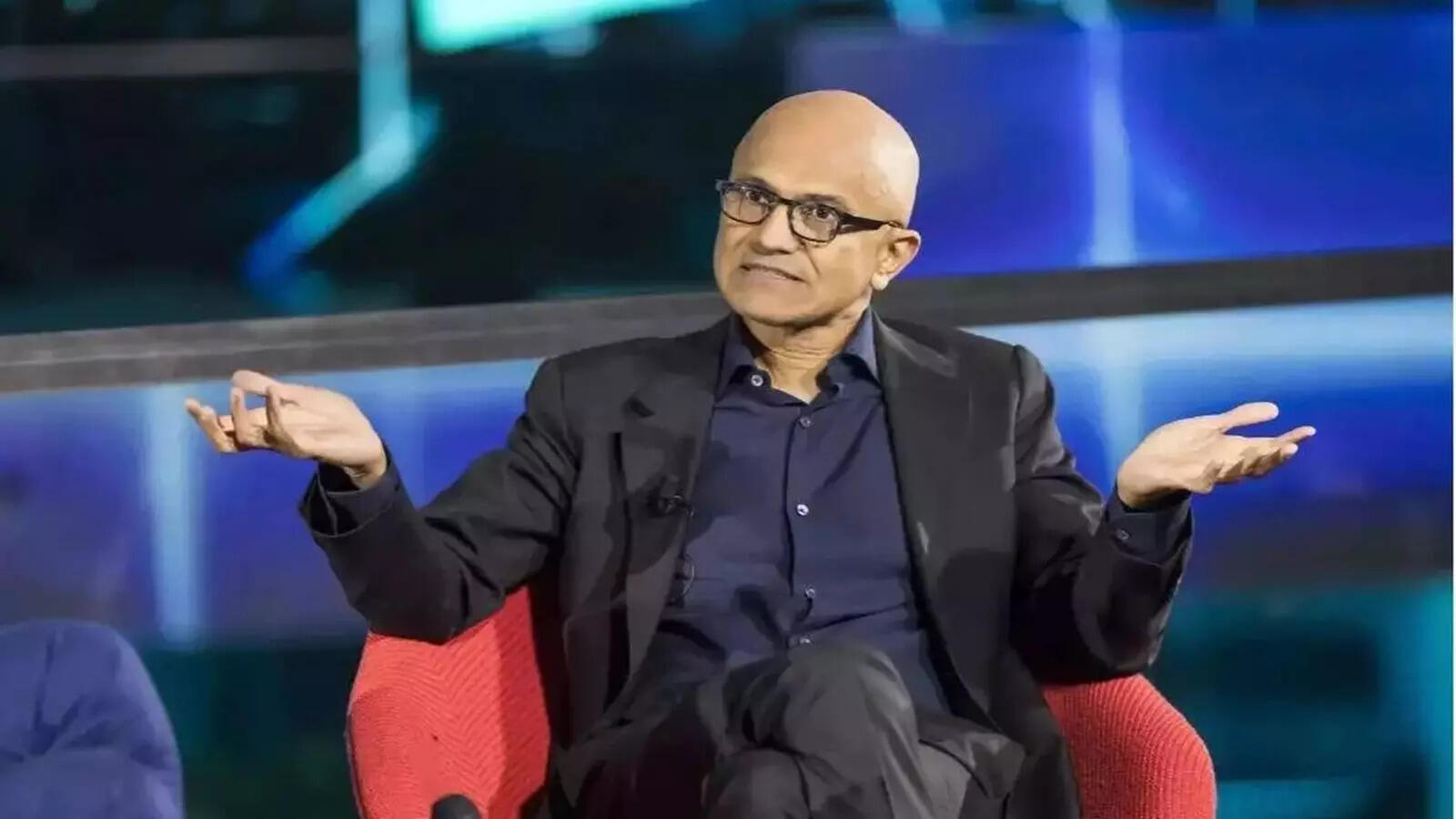
The second generation did not assimilate quietly. By the late 2010s, Indian-Americans were no longer clustered in a handful of “safe” professions. They were everywhere power accumulated.Technology was the most obvious arena. Satya Nadella at Microsoft and Sundar Pichai at Google were no longer immigrant success stories wheeled out to reassure America about diversity. They were the system itself. Shantanu Narayen at Adobe and Arvind Krishna at IBM reinforced the same quiet shock.Indians were no longer helping America run. They were deciding how it ran, or were deeply embedded in the operating systems that ran it.The spread did not stop at Silicon Valley.In science and academia, Indian-Americans occupied intellectual ground that did not require translation or apology. Venkatraman Ramakrishnan and Manjul Bhargava were not decorative achievements in a diversity brochure. They represented authority in the deepest traditions of Western knowledge. In engineering, Ajay V. Bhatt quietly underpinned everyday modern life. Nothing dramatic. Just infrastructure.Business followed the same arc. Entrepreneurs like Jay Chaudhry were no longer framed as immigrant hustlers. They were founders building companies central to American cybersecurity and defence. The Indian-American presence stopped being anecdotal. It became structural.Culture, too, shifted tone. Hasan Minhaj, Aziz Ansari, and Mindy Kaling did not explain Indianness to America. They assumed it. Their work treated Indian-American identity as an unremarkable fact of life, not an obstacle to be overcome. Representation stopped asking for permission.This should have been a celebratory moment in the immigrant imagination. Proof that quiet diligence eventually leads to acceptance.

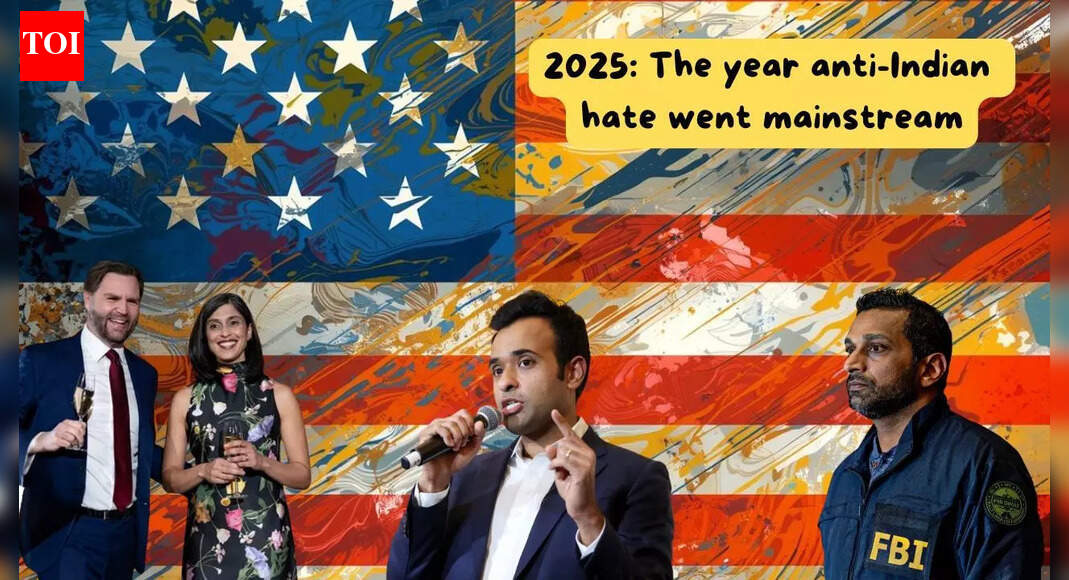
Instead, it became uniquely combustible. Because Indian success no longer looked like contribution. It looked like consolidation. And consolidation, when performed by a group long expected to remain grateful and invisible, unsettles even confident societies.By 2024, that unease could no longer be contained within boardrooms or culture pages. It spilled into politics.The US presidential election became the most India-coded contest in modern memory, with people joking that it was a Telugu–Tamil tussle between Second Lady–in-waiting Usha Vance (Telugu) and Kamala Harris (Tamil).During the GOP debates, Vivek Ramaswamy tangled with Nikki Haley, two Indian-American Republicans of different vintages. JD Vance, whom Donald Trump picked as his running mate, even waxed lyrical about how his wife’s parents’ Hindu faith helped him find Christ again. Trump went out of his way to court Indian-American and Hindu voters, wishing them Happy Diwali and promising to protect Hindu-Americans from the “radical Left”, a line often linked to California’s caste discrimination bill, which was ultimately vetoed by Governor Gavin Newsom. Some claimed the decision to veto the bill came directly from the White House while Kamala Harris was vice president.Meanwhile, the Indian-American contingent around the White House grew. Tulsi Gabbard, often considered an honorary Indian, was made head of the Office of the Director of National Intelligence. Kash Patel became chief of the Federal Bureau of Investigation. Jay Bhattacharya was appointed director of the National Institutes of Health. Vivek Ramaswamy was brought in to spearhead Trump’s government-efficiency push. Harmeet Dhillon joined the Justice Department in a senior civil rights role. Sriram Krishnan emerged as a key White House voice on AI. S. Paul Kapur took charge of South and Central Asia at the State Department. A younger cohort, including Kush Desai and Ricky Gill, filled out the administration’s communications and national security benches.Across the aisle, Zohran Mamdani led a remarkable underdog campaign to emerge as New York’s mayor-elect, beating the likes of Andrew Cuomo and Eric Adams. It appeared that Indian-Americans were no longer power-adjacent. They were calling the shots.
The Hate Machine
What changed was not Indian behaviour. It was American permission. For years, resentment towards Indian-Americans existed as background static. It surfaced as jokes about accents, casual remarks about outsourcing, the quiet assumption that Indians were useful but culturally odd. What has changed since 2023–24 is scale and legitimacy. Hostility has been systematised. It now moves fluidly between online ecosystems, mainstream media commentary, campaign rhetoric, and offline intimidation. What once lived at the edges has been invited in.
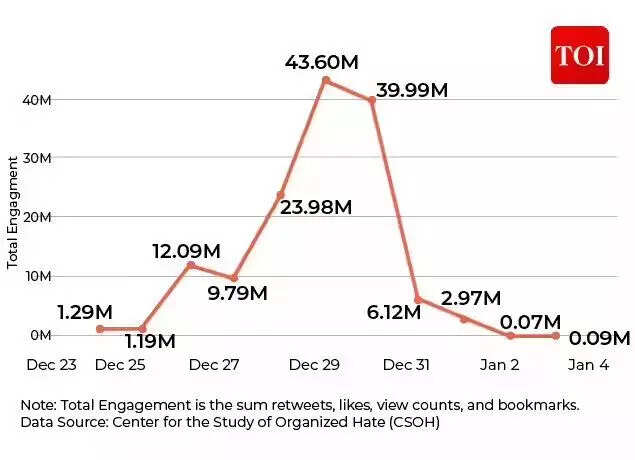
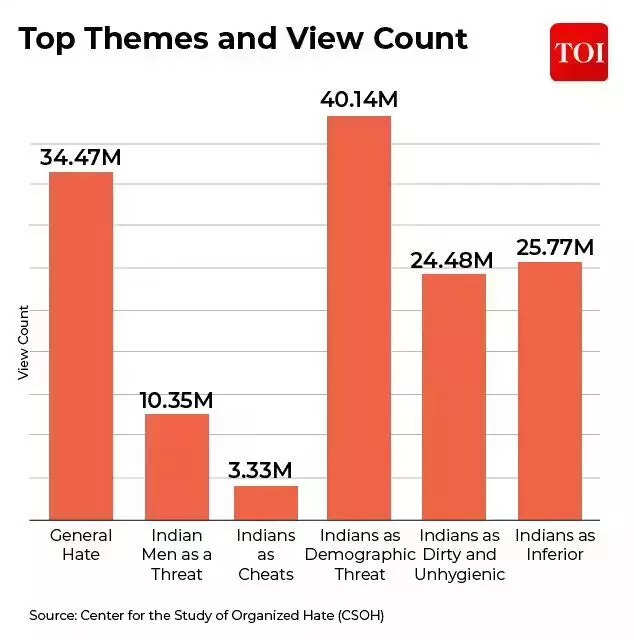
The most comprehensive documentation of this shift comes from the Center for the Study of Organized Hate (CSOH), whose report showed how anti-Indian and anti-Hindu narratives exploded across social platforms before spilling into real-world consequences. The study tracked 128 high-impact posts attacking Indians and Hindu identity over a short window, accumulating more than 138 million views. The numbers matter less than the pattern. Online rhetoric primes offline behaviour. Contempt becomes consensus. Consensus becomes action.The CSOH report shows that Hinduism is no longer treated merely as a religion in these narratives. It is reframed as an ideology, a civilisational threat, something incompatible with American identity. Indians are no longer just immigrants or professionals. They are recoded as infiltrators, beneficiaries of unfair systems, demographic threats hiding behind legality. That framing explains why symbolic flashpoints now trigger disproportionate outrage.
The backlash against the Hanuman statue in Sugar Land, Texas was not really about zoning laws or religious neutrality. It was about visibility. A Hindu god that refused to stay private. A faith that declined to remain ornamental. When a Republican Senate candidate publicly dismissed Hanuman as a “false Hindu god” and declared America a Christian nation, it was not an outlier moment. It was the logical endpoint of months of narrative conditioning.On the right, this hostility increasingly flows from Trump-era ideological infrastructure. Immigration debates have shifted from illegality to legality itself. High-skilled migration is no longer framed as economic policy but as demographic subversion. Figures like Stephen Miller have repeatedly argued that legal immigration is a loophole exploited to change America from within. Indians, because they arrive legally, in large numbers, and into elite professions, become uniquely convenient targets.
That language filters down
Far-right provocateurs like Nick Fuentes make the subtext explicit. Fuentes has attacked Vivek Ramaswamy for his Hindu faith, telling him to “go back to India”. He has also targeted JD Vance, mocking him for hosting a “traditional Indian dinner” and telling him to “eat shit” for what Fuentes framed as civilisational betrayal. The target was not policy. It was cultural permission. Who gets to belong, and on what terms.What makes this moment distinct is that the hostility does not remain quarantined on the fringe. It circulates upward.On the liberal side, the same permission structure manifests differently. Hindu identity is collapsed into caricature. Indian success is reframed as proximity to power. Hinduphobia is expressed through irony, mockery, and “analysis”. The Joy Reid episode captured this perfectly. When Reid speculated on air that Republicans could not accept a successor with a “brown Hindu wife”, before fantasising about a “white queen” replacement, she was not critiquing racism. She was reproducing it, using Hindu identity as a punchline. The fact that this passed largely without consequence speaks volumes.This is where Usha Vance becomes central to the story. Her elevation to Second Lady should have been unremarkable. Instead, her Hindu faith became something to be managed, joked about, explained away. Across the spectrum, reassurance carried an undertone of discomfort. Faith, when Christian, is tradition. Faith, when Hindu, is complication. The CSOH report makes clear that this dual hostility is not accidental. Indians and Hindus now occupy an uncomfortable position. Too successful to be ignored. Too visible to remain ornamental. Too assimilated to be dismissed as outsiders. And not yet protected by the reflexive moral guardrails that trigger immediate outrage for others.This is how the hate machine works. Not through a single ideology, but through convergence. Different vocabularies. Same permission.
What defines an American
This is where the argument inevitably lands. Not on immigration policy or social media outrage, but on the older, unresolved question that America has never quite settled. Who gets to be American, and on what terms.For much of the late twentieth century, the answer appeared settled. Ronald Reagan liked to say that while you could live in France or Japan without ever becoming French or Japanese, anyone from any corner of the world could come to America and become an American. It was a civic definition, expansive and reassuring, and it allowed the country to absorb wave after wave of newcomers without interrogating bloodlines. Belief mattered more than ancestry. Allegiance more than origin. The hate machine described above feeds on the erosion of that consensus. In recent years, conservative debates have drifted back towards inheritance, towards what is often described — sometimes openly — as Mayflower logic. The idea that Americanness is not simply a creed but a legacy, something passed down rather than opted into. That turn became visible in the Trump era and hardened by 2024.JD Vance has argued that America is not merely an idea but a people shaped by history, religion, and culture. It is a claim that sounds descriptive but functions as a gate. It asks not only what you believe, but where you come from, who came before you, and how comfortably you fit into a civilisational story.It is against this backdrop that Vivek Ramaswamy’s interventions at conservative gatherings like Turning Point USA became so charged. Ramaswamy insisted that Americanness is binary, not hierarchical. That no citizen is more American than another. That the Constitution does not recognise first-class and second-class belonging. When a Hindu son of immigrants has to defend civic nationalism to a movement increasingly nostalgic for inherited identity, the tension becomes impossible to ignore.The scrutiny surrounding Usha Vance makes the same point more quietly. Her presence at the centre of power has been treated not as routine, but as something that needs explanation. Her faith, her background, her marriage have been discussed in ways that suggest belonging is still conditional, still subject to review.This is why the hate machine matters. It is not merely about prejudice or online abuse. It is about a country renegotiating the boundaries of itself, and doing so at the precise moment when Indian-Americans, long convinced that assimilation was enough, discover that the definition of American is once again up for debate.
The White Castle dream
None of this is unique to Indian-Americans. That is the uncomfortable truth beneath the outrage.Every group that has passed through America’s gates has been told, at some point, that it has overstayed its welcome. Irish Catholics were once warned that their churches threatened Protestant civilisation. Jews were caricatured as alien elites who controlled finance and corrupted culture. Italians were dismissed as criminals, Chinese migrants as contaminants, Japanese-Americans as permanent suspects. Each wave was tolerated for its labour and distrusted for its difference. Each was told, in different ways, that assimilation was conditional.The White Castle dream was never a guarantee. It was a hope.Indian-Americans believed, perhaps longer than most, that utility would buy permanence. That if you studied hard enough, worked long enough, stayed legal enough, success would eventually dissolve suspicion. That you would arrive at the point where your presence no longer needed justification. Where you could be ordinary. Where you could waste time.What the last few years have revealed is not that Indian-Americans are uniquely targeted, but that they have finally reached the stage every visible minority reaches: the point where success itself becomes the provocation.
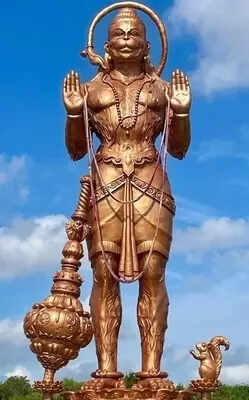
This is why the Hanuman statue matters, and why it unsettled people far more than its defenders expected.Hanuman is not a god of conquest. He is not a god of domination. In Indian tradition, he is the embodiment of strength without arrogance, devotion without spectacle, power held in service rather than display. He is remembered not for ruling kingdoms but for carrying mountains, crossing oceans, and choosing humility over triumph. Hanuman kneels even when he is invincible. He exists to remind power of its duty.For generations, Hindu practice in America mirrored that ethos. Discreet. Contained. Basements and borrowed halls. Faith folded neatly into private life so as not to make anyone uncomfortable. Hanuman was worshipped quietly, kept small, kept safe.A 90-foot statue breaks that grammar.It was a visible reminder – at least to the more rabid adherents of MAGA – that there was an immigrant who wasn’t being polite. And that, more than theology, is what triggered the backlash. The discomfort was not about idolatry or zoning laws. It was about the collapse of an unspoken rule: you may belong here, but only if you remain invisible.The White Castle dream was never about hamburgers. It was about the promise that one day you would not have to perform gratitude or manage your difference. That your faith, your culture, your presence would not be treated as an interruption.What the Hanuman moment reveals is that Indian-Americans are discovering, late and painfully, what every other group eventually learns. Acceptance is not a destination you reach by working harder. It is a condition that must be defended once visibility arrives. And visibility, once achieved, cannot be put back in the basement. Go to Source