
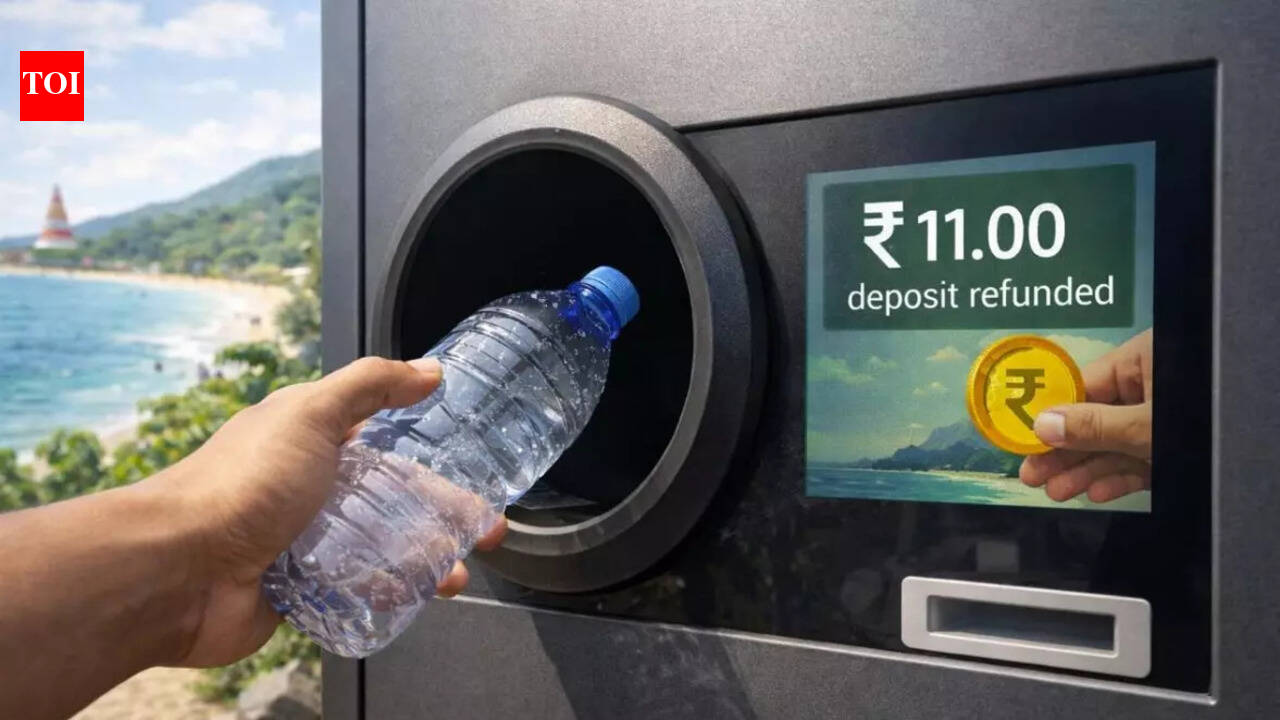


Some of India’s most intense waste loads are generated where people do not live. They are generated where people visit. (Image used for representational purpose)
NEW DELHI: India’s waste problem does not grow slowly. It arrives suddenly. It shows up on long weekends, festival seasons, school holidays, and tourist peaks. Beaches fill up. Hill stations overflow. Pilgrimage towns strain. And almost overnight, public spaces begin to look different with more bottles, more wrappers, more litter in places meant to stay clean. This is not accidental. It is structural. India’s waste systems are designed around households. Door-to-door collection, scheduled pickups, all of it assumes that waste is generated where people live. But some of India’s most intense waste loads are generated where people do not live. They are generated where people visit. Beverage containers are consumed on the move. A bottle bought on a beach, a highway, or a market street is often discarded minutes later, far from any formal collection point. Once it enters public space, it is much harder to recover cleanly. Drains, waterways, forests, and roadside edges become the default endpoints. This is why tourist-heavy states face a different kind of pressure. A floating population generates waste, but does not stay long enough to be captured by household-style systems. The waste is scattered, time-bound, and highly visible. Goa makes this imbalance impossible to ignore. The state has a resident population of about 15 lakh, yet recorded approximately 1.08 crore tourist visits in 2025. That means far more people consuming beverages in public spaces than private ones. Beaches, leisure zones, highways, and markets absorb waste loads that were never meant to be managed like residential neighbourhoods. A comparable pressure plays out in the Himalayan tourism belt. Himachal Pradesh, with a resident population of 6,864,602 (2011 Census), recorded approximately 1.80 crore tourist visits in 2024. Hill towns, pilgrimage routes such as the Manimahesh Yatra corridor, forested valleys, and highway stretches see brisk consumption of packaged products during peak seasons, and their disposal often outpaces the reach of routine collection systems. In both cases, this is where the question shifts. Not “How do we clean more?” But “How do we stop waste from becoming litter in the first place?” That question has pushed attention toward the Deposit Refund Scheme, which intervenes at the moment of disposal rather than after accumulation. Deposit Refund Schemes operate on a straightforward principle. A small, fully refundable deposit is added to the price of a beverage container or packaged product. When the empty container is returned, the deposit is refunded. The container stops being disposable and becomes something worth retrieving. Behavioural economics explains why this mechanism works. People are far more motivated to avoid losing money than to comply with abstract rules. A refundable deposit creates immediate relevance at the point of disposal. The decision to discard is no longer neutral; it carries a cost. Global experience shows how consistently this logic holds. Countries with long-running deposit systems report some of the highest beverage container recovery rates in the world. Germany reports return rates of around 98 per cent. Norway and Lithuania crossed 90 per cent within a few years of implementation. The common factor across jurisdictions is not stricter enforcement, but the presence of value. For tourism-driven regions, one design feature matters more than any other: the refund is not limited to the original buyer. Anyone who returns the container receives the deposit. This is critical in high-mobility settings, where the person who consumes a product may not be the one who disposes of it responsibly. Even if a tourist leaves a bottle behind, it does not lose its worth. Someone else will collect it because it makes sense to do so. Goa’s Deposit Refund Scheme is structured around this reality. It does not replace municipal collection or processing infrastructure. It addresses a different gap, behavioural leakage in public spaces where traditional systems struggle. By attaching value to containers, the scheme aims to reduce litter before it spreads, rather than relying solely on clean-ups after the fact. Himachal Pradesh has moved in a similar direction. The state has formally notified its Deposit Refund Scheme and begun implementation planning, including a successful pilot during the Mani Mahesh Yatra, where high footfall and difficult terrain make conventional waste control especially challenging. The pilot demonstrated how deposit-linked recovery can function even in temporary, high-pressure settings. Seen together, these developments point to a broader shift in how seasonal pollution hotspots are being addressed. The issue is not a lack of laws or infrastructure. It is the concentration of waste generation in places and moments where enforcement has limited reach. Tourism will continue to drive economic growth across India’s coasts, hills, and heritage circuits. But in places where millions pass through every year, DRS offers something traditional systems often cannot: a way to influence behaviour at the exact moment waste is discarded. For states grappling with seasonal surges and public-space litter, that distinction may prove decisive. Go to Source