

What’s lost when hospitals lose their trees
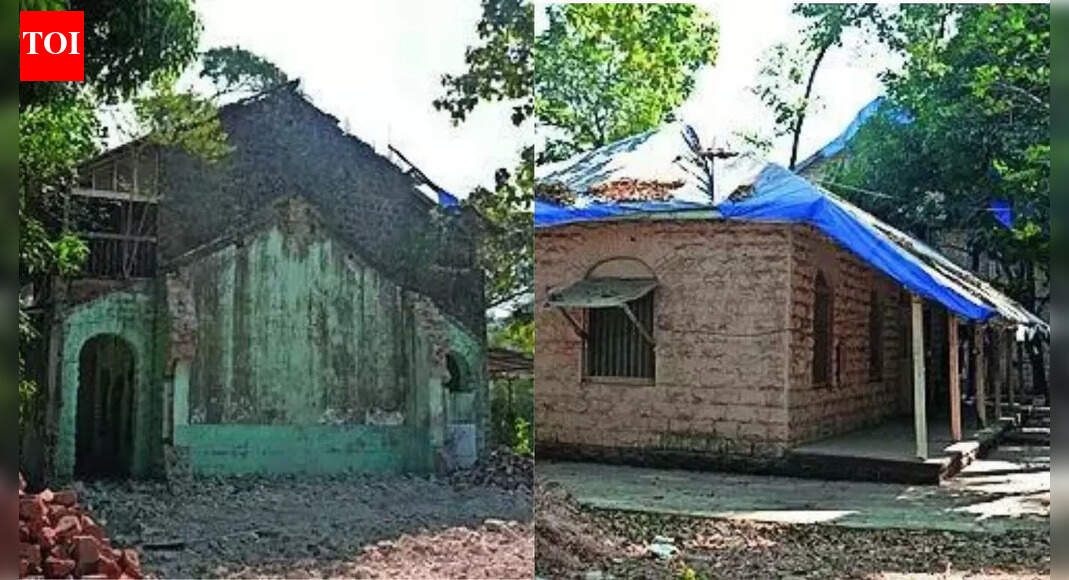
Shrieks serrate the evening air at the Regional Mental Hospital in Thane, as a flock of parakeets swoop into the overstory for a treetop council. Their agenda is easy enough to read, stapled to the trunk of every other tree across these 30 acres: a public notice inviting feedback and objections to the govt’s plan to cut and transplant trees affected by the redevelopment of this 124-year-old hospital complex. What the notice doesn’t spell out is that more than half the trees on the hospital grounds—724 of 1,614—have been marked for the axe, and some have reportedly already been felled. Such sweeping loss of green cover is a body blow to a city barrelling down the freeway to urbanisation. It threatens to unravel local biodiversity, unsettle ecological balance, undermine crucial ecosystem services, and rob the landscape of its natural environmental buffer. But there’s another loss, closer to home, that has been entirely overlooked—the chance for the hospital’s mentally ill patients to gain from the well-documented therapeutic effects of engaging with nature in their own backyard. Nature is a known healer. For centuries, people relied on its curative and palliative powers—from plant-based salves to mineral-rich soaks—to treat a wide range of ailments. But its formal role in modern mental health therapy is relatively recent. The term ‘ecopsychiatry’, for instance, was introduced in the late 1970s to examine how people’s relationship with their environment shaped their mental well-being. Its companion idea, ‘ecopsychology’, emerged in 1992 to bring ecological thinking to psychotherapy and foster lifestyles that were ecologically and psychologically healthy, as articulated in the essay Eco-psychiatry: Culture, Mental Health and Ecology with Special Reference to India. ‘Ecotherapy’, coined in 1996, went a step further, testing and shaping practical pathways for treatment. “Ecotherapy or nature therapy talks about using nature—which includes the natural environment—mountains, seas, forests—and animals to improve people’s mental health,” says Dr. Anjali Chhabria, Psychiatrist and former President of Bombay Psychiatric Society, who uses animal-assisted therapy in her own practice. “People have long been using nature for therapy, without knowing what it was called,” she says, recalling an incident from her childhood in which she witnessed mentally ill patients, in chains, being made to stand under a waterfall. Their attendants said it helped them feel better. “They didn’t know how it was helping, only that it did.” Anxiety and depression, for instance, can be alleviated by the sights, sounds, and tactile experiences of nature—and in some cases, such exposure may even allow for reduced psychiatric medication, she explains. People experience nature not only through their senses but also through non-sensory pathways, including phytoncides, negative air ions, and microbes, notes the paper Review of the Benefits of Nature Experiences: More Than Meets the Eye, adding that the science is still evolving. Nature sounds aid stress recovery; plant-derived scents enhance calmness, alertness, and mood; and human–animal interactions activate the oxytocinergic system, reducing social stress and producing positive endocrinological, physiological, and psychosocial effects. Phytoncides, volatile organic compounds released by plants, are thought to reduce stress and promote relaxation, while environmental microbes play a role in immunoregulation. Until a few years ago, patients at Thane’s Regional Mental Hospital experienced some of these effects firsthand. “We noticed that time spent in nature helped regulate patients’ emotions,” says Dr. Sandeep Divekar, a psychiatrist at the hospital. “Many of them enjoyed sitting among the trees and visiting the vegetable and flower gardens, where they gardened and grew vegetables that were used in the kitchen.” Supervised access to green spaces supplemented clinical treatment, although it wasn’t scripted into formal therapy. “Sensory-motor activities like digging and handling dirt had a calming effect on them, especially on those from rural backgrounds.” That, he admits, is no longer possible because of the ongoing construction. “We can’t take patients outdoors the way we did before, when the campus was pristine and peaceful.” Work to modernise and expand the hospital’s capacity from 1,850 to 3,278 beds is well underway and has already wiped out the gardens. The few remaining green patches are accessible only under staff escort, Dr. Divekar says. However, the current staff shortage makes such outings rare. The govt plans to turn the hospital into a state-of-the-art superspecialty mental health institution on the lines of Bengaluru’s National Institute of Mental Health and Neurosciences (NIMHANS). With wards being rebuilt, the hospital has only 669 in-patients at the moment. “Most long-stay patients have been shifted to govt-assisted private rehab centres,” says Dr. Netaji Mulik, Medical Superintendent, who says the redesigned complex will feature dedicated green corridors. According to the Institute for Health Metrics and Evaluation, mental disorders rose from the 12th to the 5th leading cause of health loss worldwide between 1990 and 2023. Recent data from the World Health Organization reveals that more than one billion people globally live with mental health disorders, the most common being anxiety and depression. These cut across gender, communities, and countries, exacting a social, economic, and human toll—an estimated 727,000 lives were lost to suicide in 2021. Urbanisation is recognised as a contributor to the rising mental health burden, one that natural environments—especially public green spaces with their preventive and restorative benefits—can help ease. These spaces are regarded as vital organs of a healthy city and are reflected in SDG 11.7 (Sustainable Cities and Communities). Their erasure deprives citizens of these essential services, pushing those who can afford it to seek nature beyond city limits, notes psychotherapist Alaokika Motwane wryly. “Yet nature itself gives freely, to rich and poor alike,” she adds, “We need hospitals to treat illness, but instead of amplifying the built environment—which often fuels these problems—why not let nature intervene earlier and nip them in the bud.” When it comes to mental health therapy, they all caution that nature should complement formal treatment, not replace it. “One must use nature judiciously, deciding what will work and how best to optimise it, because every individual’s needs differ and solutions must be tailored accordingly,” says Dr. Chhabria, acknowledging the challenge of practicing ecotherapy in cities where ecosystems themselves are increasingly scarce. By the same token, the redevelopment of the Regional Mental Hospital, Thane, should be guided not by a standardising logic, but a particularising one. “Decentralising the institute is the answer,” recommends Dr. Divekar. “Instead of one large central institution, we need to have many smaller 100-bed hospitals in districts across the state. Then there would be no need to cut these trees.” Go to Source