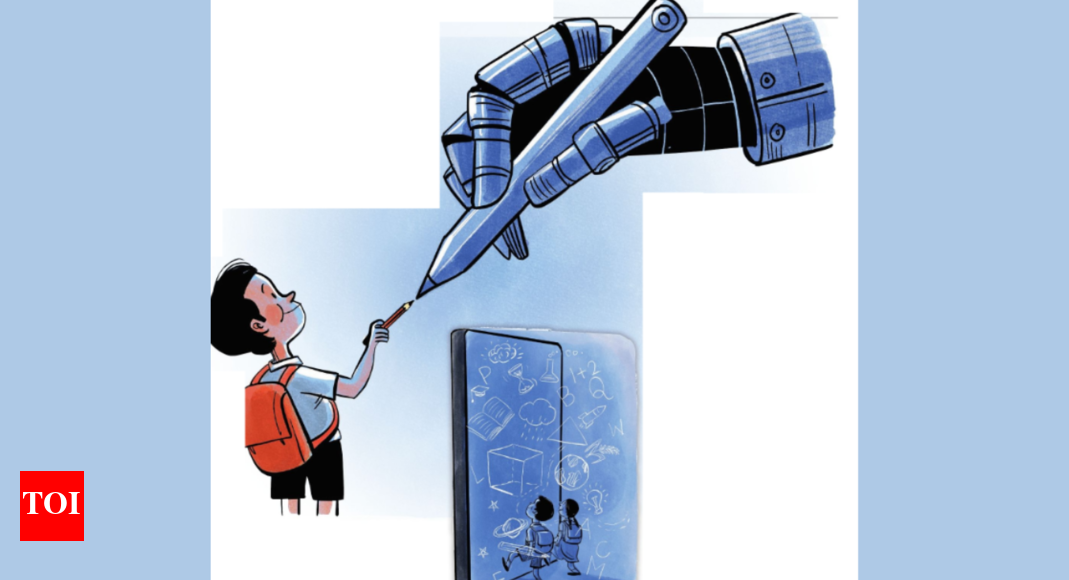

To prepare for the future, investing in human capital is key, and early childhood education can offer the highest returns. Betting on this, non- profits across India are decentralising education using tech & innovationIndian children born today will enter the workforce as young adults by 2047. At this point, India has largely won the battle for universal school enrolment. The one that beckons is universal school learning — imparting highquality education that will create opportunity for all and provide the human capital for a developed India by 2047.Economics Nobel Laureate James Heckman’s work on human capital emphasises the high return on investment in early childhood education (ECE), as early interventions enhance cognitive and non-cognitive skills critical to long-term success. The well-known Heckman curve shows that for all stages of education, the highest economic returns come from the earliest investments in children. To raise the collective intelligence of the nation there is a strong case for investing heavily in ECE, raising its share of the Samagra Shiksha budget to 5% (up from around 2% currently).The ubiquity of smartphones in India today — a recent survey reported a smartphone ownership of 1.5 per household in urban India and 1.3 in rural India — offers a never-before-seen opportunity to rapidly scale up high-quality educational inputs to children across the country regardless of their socio-economic status. This is a simple idea with great power. Educational non-profits have begun work on precisely this, and these efforts will only expand in future.For instance, Rocket Learning, a non-profit launched in 2020, has developed interactive and highly engaging educational content that can be delivered over WhatsApp to teachers, parents and children. Every day on these micro-WhatsApp groups, it sends low-income teachers and parents contextualised content in the local language that they can use for play-based activities with children in the classroom or at home. These activities take less than 20 minutes and involve readily available materials.Research shows that greater parental involvement in children’s education leads to improved academic performance. That sense of participation is reinforced by encouraging parents and educators to share images and videos back to the WhatsApp groups, creating a sense of a shared learning community.
Chimple is an android app developed in India, that uses games to instil foundational literacy and numeracy through a teacher-directed, at-home learning model. Using the app, a teacher can remotely assign content for children to practise, based on the teaching plan for the week. In a pilot study involving Class 1 and 2 students in Haryana, the treatment group saw a 50% improvement in test scores over the year with 10 minutes of usage of Chimple in a day. Similar improvements were recorded in English as well, and the low performing learners at the baseline benefited even more.Going up to higher grades of schooling, new learning opportunities can be reinforced by generative AI — a powerful use case for which is Personalised Adaptive Learning (PAL). Instead of the rigid, one-size-fits-all mode of learning that conventional classrooms offer, students can learn at their own pace and in their own space with PAL — making engaging, immersive and interactive learning available at even the remotest of locales. If children of the elite have an edge because they have access to individual high-quality coaches to quickly resolve their problems, such access can be universalised with the help of PAL.Educational non-profit Central Square Foundation (CSF) is working with Khan Academy to contextualise Khanmigo, India’s AI-powered personal tutor for low-income contexts. State govts are beginning to leverage PAL for their school systems. Andhra Pradesh has been a pioneer here as it has made PAL part of its World Bank-aided Supporting Andhra’s Learning Transformation (SALT) programme. Use of PAL to heal educational divides can only grow in future.PAL, however, is not the only AI use case in education. AI can generate the learning content itself — scripts, rhymes, worksheets and illustrations are created using LLMs, saving time and boosting creativity. AI can translate and dub across languages, simplify animation and personalise audio with voice cloning. AI can also drive data analysis at the back-end, using incoming messages to draw nuanced insights into how well specific educational programmes are working.CSF has entered into partnerships to build an AI-powered Teacher Coach for govt school teachers, which can provide actionable feedback to teachers and identify effective levers for measurable improvements in classroom practice. AI tools can also grade large volumes of student work, reducing five minutes of paper checking time to 20 seconds. They can provide nuanced understanding of a student’s performance and actionable insights based on it, thus reducing teachers’ workload and enabling them to engage more students.India’s EdTech sector is already large and bound to grow further. But what parts of it are relevant and useful, and go from being a handmaiden for the rich to being universally enabling? In order to evaluate the many available EdTech solutions, CSF has developed — jointly with IIT Bombay and IIT Delhi — an evaluation index that enables govts and other users to make quality-led, evidence-informed choices regarding EdTech procurement for schools, especially those catering to low-income students.The index is called EdTech Tulna, and helps define quality standards for what good EdTech looks like. It creates exhaustive tool-kits and training for decision-makers to apply these standards to evaluate EdTech products, and publishes reviews of products to drive demand and shape supply.Apart from EdTech innovations, there are innovations at the level of school governance and regulation that can dramatically uplift quality. At present, regulation of schools is heavily input-focused. This priority must now shift to measurement of outcomes, which should be reported transparently, publicly and regularly. Such data will allow parents to choose the best school for their children and vote with their feet, building pressure to improve school quality. It will also allow the best schools to emerge as exemplars whose best practices can be replicated at others too.Other countries have followed this transparency model to effectively improve school quality — including the Office for Standards in Education (Ofsted, UK), Knowledge and Human Development Authority (KHDA, Dubai) and Sistema de Medición de la Calidad de la Educación (SIMCE, Chile).The National Education Policy (NEP 2020) talks about a school regulator called the State School Standards Authority (SSSA) to set standards and publicise the level of each school in the state, based on those standards. To be effective, SSSAs need to function independently of the department of education and other govt bodies, and assess the quality of all schools — whether public or private — impartially. As NEP 2020 recommends, they should shift regulation from being overly restrictive (especially for private schools) to being “light but tight”. SSSAs should regularly report on the quality of schools and put these out in the public domain.Every child in India deserves a chance to reach their full potential. With new technologies as well as enabling reforms, we will be well on our way towards fulfilling that dream.The writer is founder-CEO of The Convergence Foundation, and founder chairperson of Central Square Foundation Go to Source