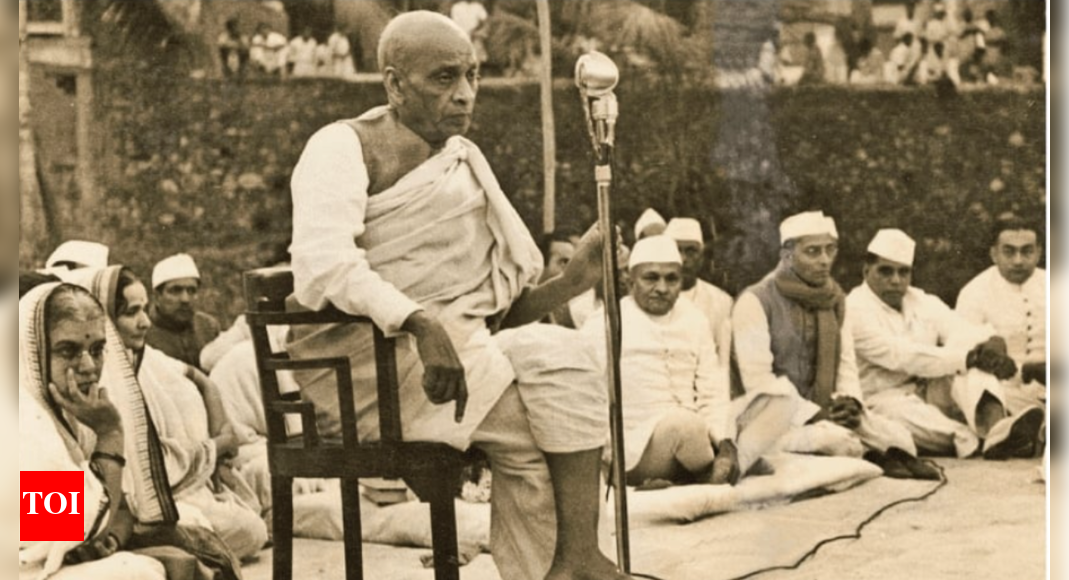

Sardar Vallabhbhai Patel didn’t just integrate India. He also helped construct the nation’s democratic institutions…Unification of India: This is the crown jewel of his glittering career. Just after attaining independence from colonial rule in 1947, India was confronted with a major challenge. About 40% of the country was under 565 princely states. Integrating them seamlessly into the fabric of a newly born nation was a masterly act of persuasion. There were some, such as the Nizam of Hyderabad, who held out. That’s when Vallabhbhai Patel, then India’s deputy prime minister and home minister, showed his iron fists. Operation Polo followed, forcing the recalcitrant Nizam to sign “the instrument of accession”. Partition had claimed at least 200,000 lives. Due to Patel’s resolute blend of diplomacy and force, one of the most demanding obstacles to a fully unified India was countered with minimum human cost. Hence, he justifiably became “the Iron Man of India.”Establishing the All-India Civil Services: The birth of civil services dates back to the early years of British rule. It was “the steel frame” of colonial rule. Which is why many were sceptical about its continuance in free India. Even before Independence, as home minister of the interim govt, Patel had been engaged with the issue of the future of the civil and police services. To that end, he had convened a conference of provincial premiers in Oct 1946. Post Independence, he held the firm view that an all-India merit-based administrative service was fundamental to hold Indians together. His efforts were key to the formation of Indian Administrative Service (IAS) and Indian Police Service (IPS) as a replacement to ICS. This was a new steel frame for a newly independent nation. He is said to have told young officers to serve the people with integrity and humility.Pioneering the first national census: Patel also outlined the purpose of the census and mapped its vision. In Feb 1950, just 10 months before his death, Patel inaugurated a conference of census superintendents in Delhi. In the conference, the deputy PM underlined that the census will play a vital role in determining India’s administrative policies. “Census, he stated, was no longer a mere counting of heads but involved the extraction of valuable scientific data of sociological importance,” a report published in TOI said. He further elaborated on the outline of the exercise: “…the present census would devote greater attention to the collection and formulation of basic economic data relating to the means of livelihood of the people and other economic activities of the individual…” Patel further said, “I would like to stress Census affords an opportunity for the Government to reach every home throughout the length and breadth of the country.” Simply put, Patel put together the building blocks of the first census, which began in 1951.Leadership of the Bardoli Satyagraha: If Champaran Satyagraha brought Mohandas Karamchand Gandhi to national prominence, the Bardoli Satyagraha did the same for Patel. Like Champaran, Bardoli was a farmers’ protest against imposition of high taxes. Patel’s methodical and disciplined organisation of a mass movement, which led to a cancellation of the tax raise, earned him the endearing sobriquet of Sardar, by which he was referred to by many for the rest of his life. Much before the Bardoli Satyagraha (1928), though, Patel had provided a glimpse of his abilities while assisting Gandhi in Kheda Satyagraha (1918). This was another battle for peasant rights where Patel showcased his pragmatic leadership style and steadfastness to farmers’ cause.
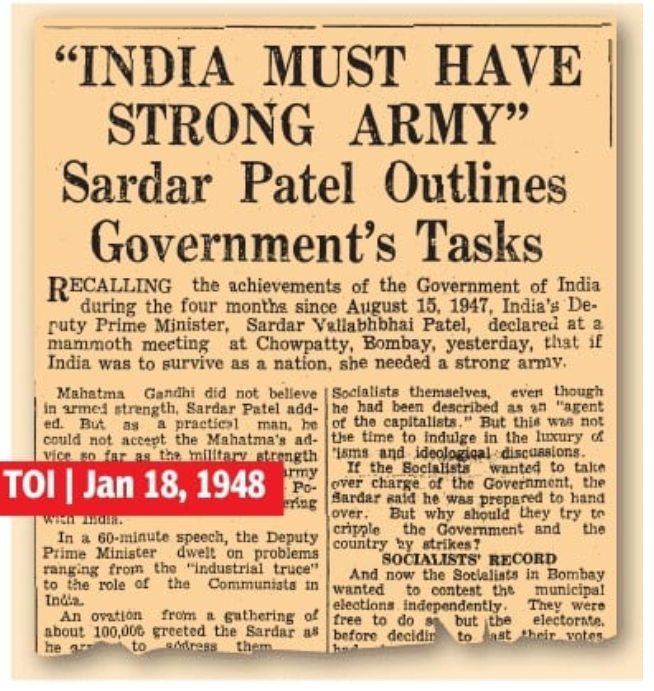
The Sardar on Indian ArmyOn Jan 17, 1948, Sardar Vallabhbhai Patel spoke at Chowpatty in Mumbai. The meeting was attended by at least one lakh people. In an hour-long speech, India’s deputy PM said that if the country was to survive as a nation, it needed a strong army. TOI reported: “Mahatma Gandhi did not believe in armed strength, Sardar Patel added. But as a practical man, he could not accept the Mahatma’s advice so far as the military strength of India was concerned. Our army ought to be strong enough that no power would ever think of interfering in India.” Go to Source