


Generative image
When the University Grants Commission (UGC), the statutory body under the Union education ministry that regulates universities and colleges, notified its Promotion of Equity in Higher Education Institutions Regulations, 2026, it introduced a new set of rules that will apply across campuses nationwide.The regulations govern how colleges and universities must prevent, identify, and respond to discrimination involving students, teachers, and staff.On paper, the objective sounds straightforward. It seeks to ensure that no student, teacher, or staff member is denied dignity or opportunity in higher education because of identity. In practice, however, the new regulations reach deep into the everyday functioning of campuses, shaping everything from admissions and hostels to classrooms, committees, and corridors.The 2026 framework replaces the UGC’s earlier equity rules and shifts the burden of compliance squarely onto institutions and their leadership.
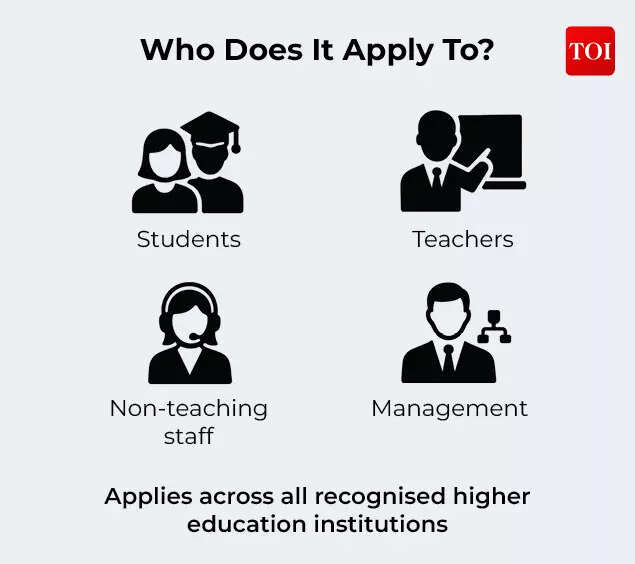
Who does it apply to?
Heads of universities and colleges are no longer just administrators; they are now the first line of accountability in preventing and responding to discrimination. New structures, new reporting mechanisms, and strict timelines are written into the rulebook, backed by the threat of serious penalties for non-compliance. Yet, as has often been the case with regulations aimed at correcting long-standing social inequities, the real questions lie beneath the stated intent. How wide is the definition of discrimination? How much discretion do institutional committees enjoy? What happens when complaints are contested, or when the process itself causes harm? And how prepared are campuses to balance speed, sensitivity, and fairness? And is it discriminatory against the non-reserved General Class students? What the regulations aim to doThe objective clause sets the tone for the entire framework. It seeks to eradicate discrimination only on specified grounds like religion, race, caste, gender, place of birth, and disability. The word “only” is significant, as it confines the scope of the regulations to discrimination based on specified identity grounds, excluding general grievances or academic disputes.At the same time, the regulations explicitly prioritise certain groups, including:
- Scheduled Castes (SCs) and Scheduled Tribes (STs)
- Socially and Educationally Backward Classes (EBC)
- Economically Weaker Sections (EWS)
- Persons with disabilities
This prioritisation reflects a remedial approach, focusing on historically disadvantaged communities, while formally keeping the protection available to all stakeholders.How the law frames discrimination and equityThe definitions section is one of the most consequential parts of the regulations. “Discrimination” is defined broadly to include not only explicit acts but also implicit, indirect, or structural forms of unfair treatment. It extends to actions that have the effect of impairing equality or violating human dignity, even if discriminatory intent is not overt. “Caste-based discrimination” is defined as discrimination against members of Scheduled Castes, Scheduled Tribes, and Other Backward Classes.
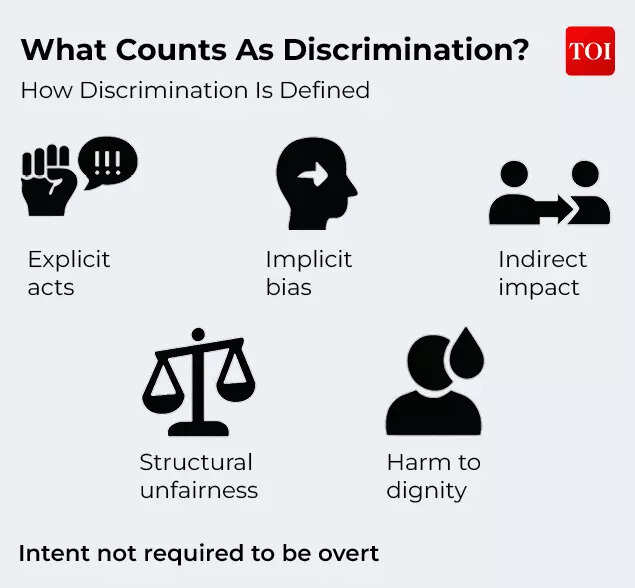
What counts as discrimination?
Importantly, the regulation does not create separate categories of discrimination for different groups but subsumes them within a common framework. “Equity” is defined as providing a level playing field for all stakeholders with respect to rights and opportunities. Together, these definitions significantly expand the interpretive space available to committees tasked with examining complaints. At the same time, the breadth of these definitions leaves substantial discretion with institutional committees. Terms such as implicit or indirect discrimination, structural unfairness, and impairment of dignity are not further qualified in the regulations, offering limited guidance on thresholds of proof or standards of assessment. This ambiguity may allow flexibility in addressing complex forms of disadvantage, but it also opens the door to uneven interpretation across institutions, particularly in contested cases where intent is disputed or where academic or administrative decisions intersect with allegations of discrimination. The Equal Opportunity CentreEvery higher education institution (HEI) is required to establish an Equal Opportunity Centre (EOC). The Centre is tasked with a wide range of functions, including policy implementation, counselling, outreach, awareness-building, and grievance handling.Smaller colleges that lack sufficient faculty strength are allowed to rely on the EOC of their affiliating university, ensuring that the requirement applies uniformly across institutions.The EOC is also expected to coordinate with civil society organisations, local administration, police authorities, and legal services bodies. This expansive mandate reflects an attempt to situate campus equity within a broader social and legal ecosystem.Composition and powers of EOCEach Equal Opportunity Centre (EOC) must have an Equity Committee, constituted by the head of the institution. Its composition is carefully structured to include:
- Senior faculty members
- A non-teaching staff representative
- Civil society members
- Student representatives (as special invitees)
The regulations mandate representation of women, SCs, STs, OBCs, and persons with disabilities within the committee. The committee is required to meet at least twice a year and to review action taken on complaints.The committee’s core role is to inquire into allegations of discrimination and submit a report with findings and recommendations.Equity squads and ambassadorsBeyond formal committees, the regulations introduce two novel mechanisms: Equity Squads and Equity Ambassadors.Equity Squads are smaller, mobile bodies tasked with maintaining vigilance and visiting “vulnerable spots” on campus. Equity Ambassadors are designated individuals in departments, hostels, libraries, and other units who act as nodal points for reporting violations.
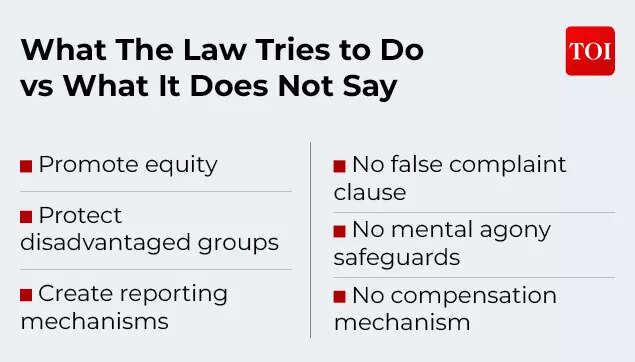
Left (What does the law say) / Right (What it misses)
These mechanisms signal a shift towards continuous monitoring, rather than complaint-driven intervention alone. While intended as preventive measures, they also raise questions about overreach, informal surveillance, and the potential chilling effect on campus interactions. The Equity HelplineEvery HEI must operate a round-the-clock Equity Helpline. Any stakeholder in distress due to discrimination can access it, and confidentiality of the complainant’s identity must be maintained if requested.Where a prima facie case under penal law is disclosed, the information is to be forwarded to the police. This provision effectively links campus grievance mechanisms with the criminal justice system, raising the stakes for both complainants and the accused.
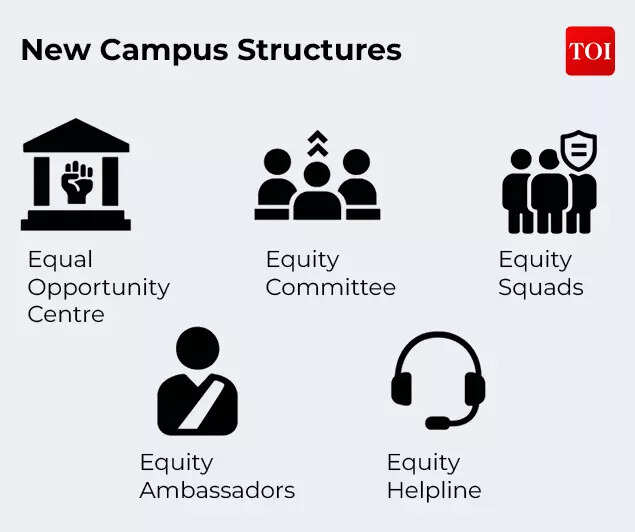
A structure for the campus
Reporting and inquiryThe procedure for handling discrimination complaints is tightly time-bound.An aggrieved person can report an incident through an online portal, email, written complaint, or the helpline. Upon receipt, the Equity Committee must meet within 24 hours to decide on the next steps.The committee has 15 working days to submit its report, after which the head of the institution has seven working days to initiate action. In cases involving the head of the institution, the coordinator of the EOC chairs the inquiry.While the timelines aim to ensure prompt action, they also raise concerns about whether complex allegations can be examined thoroughly within such compressed periods.Appeals and oversightAny person aggrieved by the Equity Committee’s report can appeal to the Ombudsperson within 30 days. The Ombudsperson may appoint an amicus curiae and is expected to dispose of appeals within another 30 days.This appellate mechanism provides an external check on institutional processes. However, it primarily addresses procedural correctness, rather than offering substantive relief for non-tangible harms such as reputational damage or mental distress.
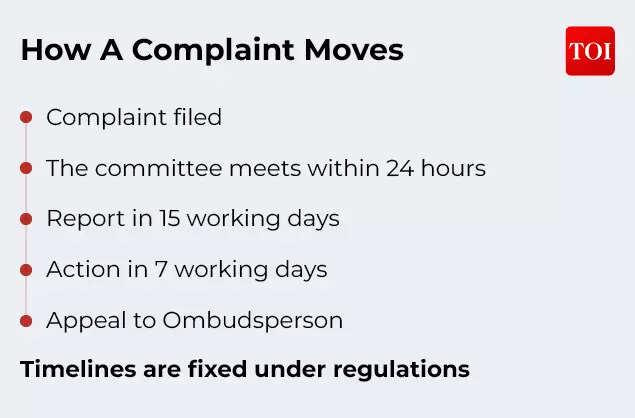
How a complaint moves
Monitoring and penaltiesThe regulations empower the UGC to monitor compliance through inspections, information requests, and national-level committees. Non-compliant institutions face serious consequences, including:
- Debarment from UGC schemes
- Loss of permission to offer degree or online programme
- Removal from UGC-recognised lists
These penalties indicate that equity compliance is not optional, but a condition for institutional legitimacy.
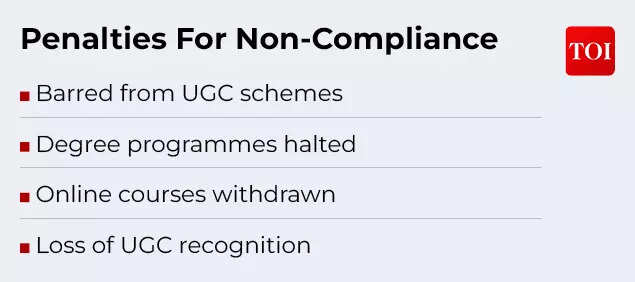
Penalties for non-compliance
Fallout and concernsDespite the breadth of the framework, the regulations are silent on several issues that are likely to shape their reception and operation on campuses. While they lay out detailed mechanisms for receiving and processing complaints, they do not spell out comparable safeguards for non-reserved individuals who may be accused of discrimination, particularly in cases where allegations are contested or later found to be unsubstantiated.There is no explicit provision dealing with malicious or knowingly false complaints, nor is there any guidance on how institutions should distinguish between bona fide grievances and those driven by personal disputes, academic disagreements, or animosity unrelated to identity-based discrimination. The absence of such clarity places a significant burden on institutional committees to exercise judgment, increasing the risk of inconsistent outcomes across campuses.
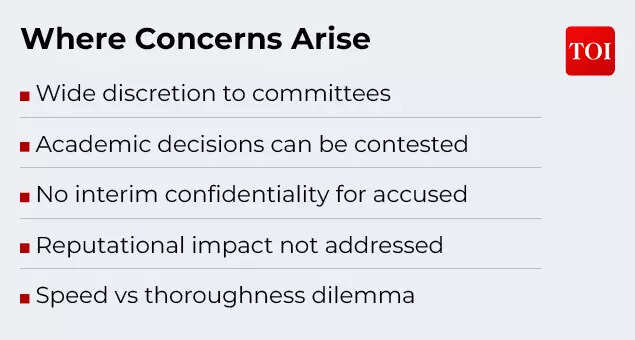
Concerns
The regulations also do not acknowledge the mental and reputational impact that the complaint process itself can have on the accused. There are no provisions for interim confidentiality for respondents, counselling support during the inquiry, or mechanisms to repair reputational harm if allegations are ultimately not upheld. In tightly knit academic environments, even the initiation of an inquiry can have lasting professional and psychological consequences, irrespective of the final outcome.Another area of concern relates to timelines. While the emphasis on speed is intended to ensure prompt redressal for complainants, the compressed schedule may limit the ability of committees to examine complex factual disputes, especially those involving academic judgment or administrative discretion. In such cases, the pressure to meet deadlines could inadvertently prioritise procedural closure over substantive fairness.The linkage of campus mechanisms with law enforcement, particularly through the equity helpline, further raises the stakes. While intended to ensure swift action in serious cases, this provision may deter open academic engagement or encourage defensive decision-making by administrators wary of escalation beyond the institution.Historically, similar regulatory frameworks in higher education and other sectors have tended to correct outcomes through appellate or judicial review, while leaving the harms caused during the process largely unaddressed. Appeals may overturn findings or set aside penalties, but they rarely compensate for stress, stigma, or disruption suffered in the interim. In the absence of explicit procedural safeguards, this gap is likely to remain.Taken together, these omissions do not negate the objectives of the regulations, but they point to areas where further clarification or supplementary guidelines may be required. How these concerns are handled, whether through institutional practice, regulatory advisories, or future amendments, will play a key role in determining whether the framework strengthens trust on campuses or becomes a source of sustained friction.Does it go against Article 14?The question arises because the regulations draw explicit distinctions by prioritising protections for historically disadvantaged groups, while applying a common framework to all stakeholders. Article 14 guarantees equality before the law, but past judicial practice has allowed differential treatment where it is linked to a legitimate objective and applied through non-arbitrary procedures. In that sense, the regulations are framed as remedial rather than exclusionary, focusing on identity-based disadvantage in higher education.However, concerns stem less from the stated objective and more from the structure of implementation. The wide discretion granted to institutional committees, combined with broadly worded definitions of discrimination and the absence of explicit safeguards for those accused, particularly from the unreserved General Class, has led some to question whether outcomes could vary unevenly across campuses. Critics argue that unequal application, rather than unequal text, could create situations where similarly placed individuals are treated differently in practice.Beyond the rulebookThe 2026 equity regulations introduce a far-reaching framework for addressing discrimination and inclusion in higher education, expanding the role of institutional mechanisms and regulatory oversight. They formalise a set of duties, procedures, and enforcement tools that universities and colleges will be required to follow.However, the way the framework functions in practice will depend on how institutions interpret and apply its provisions. The manner in which discretion is exercised, timelines are enforced, and contested complaints are handled will shape whether the regulations operate as intended or generate friction within campuses. Go to Source