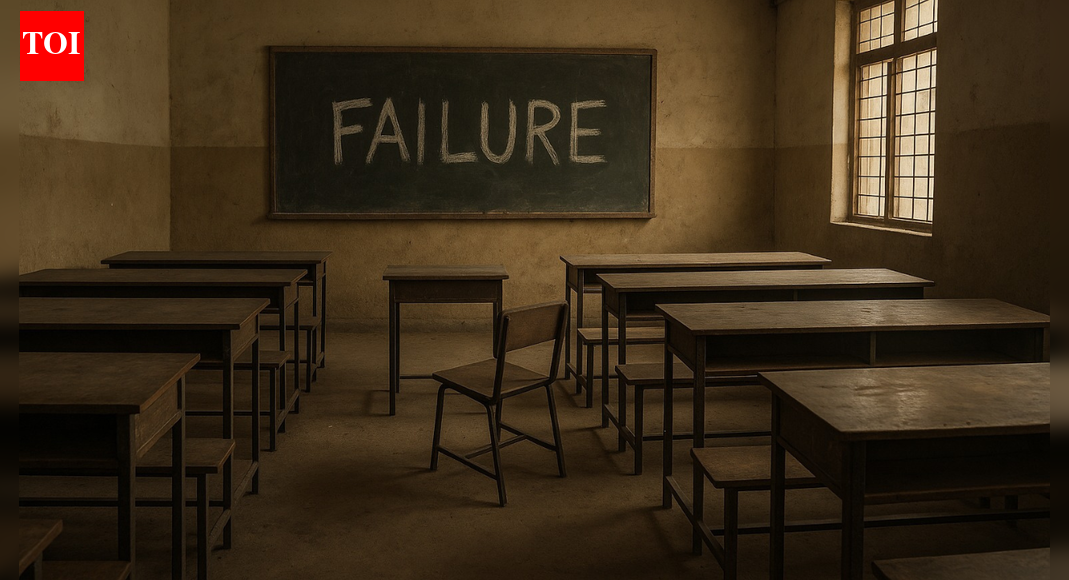

(AI image generated using ChatGPT)
“Even a small incident, something as ordinary as a scolding, can push a child towards the wrong step.”The words come from Suman Prakash, a coaching institute teacher of nearly twenty years, but they echo through classrooms across the country.His warning lands heavily in a year where student suicides have reached their highest levels ever recorded in India. Government data shows that student suicides rose from just over eight thousand a decade ago to nearly fourteen thousand in 2023, an increase far steeper than population growth. Behind the numbers are classrooms shaped by competition, families weighed down by expectations and schools where discipline often blurs into public shame.
The death of a Class 10 student in Delhi, who allegedly named teachers in a suicide note and had complained of humiliation, has now placed renewed scrutiny on whether certain disciplinary practices have become psychologically unsafe. Protests outside his school, questioning by police and testimonies from classmates have built a portrait of a child who struggled not with failure, but with fear.At the heart of the debate is a simple question:When does teaching a lesson stop being discipline and start becoming emotional injury?
Defining the boundary between scolding and humiliation
Teachers, psychologists and counsellors consistently draw a distinction between corrective reprimand and humiliation, although that distinction often collapses inside real classrooms. Scolding, in its intended form, is private and behaviour specific. It pinpoints an action, suggests correction and remains controlled in tone.Humiliation, on the other hand, is public, identity directed and often delivered with mockery, comparison or threat. It takes the shape of comments about character rather than conduct, such as “you will never succeed”, “look at others, learn from them” or “you are always the problem”.Humiliation traps a child in a social spotlight they cannot escape, and psychologists note that it activates the same pain pathways as physical harm. The difference between the two is not mere semantics, because children interpret them very differently. A behaviour based correction can motivate, but identity based shaming can rupture trust and trigger panic, especially when the student is already anxious about parental expectations or peer comparison.This is the environment in which punishment culture thrives. In schools where academic output determines reputation, in coaching centres where competitive ranks shape futures, and in homes where opportunity is tied to marks, punishment often becomes a normalised tool, even when its emotional cost is profound.
The shifting emotional world of students
Teachers with long experience describe students today as more vulnerable to harsh reprimand than those of two decades ago. Science teacher Biva Jha, who has taught for more than twenty five years, attributes this sensitivity to changes in childhood routines and family structures.She points to declining physical activity, heavy reliance on mobile phones and the increasing number of single child households. “Children today are physically and emotionally more sensitive. With less outdoor play and more exposure to social media, they become easily overwhelmed,” she explains. Many are unaccustomed to hearing the word no at home, which reduces their resilience when faced with criticism outside.Her view is echoed, though differently framed, by younger teachers entering the profession. Rashi Mungia, who has been teaching for a year, says even primary school children now “understand mental health, emotions and what feels right or wrong.” This awareness demands that teachers monitor not only what they say, but how they say it. “One negative remark can affect a child for years,” she says, calling for discipline that is “respectful and restorative, not punitive.”She also acknowledges friction between generations of teachers. Some experienced staff see empathy driven methods as too lenient, while younger teachers believe the emotional climate of classrooms has fundamentally changed. “Balancing kindness with authority is the real challenge,” she says, “but hurting a child’s confidence cannot be part of discipline.”Despite differing methods, both experienced and newer teachers agree on one point: emotional thresholds have shifted.
Pressure, competition and the punishment loop
If schools set one kind of pressure, coaching centres set another. With competitive exams acting as gateways to careers, families often invest high hopes and high fees into after school coaching. This intensifies expectations, and teachers in such environments navigate far thinner margins between motivation and harm.For Suman Prakash, the problem begins earlier, in parental choices. Many parents, he says, place their children in schools that do not match their socio economic reality. “They think a top school will help them, but it creates pressure. Parents worry about fees, children worry about matching the lifestyle of their peers,” he says. The result is an unequal emotional burden before a child even reaches the blackboard.A second shift, he argues, comes from the collapse of social outlets. “Earlier, if a teacher scolded us, we met friends, talked, laughed, released the stress. Children today have no such outlet. Everything is on the phone, no games, no informal support,” he explains. Without a peer space to process embarrassment or fear, reprimands linger and intensify.He also highlights what he calls the “marks inflation bubble”. With schools awarding higher marks more frequently, students may develop a false sense of ability. “Someone with 50 per cent ability is scoring in the 80s. When reality hits, the fall is very hard,” he says. In this environment, even a routine scolding can feel like a personal crisis, especially for students conditioned to believe that high marks validate worth.Prakash recalls an incident from his institute where a girl skipped class but accidentally revealed this by leaving her lunchbox behind. When her mother rushed to the centre, he urged her not to confront the girl immediately. “Children panic easily, and confrontation at the wrong moment can push them into extreme decisions,” he says. The matter was resolved privately the next day, avoiding both escalation and humiliation.The anecdote shows how small missteps can become high stakes events when fear replaces communication.
A fragile safety system
The Delhi student’s death has also exposed structural weaknesses in school safety systems. Classmates have said he approached a school counsellor about suicidal thoughts, but was allegedly dismissed as joking. Teachers named in his note have been questioned and internal inquiries are ongoing. These gaps are not unusual, because many Indian schools have only one counsellor for hundreds of students, inconsistent complaint mechanisms and limited training for teachers on trauma informed discipline.With rising academic pressure and limited mental health infrastructure, punishment often becomes the default response to underperformance or behavioural issues, rather than a carefully calibrated tool.This creates a cycle that students struggle to break. A reprimand leads to shame, shame leads to fear of parental reaction, fear leads to silence and silence leaves children without any safe avenue to report distress.
What change requires
Across interviews, three themes emerge as essential for reform.First, teachers emphasise that discipline must be tied to behaviour, not character. Scolding that aims to correct can be valuable, but reprimand that aims to embarrass is counterproductive and risky.Second, the emotional environment of students must be recognised as fundamentally different from earlier decades. With higher expectations, sharper competition and reduced social outlets, children today process criticism with heightened sensitivity.Third, schools and families must rebuild channels of trust. The absence of safe spaces for children to express fear or failure allows humiliation, whether intended or not, to become destructive.As student suicides continue to rise, the cost of inaction becomes clearer. Punishment culture is not simply about tough love or maintaining discipline, it carries psychological weight that many children are no longer equipped to manage. Go to Source