
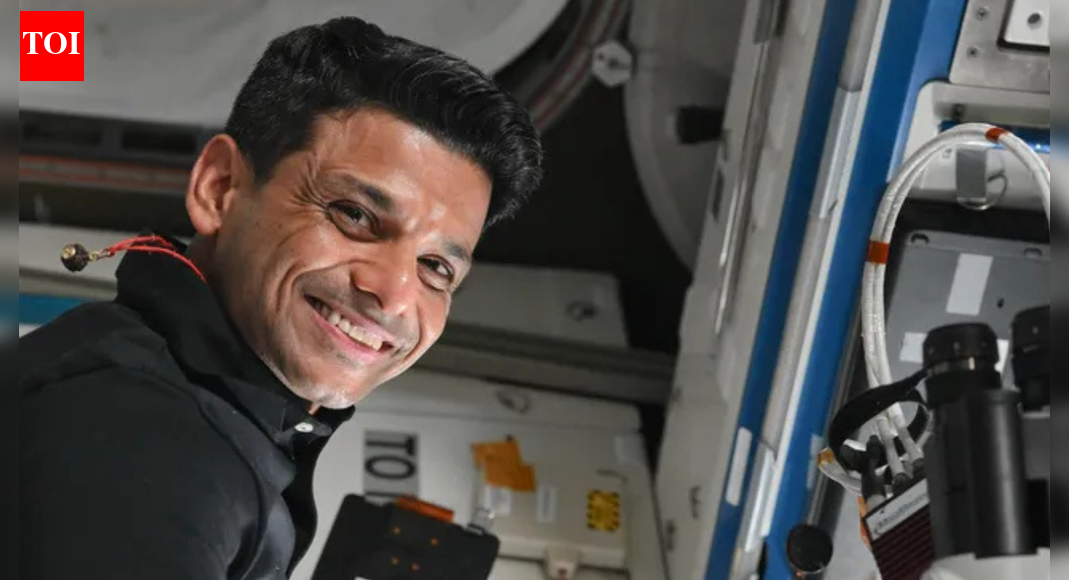

Shux utilizes a microscope to conduct research in the Destiny Lab on ISS. Pic Credit-Nasa
Group Captain Shubhanshu Shukla’s (Shux) 20-day mission to the International Space Station earlier this year gave India a rare, first-hand view into how the world’s most complex engineering project functions on an ordinary day—and how it copes when things are not ordinary at all. As India prepares for a sustained human presence in low-Earth orbit through the Bharatiya Antariksh Station, Shukla’s reflections offer a grounded account of what the ISS achieved, where it stumbled, and how India should shape its own long-term strategy.In this exclusive interview to TOI, Shux speaks about the moments that defined his time on the station, the value of international collaboration, and the design philosophy that India could adopt for missions in the coming decades.When you look back at your time on the ISS, what moment best captured what the station was meant to achieve?The International Space Station remains one of humanity’s most dazzling examples of what happens when engineering ambition meets international cooperation, and miraculously, everyone agrees on the same orbit. Conceived in an era when floppy disks were still in fashion and the internet sounded like a dial-up flute, the ISS was built to push the boundaries of science in microgravity, test systems essential for future deep-space missions, and serve as a beacon of peaceful collaboration between nations that otherwise rarely agree on anything terrestrial. Construction of this orbital leviathan began in 1998 and reached completion in 2011. To assemble it, humanity performed a kind of celestial Lego project that required more than 1,000 hours of spacewalks and more than 40 Space Shuttle flights. The result? The largest continuously inhabited laboratory off the planet, a structure the size of a football field hurtling around Earth at 28,000 km/h, completing a lap every 90 minutes.During my own mission aboard the ISS, the station felt exactly like the global village it was designed to be. We had 11 crew members representing six nationalities, a small floating model of the United Nations, minus the speeches and with better views. Over the course of our 20-day stay, we conducted more than 60 scientific experiments spanning biology, materials science, human physiology, and space technology. We also carried out STEM demonstrations that connected us with students across the world, sparking curiosity, answering wide-eyed questions, and hopefully inspiring the next generation of explorers, engineers, and dreamers.Looking back, those 20 days perfectly captured the essence of what the ISS set out to achieve. For a machine conceived with 1990s technology, when the most futuristic thing on Earth was a Nokia phone, to not only remain relevant but to continue fulfilling and expanding its mission objectives is extraordinary. The station does not just orbit Earth; it orbits the idea that cooperation, curiosity, and courage can build something remarkable, even 400 kilometres above our heads.Did working with an international crew change your view of what India should prioritise as it builds its own human-spaceflight capability?Working with crew members from different nationalities reaffirmed something fundamental about space exploration: at its core, it is a profoundly collaborative human endeavour. Space does not care about passports, accents, or geopolitical boundaries. Up there, the only border you notice is the thin blue line of Earth’s atmosphere.During my training for this mission, I found myself hopping across continents more frequently than airline safety videos. From the meticulous engineers in Japan, to the precision-driven teams in Europe, to the seasoned experts in the United States, and the ever-innovative minds in India, each group brought its own culture, expertise, and philosophy to the table. It was like assembling a global orchestra where every instrument mattered, and the symphony was a successful human spaceflight.Before this mission, I knew conceptually that space operations required international coordination. But seeing it firsthand—the late-night calls across time zones, the joint simulations, the integrated training programmes, and the sheer number of people quietly working behind the scenes—made me appreciate the astonishing complexity of sending even one human to space. A single crewed mission represents thousands of hours of planning, countless technical discussions, and the collective will of teams who might never meet but still trust one another implicitly.Beyond accomplishing scientific and operational goals, this collaboration builds something equally important: relationships and trust among people from vastly different cultures and backgrounds. In space, camaraderie is not optional; it is oxygen for the mission. You quickly learn that no matter where someone comes from, if they work in human spaceflight, they speak a common language: space.As we continue advancing on our journey in human space exploration, it is vital that we hold on to this foundational principle. The power of collaboration is not just a sentiment; it is the engine that drives progress. Space has always transcended boundaries, and the work we do should honour that spirit. The only way humanity will reach farther into the cosmos is by going there together.

Shux with Axiom-4 and other ISS crew – pic credit Axiom Space
From an astronaut’s perspective, what did the ISS get right in long-duration life support and crew operations—and where did it fall short?The first module of the International Space Station, the Russian-built Zarya, appropriately named “Dawn”, launched in 1998, marking the beginning of humanity’s most ambitious construction project not on Earth. Over the next 13 years, we assembled this orbital behemoth piece by piece, like a cosmic IKEA kit, except the manual was 10,000 pages long and required spacewalks instead of Allen keys.One of the ISS’s greatest design triumphs was its modular architecture. This was not just clever; it was visionary. The modular approach meant components, scientific racks, power systems, and entire habitable modules could be added, upgraded, or even replaced long after launch. Several of the station’s capabilities today, from advanced biology labs to new solar arrays, were not on the drawing board in the 1990s. Yet the structure welcomed them gracefully, proving its resilience.Another stroke of genius was the strict standardisation of interfaces and protocols. Despite contributions from different space agencies—Nasa, Roscosmos, ESA, JAXA, and CSA—each with its own engineering philosophy, the requirement was simple: any module joining the ISS had to integrate seamlessly with the command-and-control backbone. This ensured that a Japanese experiment rack, a European robotic arm, and an American airlock could all operate in harmony.Equally important was the flexibility for on-orbit maintenance and upgrades. Astronauts often replaced hardware, rerouted cables, installed new instruments, and even deployed new solar arrays. When you build for decades of use, you cannot predict every challenge, so the ISS needed enough adaptability to absorb surprises.That said, the ISS was not designed to be fully future-proof. Technology has moved fast in the last two decades, and modern ISS interiors sometimes look like an enthusiastic octopus let loose with a box of cables. It is high-functioning chaos.As we look ahead, this is the lesson we must carry forward: whatever we design today must be able to absorb the technology of tomorrow.As the ISS nears retirement, what key lessons should India apply when planning future partnerships?As the ISS approaches its well-earned retirement after more than two decades in orbit, it leaves behind a legacy and a treasure trove of lessons. My time aboard crystallised one truth: before building a space station, you must begin with a sharply defined question—what is it for?Is it a research laboratory? A technology testbed? A stepping stone to the Moon? A commercial outpost? A training ground? The purpose shapes everything that follows.The ISS has also shown the power of collaboration. At a time when nations often disagree on Earth, the station has remained a counterexample, an engineering handshake orbiting above geopolitics. It is still the only structure where multiple countries can send astronauts, run experiments, and access an environment otherwise out of reach. India has been a proud beneficiary of this openness.But the ISS also teaches caution: mismatched priorities, slow adaptation to emerging technologies, and design decisions frozen in the 1990s reveal pitfalls to avoid.Going forward, the challenge is to distil the ISS story into a blueprint for the next chapter of human presence in space. Embedded in its cables and maintenance logs are lessons on what must be done, what must never be done again, and what must be done better. The ISS is not merely retiring; it is passing the torch.
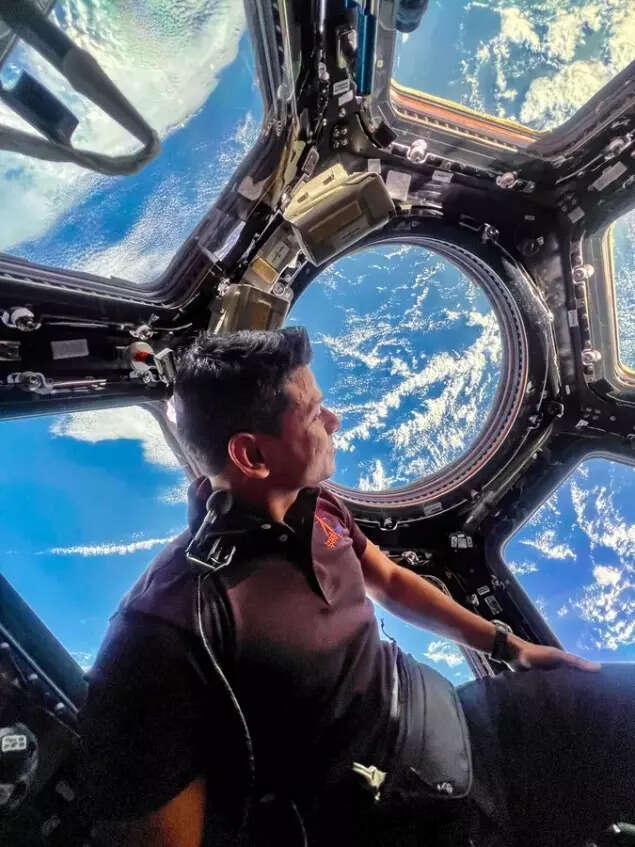
Shux looks out towards Earth from the Cupola module on ISS – pic credit: Shubhanshu Shukla–ISRO
As India plans a long-term presence in low-Earth orbit, what design or mission principles from the ISS would you keep, revise, or discard?The philosophy of modularity has been one of the ISS’s greatest gifts to space engineering. In microgravity, “weight” loses its meaning, and you can launch components separately, even years apart, and assemble them like an orbital jigsaw. But modularity works only if you treat construction as a long-term strategy, a roadmap spanning decades.Flexibility is the other key lesson. Space teaches you quickly that no plan survives first contact with reality. The ISS construction phase was a masterclass in adapting to hardware mismatches, alignment quirks, and surprises delivered by orbital mechanics. The design must have elasticity to absorb new insights and evolving technologies.A station is not just modules; it is an ecosystem. The Earth-based infrastructure—mission control, simulators, life-support testbeds, logistics chains—matters as much as the hardware in orbit. Astronauts need operational flexibility too. They become builders, plumbers, electricians, scientists, and troubleshooters.Design follows objectives. Before drawing the first bolt pattern or finalising an airlock diameter, the mission’s purpose must be clear.As India prepares for the Bharatiya Antariksh Station, we are at a pivotal moment. The insights from decades of ISS operations—its triumphs, surprises, and even its cluttered cable aesthetics—are guiding our approach. We now have the opportunity to design a next-generation station informed by a quarter-century of real orbital experience. Go to Source

