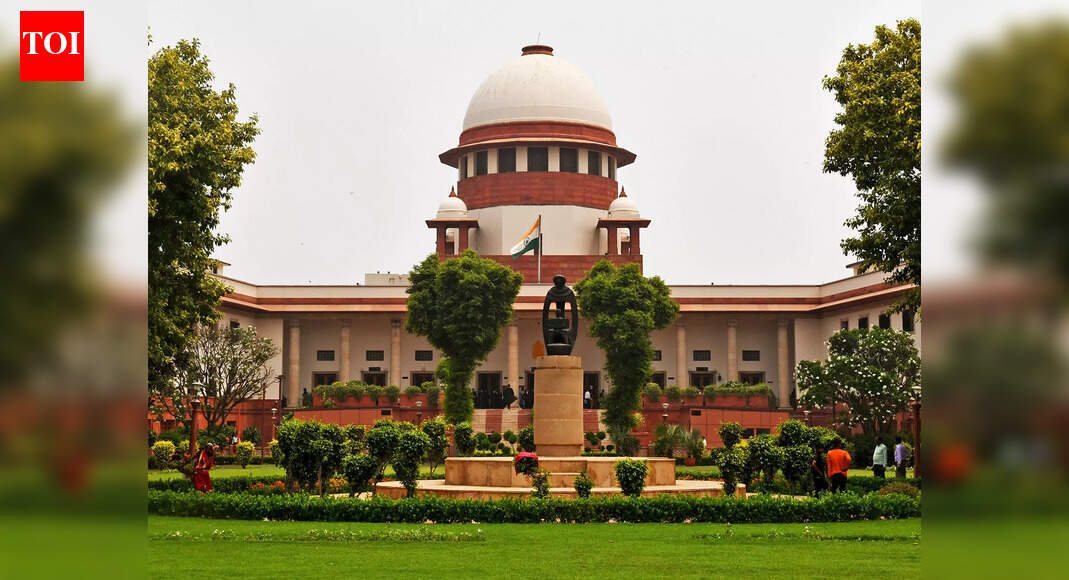

Supreme Court of India
NEW DELHI: Underlining that an investigative agency must be given freedom to conduct a probe, Supreme Court has held that courts should ordinarily refrain from setting timelines for agencies to complete the investigation as it would amount to stepping on the “toes of the latter”. A bench of Justices Sanjay Karol and N K Singh said that courts should step in to impose timelines only if there is delay on part of the agency to wrap up the investigation. “In sum, timelines are imposed reactively and not prophylactically,” it said, quashing the order of Allahabad HC that set a timeline of 90 days for the state police to complete the probe in a criminal case pertaining to procurement of arms licences on the basis of forged documents.Speedy trial, timely probe integral to Article 21: SC Supreme Court said judicial directives fixing timelines are warranted only where there is evident stagnation, unexplained inaction or a pattern of delay that cannot be justified by the nature or complexity of a case. Referring to various judgments of SC, the bench said, “Necessary conclusion to be drawn from the discussion is that timelines are not drawn by court to be followed by investigators/executive right from the beginning, for that would clearly amount to stepping on the toes of the latter. Timelines are, therefore, imposed at a point where not doing so would have adverse consequences i.e. there is material on record demonstrating undue delays, stagnation or the like.” At the same time, it stressed speedy trial, which necessarily includes timely and diligent investigation, has been recognised as an integral part of Art 21 of Constitution and cannot be ignored as it is essential to maintain fairness and credibility of criminal justice system. “The challenge, therefore, lies in balancing the practical realities of investigation with constitutional mandate that criminal proceedings, from investigation through trial, be conducted with reasonable promptitude and care. It is this balancing role that judiciary plays. It is for those reasons that while on the one hand, there is a statutorily laid down process in place which is generally followed, powers such as that of Article 226 of the Constitution and Section 482, Code of Criminal Procedure, have been kept open in their widest sense possible – to secure the ends of justice,” the bench stated. Court said the process of investigation is long and winding and legal proceedings also frequently intersect with the investigation and affect its pace and direction, and hinted that it might be difficult to complete a probe within a fixed timeline. “Applications for anticipatory bail, regular bail, or the like can result in temporary pauses or changes in strategy. Courts may call for further investigation, ask for clarification on specific aspects, or even direct a change of the investigating officer. Each such intervention requires the investigating agency to revisit its work and sometimes take a fresh path altogether,” it said. “So, it can be seen that the investigative process is at times straight, at other times one of lots of twists, turns and recalibrations and in yet others, frustratingly round-about like before it can come to a somewhat definitive conclusion to present the case for trial before the concerned, and sometimes, even at that time the definitive conclusion, at least from an investigator’s standpoint, remains elusive,” it added. Go to Source