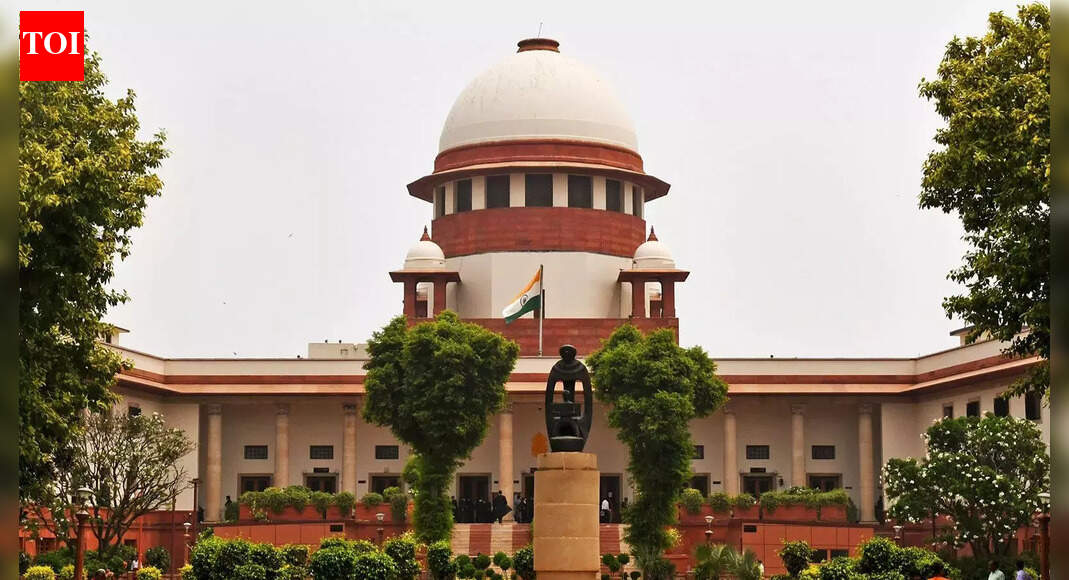

Supreme Court
NEW DELHI: Supreme Court on Wednesday came up with a unique solution to allow an advocate to pay for the maintenance of his son from his first marriage after the man expressed his inability to do so, citing his second marriage and limited income.The apex court directed that the advocate be assigned two or three cases a month by Supreme Court Legal Services Committee, which provides free legal assistance to poor litigants — an assignment that would help him earn an extra Rs 10,000 every month.The Muslim advocate had divorced his first wife with whom he had a son and married another woman with whom he had another child. The first wife moved Supreme Court challenging the mode of execution of triple talaq and claimed maintenance for her child.Appearing for the divorced woman, senior advocate Rizwan Ahmed told a bench led by Chief Justice Surya Kant she was not contesting his second marriage, though annulment of the first marriage was illegal under Sharia. “She is an educated woman. For the past 36 months, he has not paid a penny towards the maintenance of his son,” Ahmed said.When the bench asked the man to pay a monthly maintenance of Rs 10,000 in the interim, the man, through senior advocate M R Shamshad, said he was working as a junior in a lawyer’s chamber and got just Rs 21,000 as monthly remuneration. “He has a wife and a child from the second marriage. Paying Rs 10,000… would ruin his household,” Shamshad said.CJI Kant then asked Shamshad to send the advocate to Supreme Court Legal Services Committee and said he would be assigned two or three cases a month that would earn him Rs 10,000, enabling him to pay maintenance.Ahmed requested SC to consider directing the man to pay a lump-sum amount for the last 36 months. The bench asked the advocate to consider the same and posted the matter for further hearing on Jan 21, when it would also consider petitions by Muslim women challenging the triple talaq custom in Muslim Personal Law and the absence of maintenance provision for women.The women petitioners, many through advocate Ashwini Upadhyay, have challenged Talaq-e-Hasan and all other forms of unilateral and extra-judicial Talaq and sought “framing of guidelines for gender neutral, religion neutral uniform grounds of divorce and uniform procedure of divorce for all citizens”.The SC allowed a plea by advocate Ejaz Maqbool to make Hyderabad-based Sharia Committee for Women a party in the pending petitions. The committee had opposed uniform gender and religion neutral divorce procedure saying it would deprive Muslim women of their right to dissolution of marriage under Muslim Personal Law. It had said every individual shall be held accountable for their actions on the “Day of Judgement” and that concept of divine accountability underscores the balance between rights and responsibilities.