
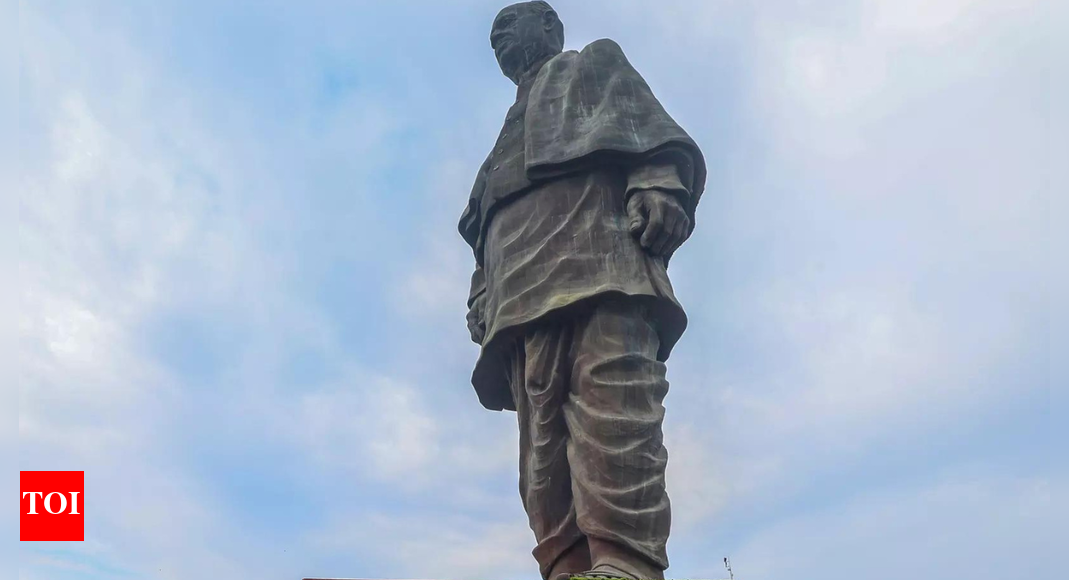


Traffic flows as usual on APJ Abdul Kalam Road (formerly Aurangzeb Road) in Lutyens’ Delhi. Behind the dense, aged neem, tamarind, and jamun trees lining both sides of the road, glimpses of grand bungalows are visible. In a small portion of one such bungalow, Sardar Vallabhbhai Patel once lived. His address was 1, Aurangzeb Road. He shifted to Delhi in 1946. It was a private residence. Sardar Patel was handling the Home and Information & Broadcasting ministries in the interim government formed in 1946 under Pandit Jawaharlal Nehru’s leadership.Police Action in HyderabadSardar Patel spent his time either in his first-floor office at North Block or at home. It was from these two places that he orchestrated the integration of 562 princely states into India after independence. While living here, he strategised the police action in Hyderabad with his advisors. Known as ‘Operation Polo’, it began at 4am on September 13, 1948. Following this action, Hyderabad was integrated into India. Sardar Patel’s daughter, Maniben Patel, also lived with him in Delhi.The Iron Man at Metcalfe HouseMetcalfe House in Civil Lines is about 15 km from Sardar Patel’s Delhi home. On April 21, 1947, he addressed soon-to-be-independent India’s bureaucrats on the importance of swaraj. He called civil servants India’s “steel frame”—meaning they were the supporting pillars of the nation’s administrative structure. Badruddin Ahmad, a 1934-batch ICS officer of the Punjab cadre, told this writer in 1998 at his West End bungalow in South Delhi that Sardar Patel met government officers at his residence after office hours. His doors were always open to everyone. He was a paragon of integrity. He owned no house. At his death, his bank account held just Rs 260.Who Was the Last Person to Meet Gandhi?Sardar Patel was the last person to meet Gandhi on that ill-fated January 30, 1948. He arrived at 5, Albuquerque Road (now 5, Tees January Marg) shortly before 4:45pm to see Gandhi. He had come directly from his residence to Birla House. The time for Gandhi’s interfaith prayer meeting was approaching. People had begun gathering at the prayer ground. The meeting usually started at 5pm K.D. Madan, who recorded the proceedings for All India Radio, had also arrived.Madan recalled: “When Gandhi emerged from inside Birla House to join the prayer meeting, it was 5:16pm by my watch. Though it is said the shots were fired at 5:17pm. That day, Sardar Patel had come to discuss something urgent with Bapu.” What Patel wanted to discuss and why their conversation ran long remains a mystery. Even on October 2, 1947, Sardar Patel met Mahatma Gandhi at Birla House. Bapu marked the day with fasting, prayer, and extended time at his charkha. He felt deeply disheartened and helpless amid the prevailing conditions. Gandhi’s despair was palpable. Gandhi spoke openly, asking Patel, “What crime have I committed that I must live to see this sorrowful day?” Maniben Patel wrote: “We went with enthusiasm but returned heavy-hearted.” Until Sardar Patel’s death, Maniben served him devotedly, witnessing his hopes, disappointments, sorrows, and joys up close. After his passing, she entered politics and served society as an MP for nearly three decades, embodying the simplicity inherited from Gandhi and Patel throughout her life.Install a Plaque at Sardar’s BungalowRegrettably, no one has made an effort to install a plaque outside the home of this towering figure of independent India, so that the younger generation remains aware that Sardar Patel’s Delhi residence witnessed many pivotal events in the nation’s history. His life was akin to that of an ascetic. When the interim government was formed in 1946 under Pandit Nehru’s leadership, and later India’s first government in 1947, Dr. Rajendra Prasad lived on Rajendra Prasad Road (formerly Queen Victoria Road), C. Rajagopalachari on Rajaji Marg (formerly Hastings Road), and Babu Jagjivan Ram on Krishna Menon Marg (formerly King George Avenue). Yet Sardar Patel never took a large bungalow for himself.After Sardar Patel’s death in Mumbai on December 15, 1950, the government wanted to acquire his bungalow and turn it into a memorial. But the owner, Banwari Lal Purohit’s family, reportedly refused. It is surprising that the capital has no proper memorial for a figure of Patel’s stature, especially since many critical decisions were taken while he lived here. Memorials exist for Gandhi, Pandit Nehru, Baba Saheb Ambedkar, Lal Bahadur Shastri, Indira Gandhi, Babu Jagjivan Ram, and others—yet none for Patel. This is a question in itself. If Birla House, where Gandhi spent his last 144 days, and 26 Alipur Road, where Dr. B.R. Ambedkar lived until his death in 1956, could be preserved as memorials, why not Sardar Patel’s home? Similar examples abound. Go to Source