
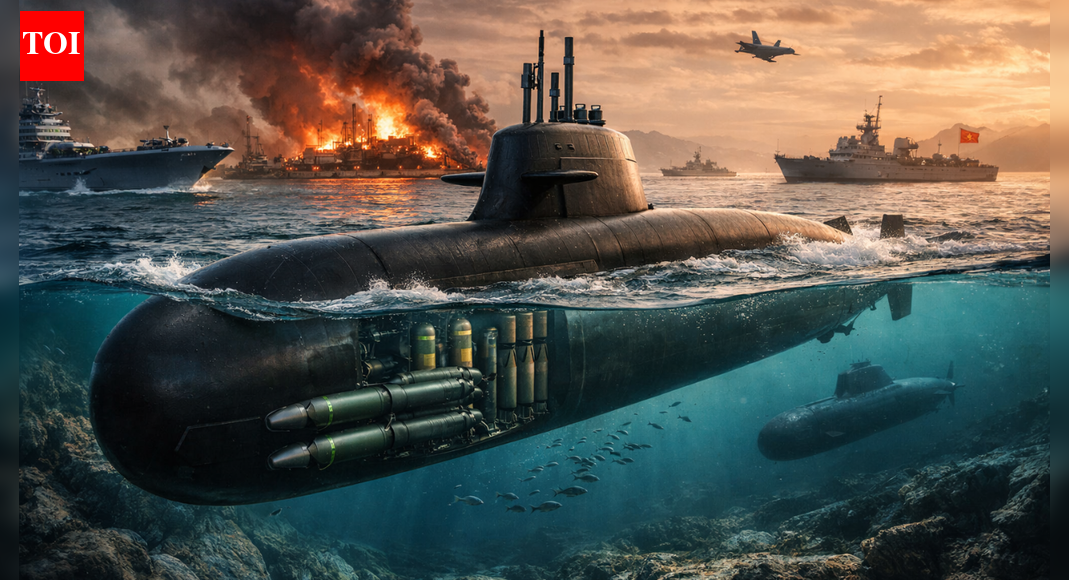


NEW DELHI: More than five decades after Indian naval strikes crippled Karachi during the 1971 war, undersea power is once again at the heart of New Delhi’s strategic thinking. As German Chancellor Friedrich Merz begins his visit to India on Monday amid a more volatile regional and global security environment, discussions around Project-75I have acquired fresh urgency.The Indian Navy’s plan to induct six next-generation conventional submarines equipped with air-independent propulsion reflects a convergence of hard lessons from history, renewed friction with Pakistan following recent crises, and China’s expanding undersea presence in the Indian Ocean. Together, these factors are pushing India towards one of its most consequential naval procurement decisions in years, one that blends deterrence, indigenisation and long-term strategic signalling.
What is Project-75I and why it matters
Project-75I is the Indian Navy’s flagship programme to build six modern diesel-electric submarines equipped with fuel-cell-based air-independent propulsion, advanced sensors, torpedoes and missile systems. The Ministry of Defence issued the Request for Proposal for the project in July 2021 under the Strategic Partnership Model, describing it as a key pillar of the government’s Make in India push, according to a PIB statement.
The project envisages indigenous construction, long-term technology transfer and the creation of a domestic submarine-building ecosystem. The estimated cost was over Rs 40,000 crore at the RFP stage, with current assessments placing the final contract value closer to $8 billion, or about Rs 72,000 crore, based on configuration and lifecycle support.For the Indian Navy, the programme addresses a critical gap. Its conventional submarine fleet is ageing even as undersea activity by China and Pakistan increases in the Indian Ocean and along India’s maritime approaches.
Why the German Type-214NG was selected
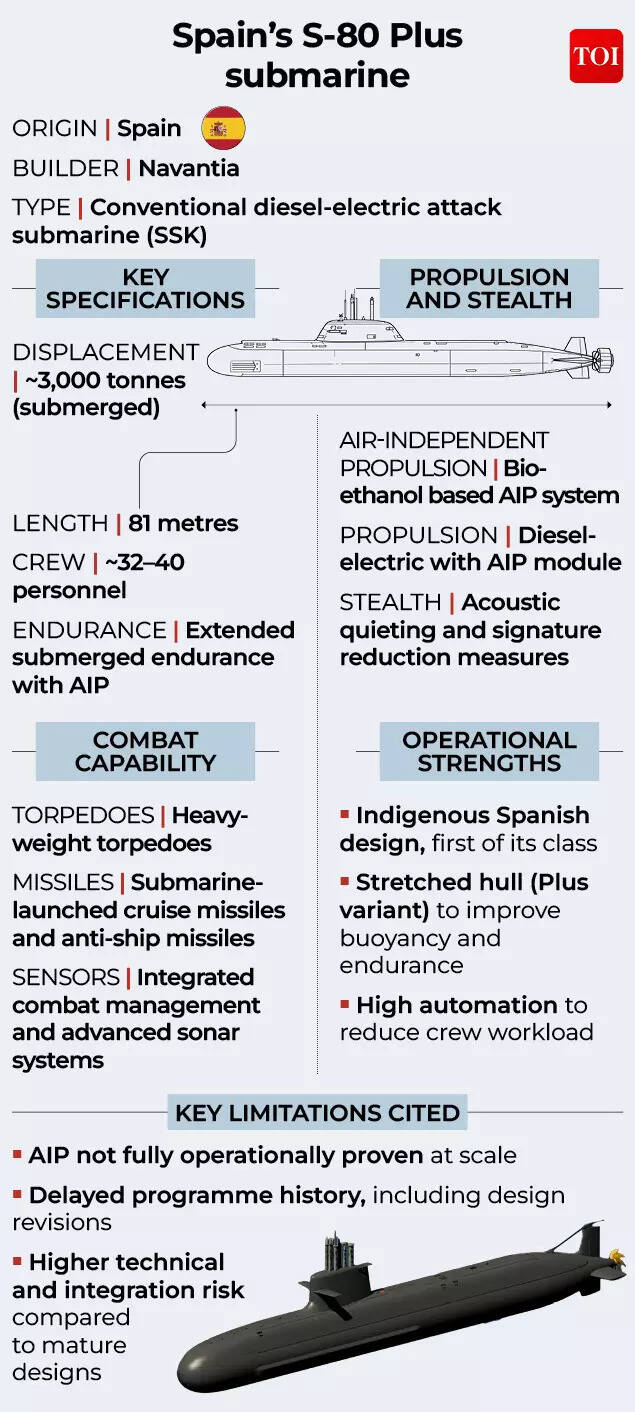
The Indian Navy has selected the German Type-214 Next Generation submarine, edging out Spain’s S-80 Plus offered by Navantia, defence sources said. The decision was driven primarily by the maturity of the German fuel-cell-based AIP system, acoustic stealth and lower lifecycle risk.
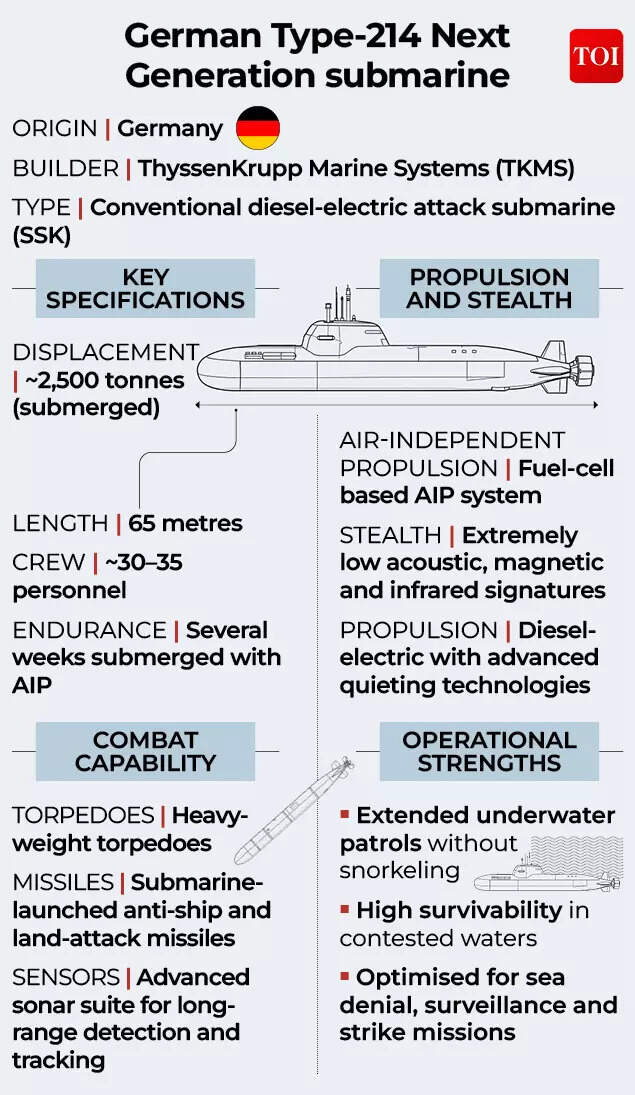
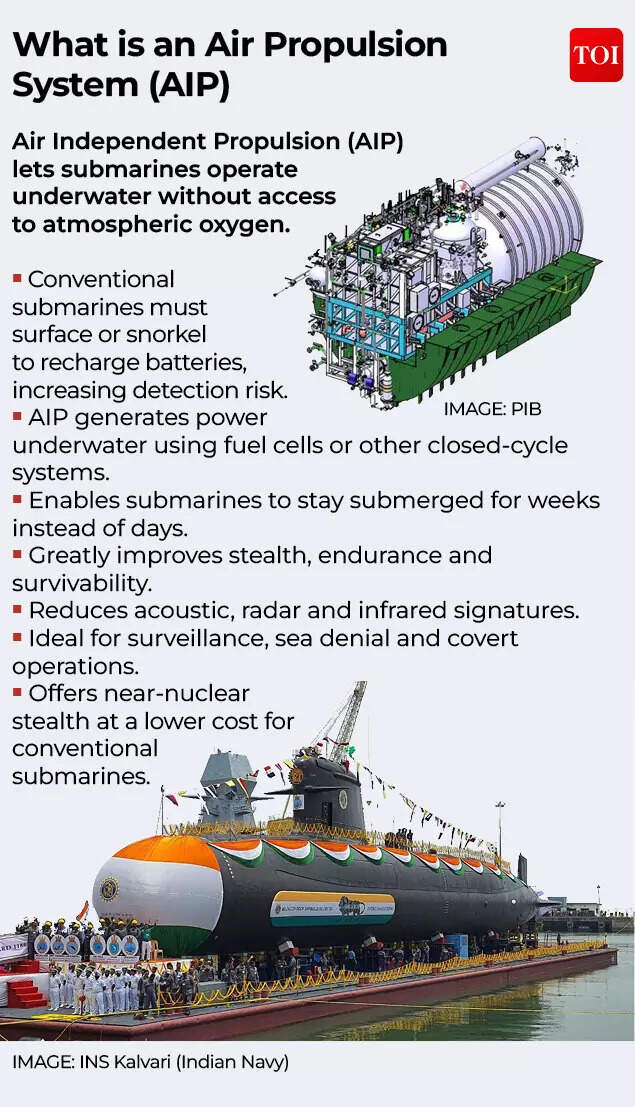
AIP allows submarines to remain submerged for weeks without surfacing or snorkeling, reducing detection risk. In contested waters, endurance and silence are decisive. The Type-214’s AIP technology is widely regarded as operationally proven, while competing systems are still undergoing validation.In undersea warfare, reliability and survivability often outweigh novelty. That calculus appears to have guided the Navy’s choice.
Make in India at the core
Under the proposed framework, all six submarines will be built in India at MDL, with TKMS providing design authority, engineering expertise and technical consultancy. Indigenous content is expected to start at around 45 percent and rise to nearly 60 percent by the final boat, aligning with Atmanirbhar Bharat goals.TKMS and MDL signed a memorandum of understanding in June last year to jointly pursue the project, laying the groundwork for the partnership. MDL’s prior experience building Scorpène-class submarines under the earlier Project-75 strengthened its case as the Indian strategic partner.
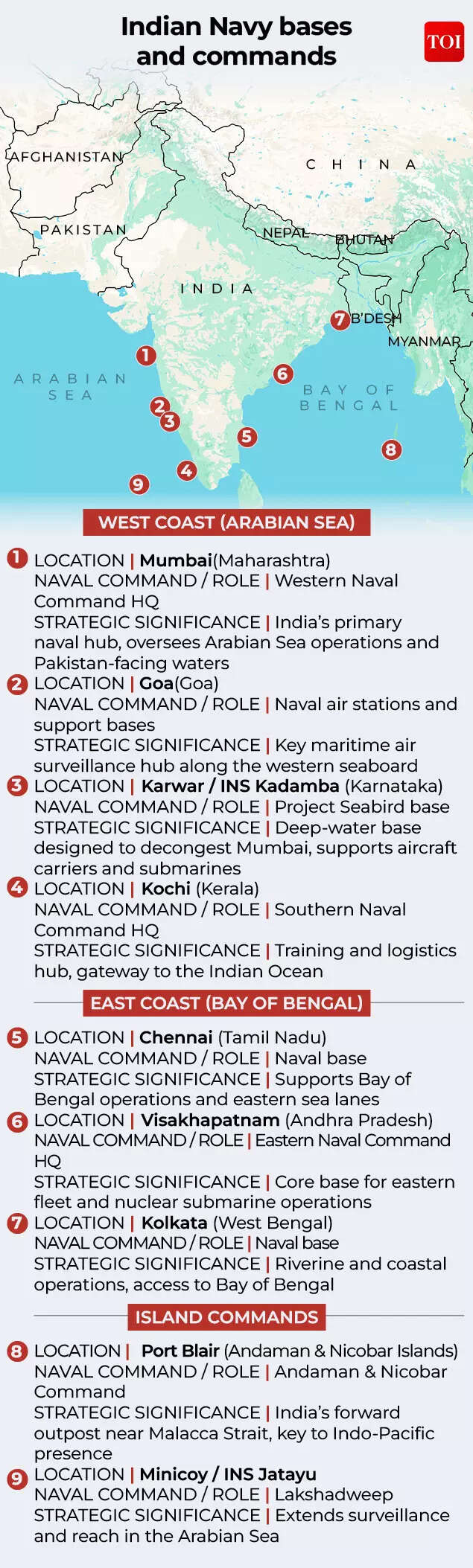
The ministry of defence has repeatedly stressed that Project-75I is not only about acquiring platforms but about absorbing complex submarine design and construction technologies, as outlined in the 2021 PIB release.
Pakistan, Karachi and the logic of sea denial
India’s emphasis on undersea capability is rooted in history. During the 1971 war, the Indian Navy’s attacks on Karachi port crippled Pakistan’s maritime logistics and fuel supply, accelerating Islamabad’s defeat. That episode stressed how control of the seas can shape outcomes on land.The relevance of that lesson resurfaced during Operation Sindoor in May 2025, when tensions with Pakistan escalated following a major terror provocation. Between May 8 and May 11, India placed its naval forces on heightened readiness, with Karachi again emerging as Pakistan’s most critical vulnerability.Karachi handles the bulk of Pakistan’s maritime trade and energy imports. India’s ability to credibly threaten that hub, even without firing a shot, highlighted the deterrent value of naval and undersea power. New submarines with extended underwater endurance would sharpen that leverage.
China’s expanding undersea footprint
Beyond Pakistan, China looms large in India’s maritime threat assessment. The People’s Liberation Army Navy operates a rapidly expanding submarine fleet, including nuclear-powered platforms that have increasingly deployed into the Indian Ocean.Chinese submarines have docked at regional ports and conducted patrols close to Indian waters, while Pakistan, with Chinese assistance, is also upgrading its submarine arm. For Indian planners, this twin challenge has made restoring conventional submarine strength an urgent priority.
Project-75I is designed to plug that gap by giving India a survivable, persistent undersea capability suited to monitoring choke points, tracking adversary submarines and conducting sea-denial operations.
Strategic timing of Merz’s visit
Chancellor Merz’s visit from January 12–13 comes amid a broader effort by Germany to expand its strategic footprint in the Indo-Pacific. Berlin and New Delhi are also working toward an EU-India free trade agreement, as noted by AFP.For India, the potential submarine deal fits into a wider diversification of defence partnerships beyond legacy suppliers such as Russia. For Germany, it represents an opportunity to anchor a long-term industrial and security relationship with the world’s largest democracy.According to informed defence sources cited by idrw.org, the final contract is not expected to be signed during Merz’s visit but could be concluded within the next three months, with the high-level engagement expected to provide political momentum.
French-origin Scorpene follow-on plan put on hold as Project-75I gained priority
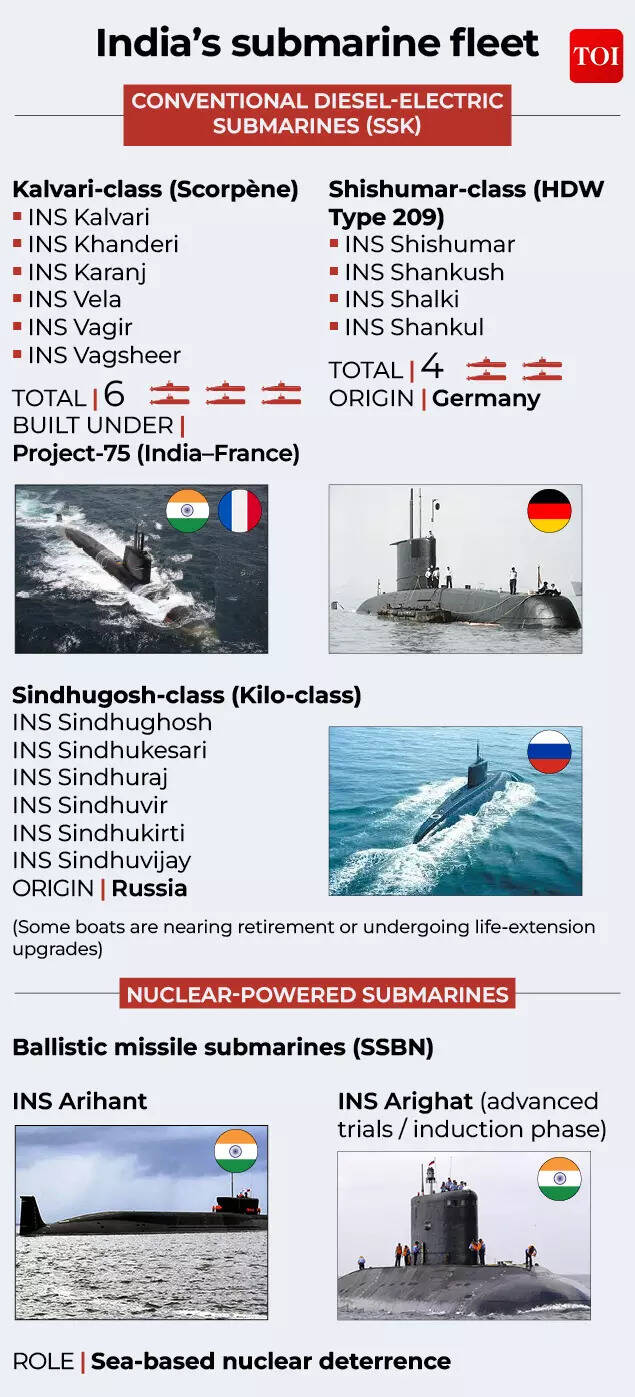
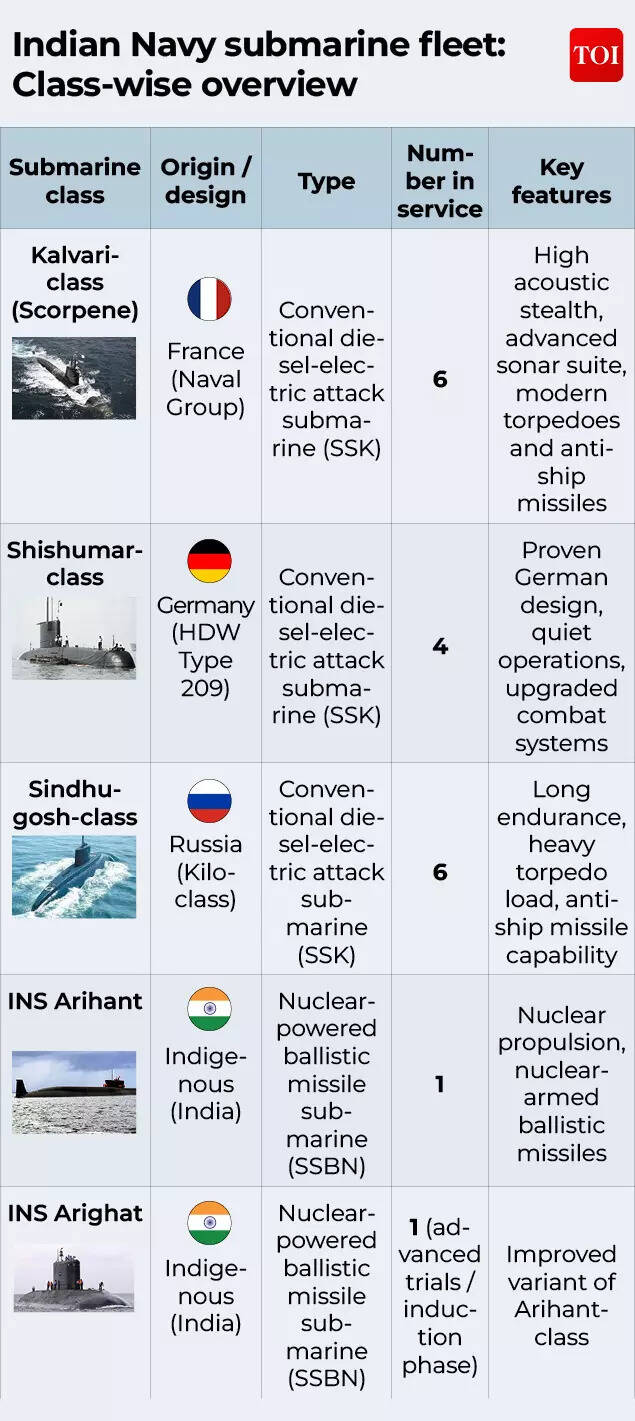
In October 2025, India put on hold plans to build three additional French-origin Scorpene submarines at Mazagon Dock Shipbuilders Limited, even as it moved decisively to push ahead with Project-75I, which envisages the construction of six new-generation German-origin diesel-electric submarines at the same shipyard, The Times of India reported.Top government sources told TOI that the proposal for the three additional Scorpenes, estimated to cost around Rs 36,000 crore, “was not being pursued” at the time, although a formal decision to scrap it had not been recorded. While cost negotiations for the Scorpene follow-on order had concluded in the previous fiscal, final clearance from the Prime Minister-led Cabinet Committee on Security remained on hold.Officials told TOI that the German submarines under Project-75I were considered “a generation ahead” in terms of technology and capability. Concerns also existed about MDL’s ability to simultaneously execute two complex submarine construction programmes. The six original Kalvari-class submarines had already been built at MDL under the earlier Project-75 contract signed in October 2005, with the first boat INS Kalvari commissioned in December 2017 and the sixth, INS Vagsheer, inducted in January 2025.All six Kalvari-class submarines were slated to be retrofitted with the DRDO-developed air-independent propulsion system to improve underwater endurance. AIP allows a diesel-electric submarine to remain submerged for nearly two weeks, compared to boats without the system that must surface or snorkel every few days to recharge batteries.In contrast, the submarines planned under Project-75I, to be built in partnership with Germany’s ThyssenKrupp Marine Systems, were designed to incorporate AIP from the outset, along with land-attack cruise missiles and other next-generation technologies, TOI reported.Sources told TOI that the decision to proceed with final techno-commercial negotiations for the six German submarines, with an option for three more at a later stage, followed extensive deliberations involving the defence ministry, the Navy and the National Security Council Secretariat. Formal contract negotiations began in September 2025.“These new-generation boats under P-75I will come with design ToT (transfer of technology) and a greater indigenisation level of around 60%. The project will serve as a bridge to the future P-76, under which conventional submarines will be constructed based on totally indigenous design,” a source told TOI.Despite the pause on the Scorpene extension, officials indicated that France’s broader strategic partnership with India remained strong. Negotiations progressed on additional Rafale fighters for the Indian Air Force’s proposed 114 multi-role fighter aircraft programme, as well as a collaboration to co-develop a powerful jet engine with French major Safran for India’s fifth-generation Advanced Medium Combat Aircraft was nearly finalised.At the time, the Navy’s conventional submarine strength stood at six Scorpenes, six ageing Russian Kilo-class boats and four German HDW submarines, alongside two nuclear-powered ballistic missile submarines. China, by comparison, operated more than 50 diesel-electric and around 10 nuclear submarines and was in the process of supplying eight Yuan-class AIP-equipped submarines to Pakistan, a development seen as a major capability boost for Islamabad, TOI reported.
Long-term impact on India’s naval posture
Once inducted, the six Type-214NG submarines will significantly enhance the Indian Navy’s capacity for covert surveillance, sea denial and precision strike missions. Their sensors, weapons and endurance will form a key layer of India’s maritime deterrence architecture.Equally important is the industrial legacy. By absorbing advanced submarine technologies, India positions itself for future indigenous designs and follow-on projects. MDL’s role would be strengthened, and a specialised domestic supply chain would be deepened.
Project-75I marks one of the most consequential naval procurement decisions India has taken in years. It addresses hard lessons from 1971, recent operational realities with Pakistan, and the growing challenge posed by China’s undersea expansion.As Germany’s chancellor arrives in India, the submarine negotiations underscore how defence industrial cooperation has become central to New Delhi’s foreign policy. From Karachi’s burning docks in 1971 to the silent depths of the Indian Ocean today, India’s maritime strategy is being reshaped through capability, indigenisation and strategic foresight. Go to Source