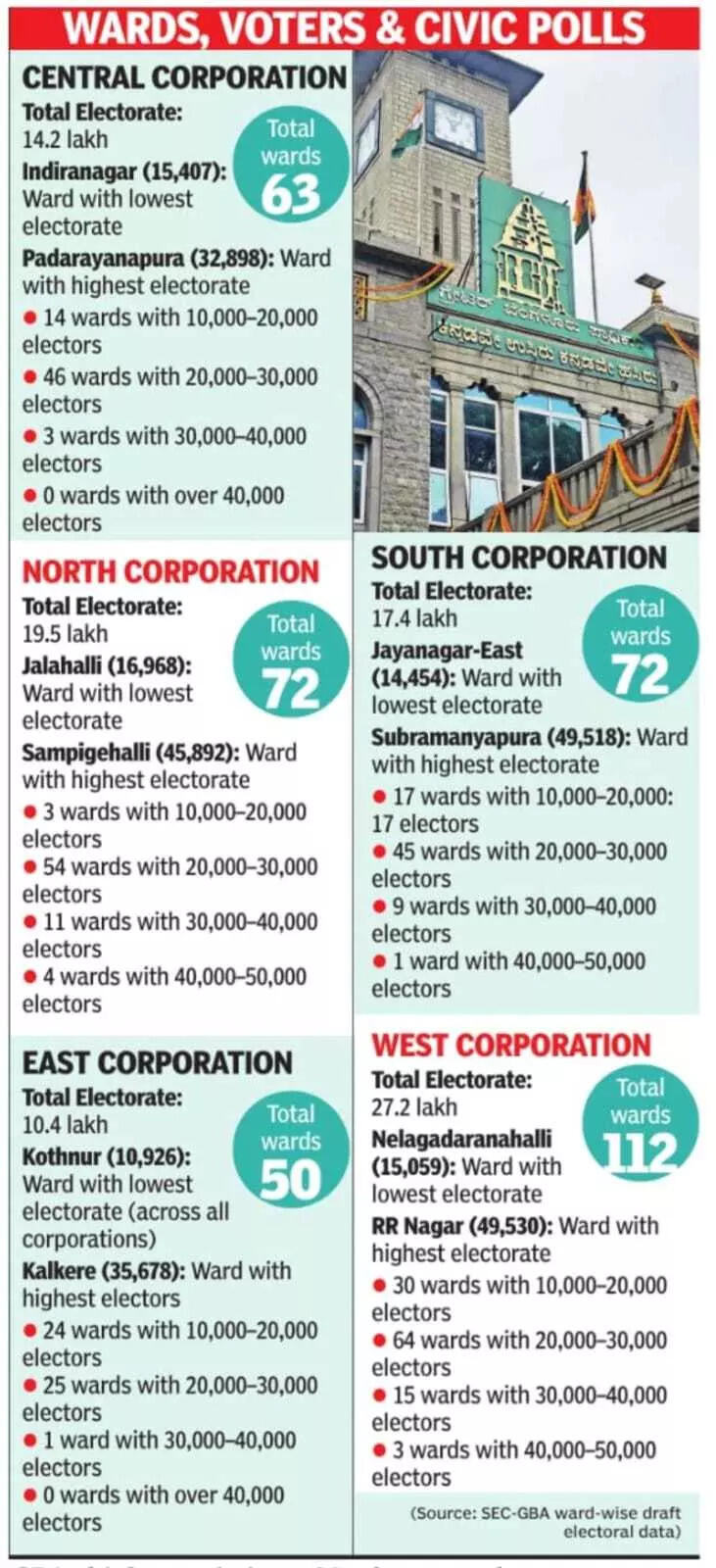
BENGALURU: The city’s new municipal structure under the Greater Bengaluru Authority (GBA) exposes a fundamental challenge to democratic representation: massive disparities in voter counts across wards. With more than 88.9 lakh electors distributed across 369 wards in five corporations as per the draft rolls, Bengaluru’s electoral map reveals not just administrative divisions, but deep inequities in political voice.The numbers tell a story. Kothanur (Ward 16) in East Corporation represents just 10,926 voters, while RR Nagar (Ward 23) in West Corporation speaks for 49,530—a 4.5-fold difference. This means a voter in East’s smallest ward theoretically wields four times the electoral influence of someone in West’s largest. Such imbalances could fundamentally undermine the principle of “one person, one vote”. Also, if past voter turnout data is a barometer, then back-of-the-envelope calculations suggest that a candidate with as few as a 1,000 votes could become a corporator in Kothanur. Among the corporations, North emerges as the most internally unequal, with four wards exceeding 40,000 electors while some hover around 17,000. This sprawl reflects Bengaluru’s explosive, unplanned growth along its northern periphery, areas that have absorbed migration and development without corresponding administrative restructuring. South Corporation tells a similar tale, housing both tiny wards of 14,000 and megawards approaching 50,000, suggesting frozen boundaries that haven’t kept pace with demographic shifts.Central and East corporations show tighter clustering, but this consistency comes at a cost. Central’s concentration in the 20,000-30,000 range (73% of its wards) suggests older, stabilised neighborhoods, while East’s even split between smaller and mid-sized wards points to a corporation still finding its demographic balance.West Corporation, with 112 wards—the most of any corporation—paradoxically contains some of the city’s largest wards despite having the most opportunities for equitable division. Overall, of the 369 wards across the five corporations, there are 234 with 20,000-30,000 electors, 88 with 10,000-20,000 electors, 39 with 30,000-40,000 electors and eight that have more than 40,000 but under 50,000 electors.
–
“As per the guidelines for delimitation, we could only go by the population figure and not that of the total electorate. That was the statute. Therefore, we have gone with the population figure available as per the 2011 census,” GBA chief commissioner M Maheshwar Rao, told TOI.Notwithstanding why the delimitation has created wards with such massive disparity, the disparities will have real consequences. Councillors representing nearly 50,000 voters face impossible service demands compared to those with 15,000 constituents. Budget allocations, infrastructure priorities, and political attention inevitably skew toward larger wards. As Bengaluru confronts its infrastructure crisis, this electoral imbalance means unequal access to civic solutions—entrenching disadvantage in a city already struggling with spatial inequality. Go to Source