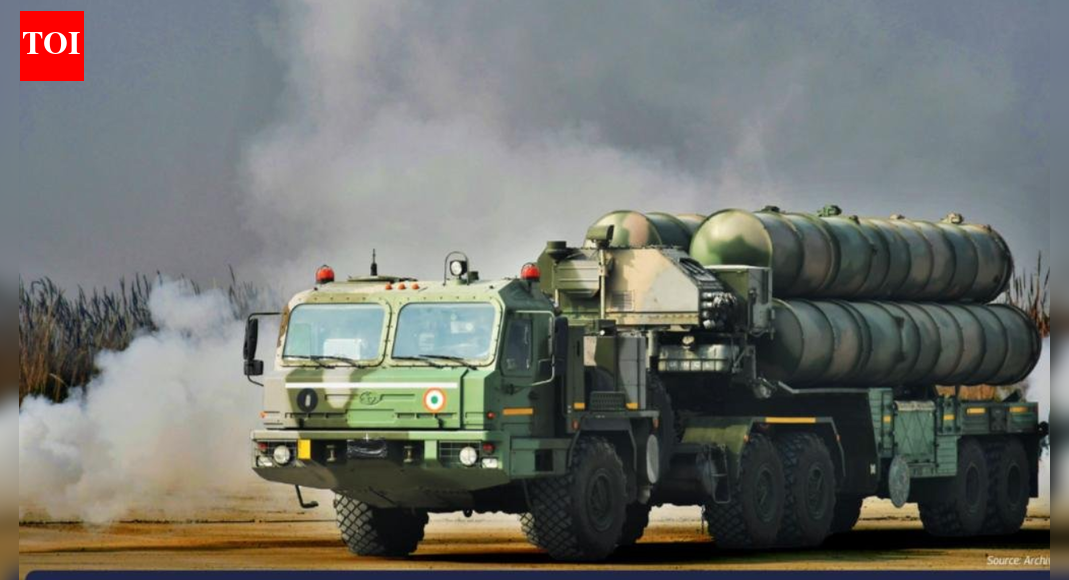

Sudarshan – surface-to-air defence system
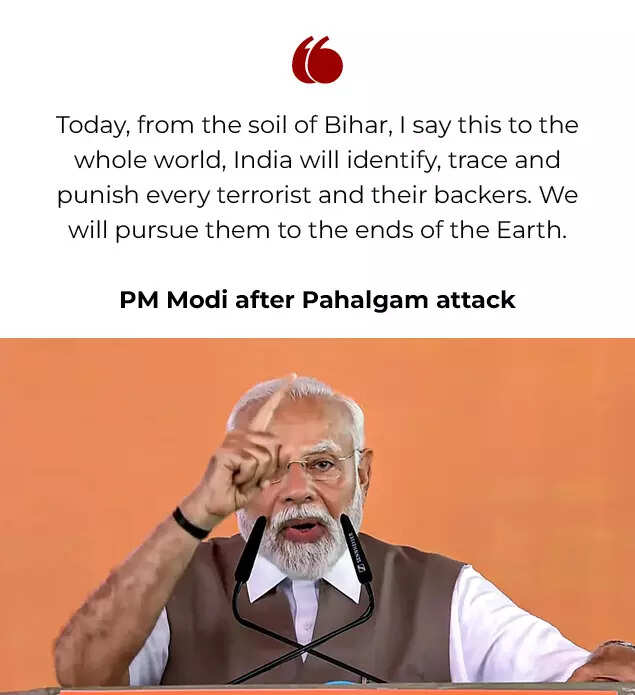
NEW DELHI: The “new normal” in India’s national security playbook took on a harder edge in 2025. Under Prime Minister Narendra Modi, the country’s zero-tolerance doctrine against terrorism, especially the kind nurtured across the border in Pakistan, became not just policy but a mindset. For years, Pakistan has acted much like a hostile neighbour, failing short of India’s expectations while cultivating, training and unleashing anti-India sentiment and activities from its soil. In 2025, that long-running tension erupted into one of the darkest chapters in Kashmir’s recent history.Crossborder terrorism and India’s counterterror responses became defining markers of 2025. The Pahalgam massacre, one of the most horrifying attacks in recent years, shook the nation and ignited widespread grief and anger.The Prime Minister, who was abroad at the time, cut short his trip and returned to New Delhi immediately.In his first public remarks after the attack, switching briefly and unusually to English, he signalled India’s mood and mission. “Today, from the soil of Bihar, I say this to the whole world, India will identify, trace and punish every terrorist and their backers. We will pursue them to the ends of the Earth,” he declared, framing a battle of “Yuddha” against terror from the land of “Buddha.”
The year went on to witness not just an ugly terror attack but also India’s most far-reaching counteroffensive since the 2016 surgical strikes and the 2019 Balakot airstrikes. Operation Sindoor, New Delhi’s military retaliation after Pahalgam, targeted terror infrastructure deep inside Pakistan and PoK, making this the first time India expanded its precision strikes beyond PoK into mainland Pakistan.The operation, the government says, remains in a “paused” state. Alongside Sindoor, several other counterterror operations were carried out through the year, keeping a firm and continuous check on terror.
Pahalgam massacre
April 22 began as a quiet spring morning in the Baisaran Valley in Pahalgam, a routine day for a popular tourist spot. Within hours, it became the scene of one of the gravest terror incidents in recent years. Pakistan-sponsored terrorists, from a proxy group of Lashkar-e-Taiba, opened fire on civilians in the meadows, killing 26 people and leaving the region shaken.
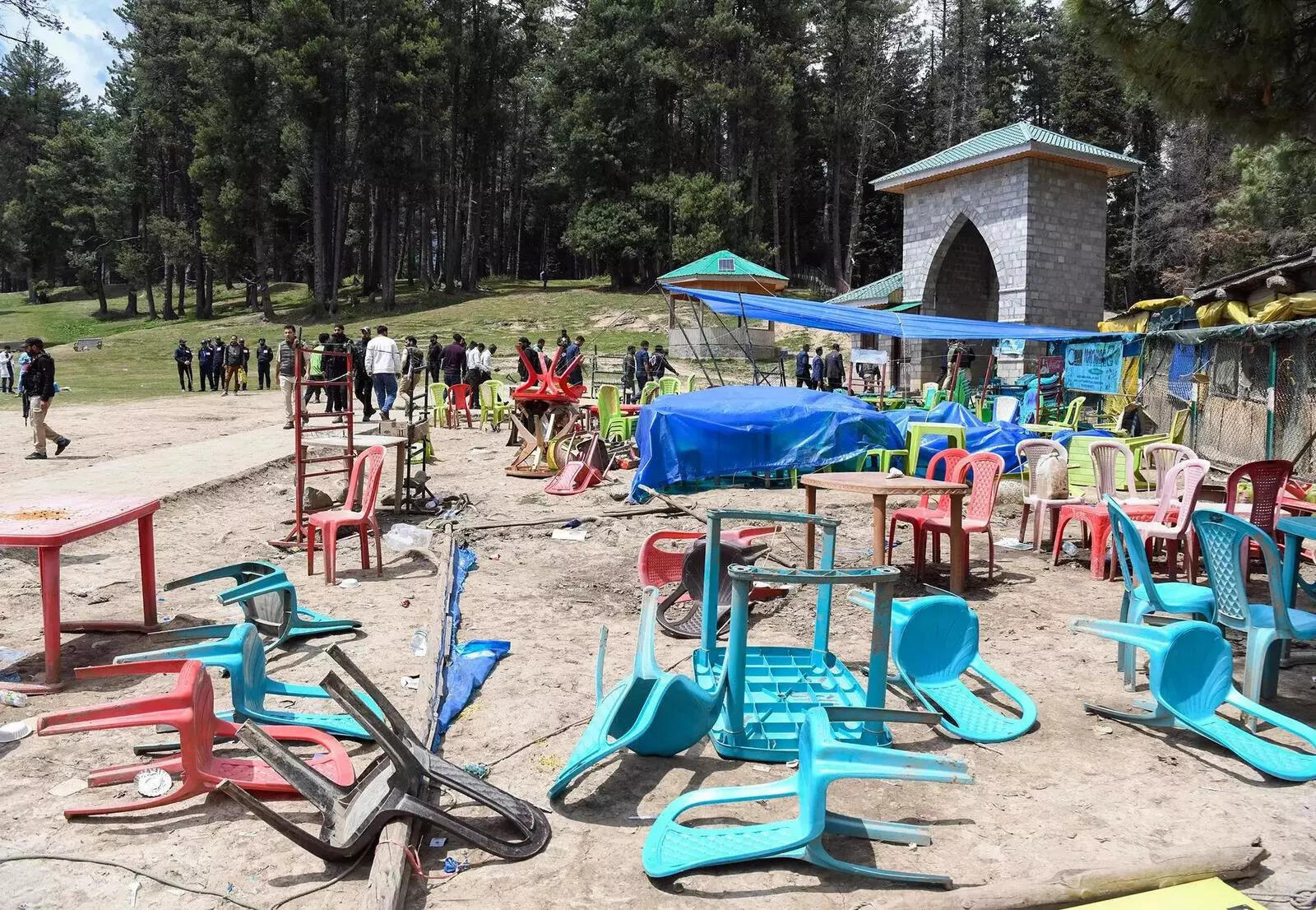
Baisaran Valley, Pahalgam
Eyewitnesses recounted the attackers tried to identify victims’ faith by demanding Aadhaar cards or driving licences, asking them to recite the kalma, and even forcing some to unzip their pants so they could check for circumcision. Unlike many other terror incidents, this attack reportedly did not follow a usual pattern, as the killings appeared to be carried out selectively.As soon as the news reached the national capital, New Delhi moved quickly. Union home minister Amit Shah reached the Valley the same day and also visited the site in Baisaran later. Prime Minister Narendra Modi, who was on an official trip to Saudi Arabia, cut short his two-day visit, skipped a scheduled state dinner to be hosted by Kingdom and returned to India immediately.Global leaders spoke to the Prime Minister, expressing condemnation and solidarity. The attack also coincided with the visit of US Vice President JD Vance, who was in India on a four-day trip with his family. From US President Donald Trump to then Nepalese prime minister KP Oli, several world leaders reached out to PM Modi, conveying support for India and strongly condemning the attack.”President Donald Trump @realDonaldTrump @POTUS called PM @narendramodi and conveyed his deepest condolences at the loss of innocent lives in the terror attack in Jammu and Kashmir. President Trump strongly condemned the terror attack and expressed full support to India to bring to justice the perpetrators of this heinous attack. India and the United States stand together in the fight against terror,” The ministry of external affairs spokesperson Randhir Jaiswal said in a post on X. As investigations began, it quickly became evident that the conspiracy once again traced back to Pakistan and its proxy terror networks. Evidence pointed clearly to crossborder involvement, with the planning and execution of the Pahalgam attack fitting the same pattern seen in past incidents in the region.For the agencies, Pakistan’s role was no mystery. Army units and intelligence teams followed the trail, identified those behind the killings, and eventually eliminated the Lashkar terrorists responsible for the April 22 massacre during Operation Mahadev in August.
Punitive actions on Pakistan
The very next day of attack, on April 23 — India initiated retaliatory measures diplomatically against Pakistan. New Delhi announced a series of strict punitive actions, signalling a decisive diplomatic response.That evening, the ministry of external affairs, led by foreign secretary Vikram Misri, briefed the media after a meeting of the Cabinet Committee on Security (CCS) chaired by Prime Minister Modi. The intent was communicated unambiguously: India would respond firmly to the Pahalgam attack and hold Pakistan accountable.The decisions taken were strong retaliatory steps aimed at exerting diplomatic and economic pressure on Pakistan, whose soil has long been used to support terror networks targeting India.
1. Suspension of Indus Waters Treaty
The long-standing Indus Waters Treaty, signed in 1960 with World Bank mediation, was put in abeyance with immediate effect. The move sent a clear message. The waters of the Indus, Jhelum and Chenab are vital for Pakistan’s agriculture, particularly wheat and cotton, and form the backbone of its water security.Following the suspension, Pakistan faced a heightened risk of inadequate water storage earlier this year, according to the Ecological Threat Report 2025. Roughly 80% of Pakistani farmland depends on the Indus basin, as do most of its hydropower projects.
2. Closure of Attari integrated check post
India closed the Attari border ICP and instructed individuals who had crossed with valid endorsements to return through the same route immediately.
3. Cancellation of Saarc Visa Exemption Scheme (SVES) privileges
Pakistani nationals were barred from travelling to India under the SAARC Visa Exemption Scheme. All previously issued SVES visas were cancelled with immediate effect, and Pakistani nationals in India were instructed to leave within 48 hours.
4. Expulsion of defence advisors
India declared the defence, naval and air advisors at the Pakistani high commission in New Delhi as Persona Non Grata, giving them a week to leave the country.India simultaneously withdrew its own defence, naval and air Advisors from its high commission in Islamabad. These posts in both missions were formally annulled, along with the withdrawal of five associated support staff on each side.
5. Reduction of high commission staff strength
The staff strength in both high commissions was ordered to be reduced from 55 to 30, with the changes taking effect by 1 May 2025.These measures underscored a clear shift: Pakistan was pushed to the margins of India’s diplomatic priorities, a direct consequence of the Pahalgam attack and its continuing role in crossborder terrorism.
India’s armed response: Operation Sindoor
After days of rising tension and diplomatic fallout with Pakistan, India launched a decisive military response. On the intervening night of May 6 and 7, almost two weeks after the Pahalgam attack, the Indian armed forces carried out Operation Sindoor, targeting key terror bases, including high-value targets.The terrorists responsible for the Pahalgam attack were linked to LeT’s proxy, The Resistance Front (TRF). The operation struck nine terror installations, including the Muridke base of LeT chief Hafiz Saeed. The Bahawalpur base of JeM chief Masood Azhar was also targeted, resulting in the deaths of several of Azhar’s family members.
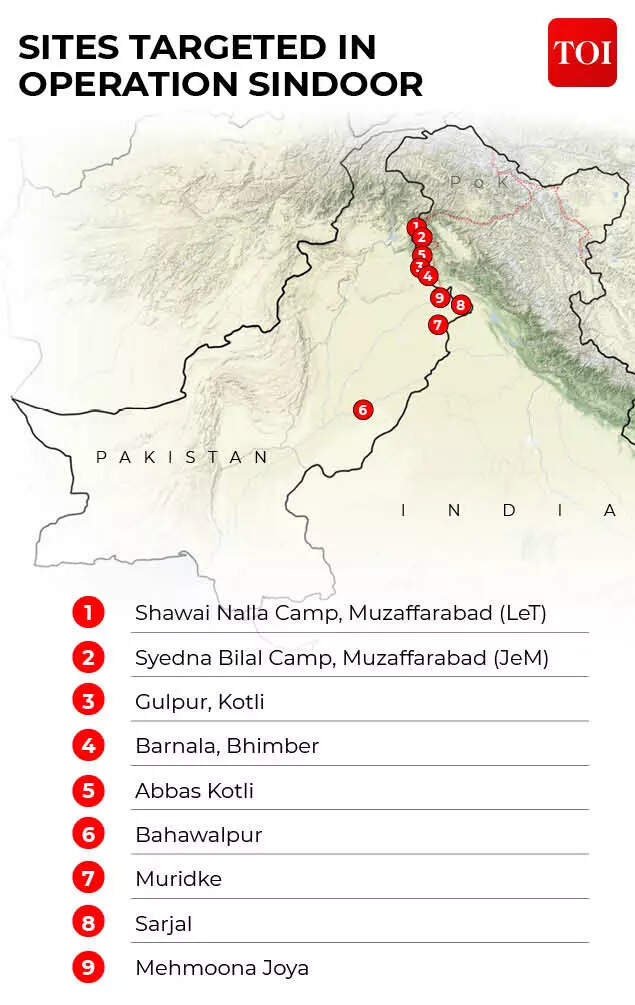
According to the ministry of defence, the operation was so far “focused, measured and non-escalatory,” deliberately avoiding Pakistani military facilities.The Indian Air Force struck nine high-value terror camps where militants harboured and trained. These included:
- Markaz Subhan Allah, Bahawalpur – JeM
- Markaz Taiba, Muridke – LeT
- Mehmoona Joya, Sialkot – Hizbul Mujahideen
- Markaz Ahle Hadith, Barnala – LeT
- Markaz Abbas, Kotli – JeM
- Maskar Raheel Shahid – Hizbul Mujahideen
- Shawai Nalla Camp, Muzaffarabad – LeT
India made it clear that the precision strikes targeted only terrorist infrastructure and did not affect Pakistan’s state or army installations.But in the following night, Pakistan carried out another misadventure and attempted retaliation with the barrage of drones and missiles, which were seen from several cities on border line.However, India’s Sudarshan Chakra, a multi-layered integrated air defence system including IADS and the S-400, intercepted and neutralised all threats, including Turkish drones, Chinese missiles, and possibly some Pakistani aircraft, preventing any damage on Indian soil.The day after the operation, the MEA held a briefing led by foreign secretary Misri, joined by Colonel Sofia Qureshi and Wing Commander Vyomika Singh, to provide updates on the military action of the night.

“These were neutralized by the Integrated Counter Unmanned Aerial System and other Air Defence systems,” said Wing Commander Vyomika Singh during an MEA briefing.In response, India carried out further strikes inside Pakistan, targeting 11 key airbases, including Nur Khan, Rahim Yar Khan, Bholari, Rafiqui, Murid, Sukkur, Sialkot, Pasrur, Chunian, Skaru, and Jacobabad. The strikes reportedly destroyed around 20 percent of Pakistan Air Force infrastructure, including fighter jets and a SAM system. Over 50 personnel were killed at Bholari Air Base, including Pakistan squadron leader Usman Yousuf.
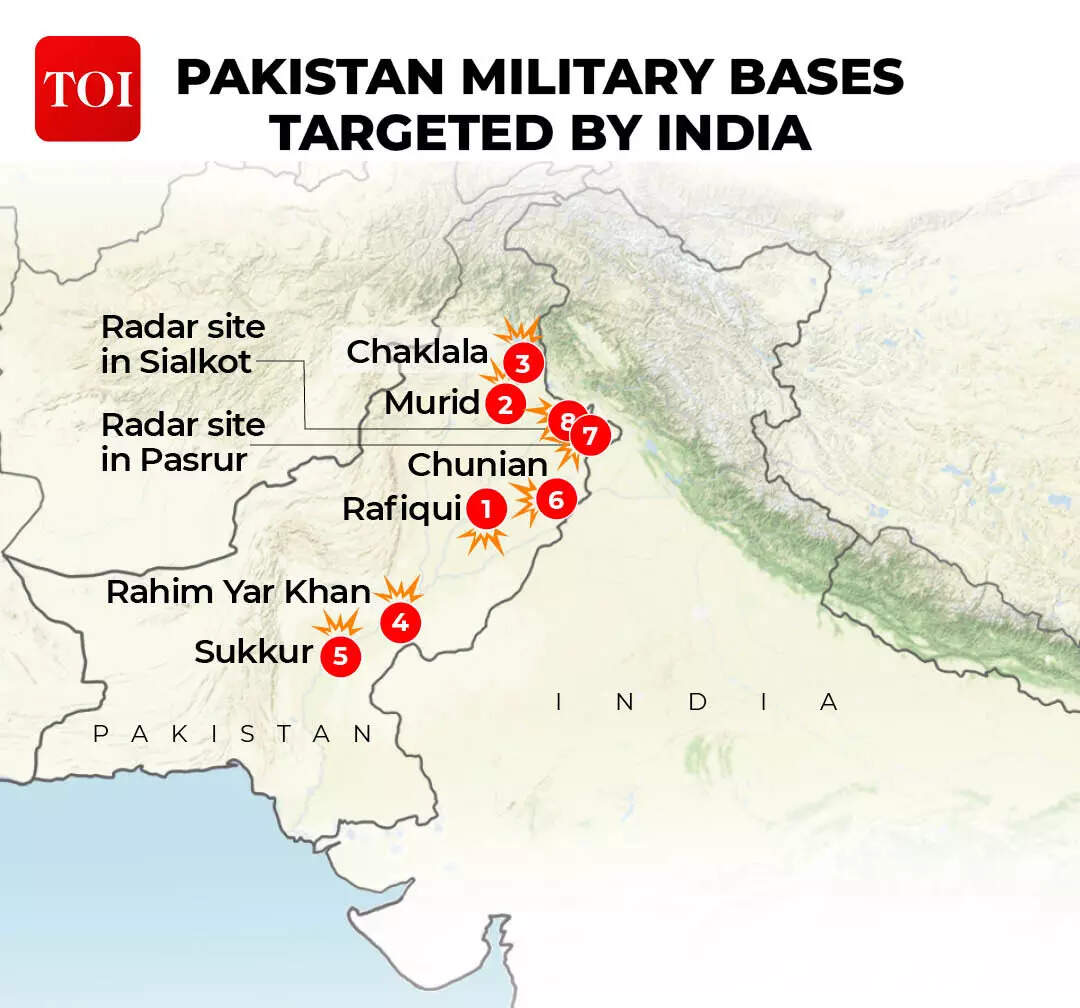
Some bases, such as Rahim Yar Khan, remained non-operational for months.Military tensions between the two nuclear-armed neighbours eventually eased on May 10 after Pakistan’s DGMO contacted the Indian counterpart to agree on a ceasefire on land, air, and water.
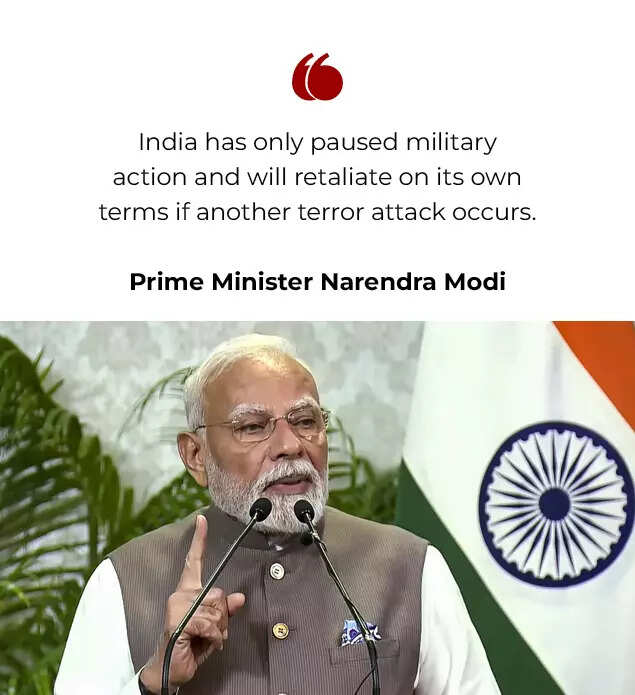
However, India maintains that Operation Sindoor is just “paused” as the Prime Minister Modi, and Amit Shah clearly stated.
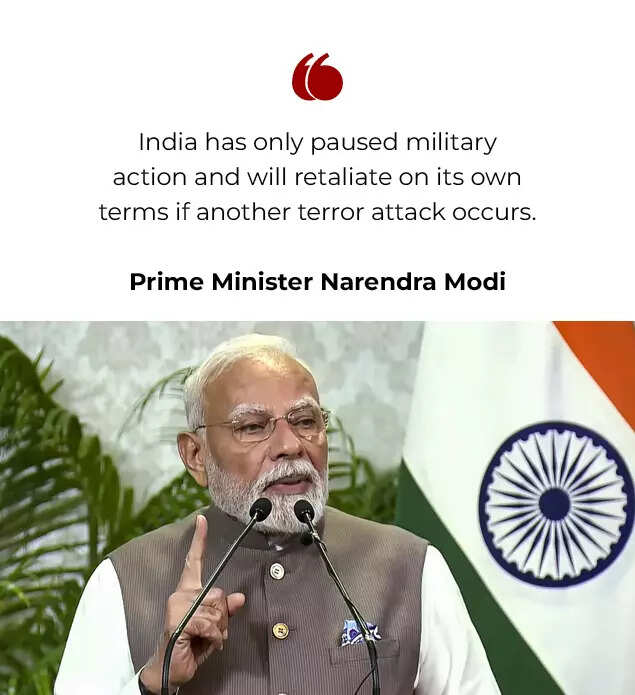
PM Modi on Operation Sindoor
In his first address after the strikes, he said, “India has only paused military action and will retaliate on its own terms if another terror attack occurs.” He added, “The three armies of India — Air Force, Navy, and Army, along with BSF and military forces — are on alert. After the surgical strike and air strike, Operation Sindoor is India’s policy against terrorism. Operation Sindoor has drawn a new line against terrorism.”
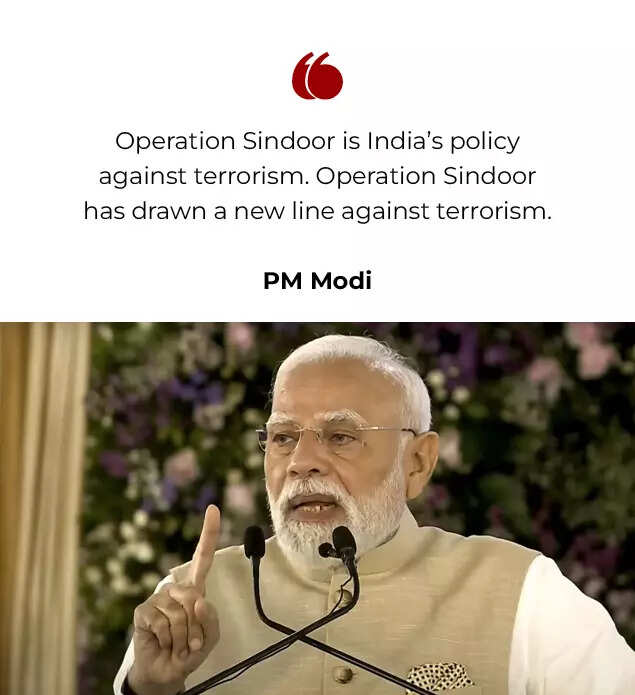
‘Op Sindoor drawn a new line against terrorism’
“Operation Sindoor is not just a name but it’s a reflection of the feelings of millions of people of the country,” Prime Minister Modi said.Months later, IAF chief Amar Preet Singh confirmed the scale of losses inflicted on Pakistan. “We have signs of one C-130 class aircraft and at least four to five fighter jets, most likely F-16s, along with one SAM system destroyed. We have clear evidence of a long-range strike exceeding 300 km, along with five high-tech fighters between F-16 and JF-17 class,” he said.
Operation Keller
Soon after Operation Sindoor, the Army launched large-scale raids and counterterror operations across the Valley. One of the major actions was Operation Keller, a “search and destroy” mission initiated in May in the Keller forest area of Jammu and Kashmir’s Shopian district.The Army, CRPF and Jammu and Kashmir Police conducted a coordinated manhunt to track terrorists believed to be hiding in the dense forest belt.During the operation, security forces eliminated three Lashkar-e-Taiba terrorists and recovered a significant cache of arms and ammunition, including AK-47 rifles, grenades and hundreds of rounds.Those killed included Shahid Kuttay, an LeT/TRF commander, and Hussain Thokar, both linked to recent terror activities in the region.Operation Keller underscored the heightened synergy between security forces and intelligence agencies after the Pahalgam massacre, marking the start of a sustained crackdown on terrorist networks in the Valley.
Operation Mahadev
The terrorists responsible for the April 22 Pahalgam massacre, in which 26 civilians were killed, remained on the run for months. Under Operation Mahadev, they were finally tracked down and neutralised.The operation, carried out over 12 days with precise intelligence inputs, led to the elimination of three Lashkar-e-Taiba terrorists confirmed to be involved in the Pahalgam killings.Union home minister Amit Shah announced the outcome during the Monsoon Session of Parliament: “I want to tell the House and the people of the country that those who killed our people in Baisaran Valley … all three terrorists have been killed.”He added that “Operation Sindoor and Operation Mahadev have sent a clear message to the masterminds of terror about the consequences of playing with the lives of Indian citizens.”
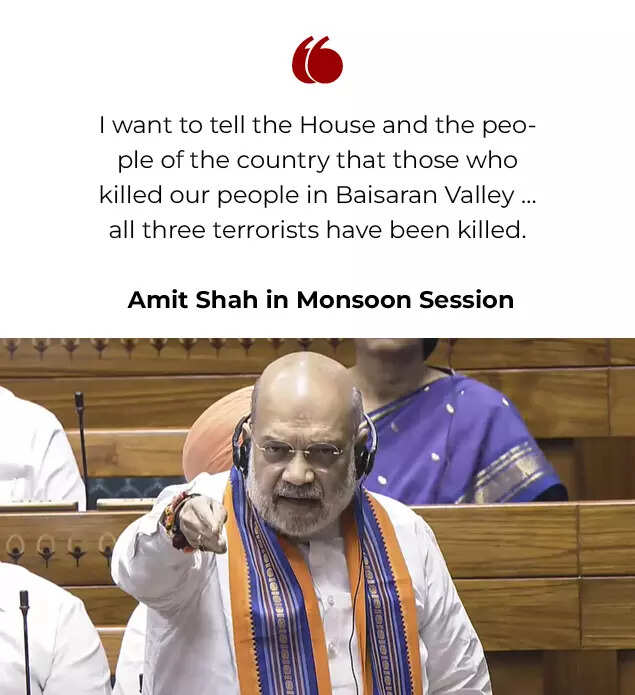
Amit Shah in Monsoon Session
The three high-profile Lashkar terrorists were killed on July 28 in an encounter in the Dachigam forest near Srinagar, where they had been hiding since the April attack. Go to Source