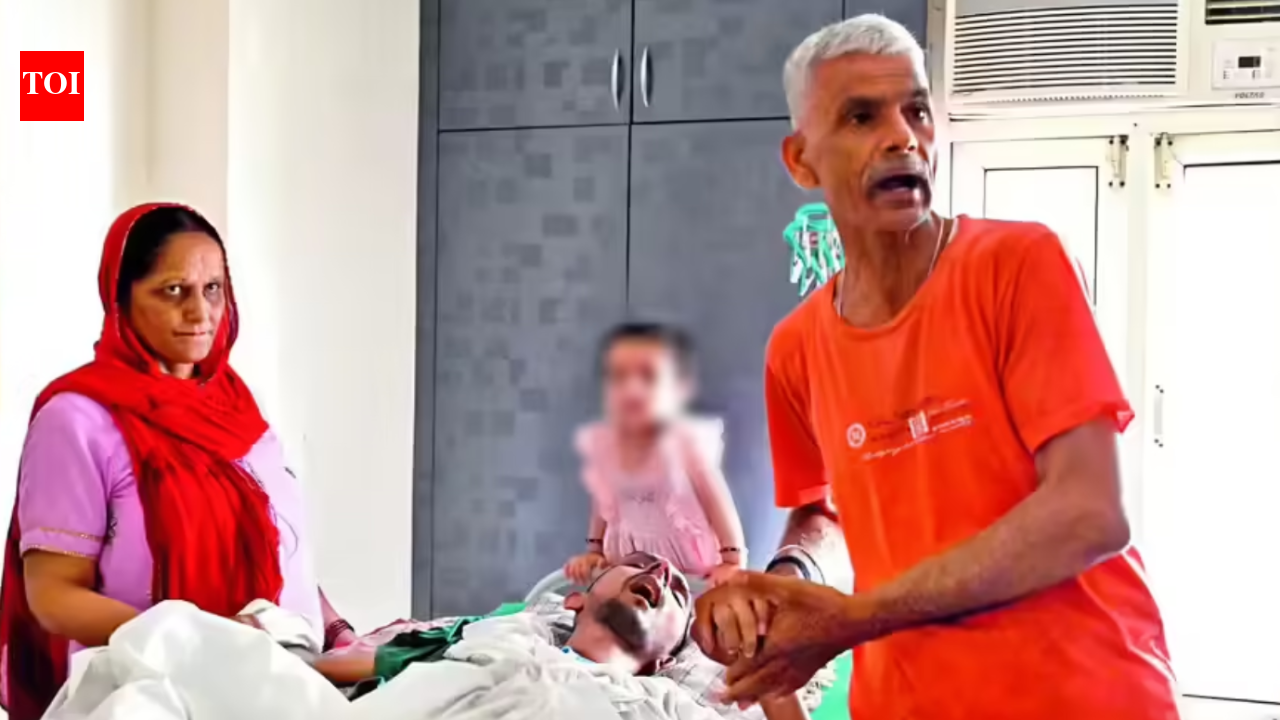

NEW DELHI: Comparing it with the case of Aruna Shanbaug, who spent 42 years in a vegetative state, additional solicitor general Aishwarya Bhati on Thursday told the Supreme Court that the medical condition of Harish Rana, who has been in a vegetative state for the last 13 years, is worse than hers and favoured his plea for passive euthanasia.Appearing before a bench of Justices J B Pardiwala and K V Viswanathan, Bhati, who is appearing for the Centre, said that Shanbaug’s eyes would respond, and she also used to move her lips to lick sugar. But Harish has been in a state of complete inertness. His eyes do not move, nor respond to danger.Advocate Rashmi Nandakumar, appearing for Harish, submitted that he has been in an irreversible and incurable state with 100% disability since the accident, with no hope of recovery.
Election Results
The court should proceed to make a final decision on withdrawing his life support system, she said.The court reserved its order after hearing both the sides. This is the first case of its kind when the apex court will decide a plea for passive euthanasia since it legalised the same.Shanbaug, a nurse who spent 42 years in a persistent vegetative state after being raped, died in 2015. She was left with severe brain damage and paralysed after the 1973 attack by a ward attendant in the Mumbai hospital where she worked. A plea was filed by a writer in SC seeking removal of her life support system, but the hospital staff, who were taking care of her, strongly opposed the plea and the court did not allow it. Passive euthanasia had not been legalised in the country at that time, happening only after the apex court’s verdict in 2018.Bhati had told the bench earlier that she had had a talk with the team of doctors, i.e., members of the Primary Board as well as Secondary Board, who examined Harish, and they were of the opinion that continuation of medical treatment was not in his best interest and that, in the given circumstances, nature should be allowed to take its course. “The doctors are also of the opinion that Harish would remain in this permanent vegetative state (PVS) for years to come, with tubes inserted all over his body. However, he would never be able to recover and live a normal life,” she told the bench.As per the procedure framed by SC on passive euthanasia, the decision to withdraw the artificial life support system can be taken only after the primary and secondary medical boards concur on the issue. In this case, both the boards are one on withdrawing Harish’s life support system, and the final call now has to be taken by the apex court.Harish had fallen from the fourth floor of his paying guest accommodation on Aug 20, 2013, while he was pursuing a B.Tech degree at Punjab University. He was treated at various hospitals, but his condition did not improve. His father had first moved Delhi HC, which refused his plea to refer the case to a primary medical board. Go to Source