
For decades, India’s energy challenge could be simply summed up: build more capacity. More coal, more transmission lines, more renewable energy. Solar, in particular, became the poster child of the country’s clean energy ambitions.Now, success has created a new problem.Across India’s vast solar parks, electricity is increasingly generated faster than the grid can absorb it. Panels continue to harvest abundant sunshine, but not every electron finds a home.It is an irony few would have predicted a decade ago.India’s solar revolution is no longer constrained primarily by a lack of generation capacity. It is increasingly constrained by the ability to move, store and use the electricity it produces.That paradox, producing too much clean electricity at the wrong time, could define the next phase of India’s energy transition.
From solar laggard to powerhouse
India’s solar story has been one of the country’s most remarkable infrastructure transformations.India gets 250–300 sunny days a year in most parts of the country, with solar insolation of 4–7 kWh per square metre per day. A recent working paper by the Economic Advisory Council to the Prime Minister (EAC-PM) says India’s installed solar capacity has expanded from just 3 GW in 2014 to around 157 GW by May 2026.
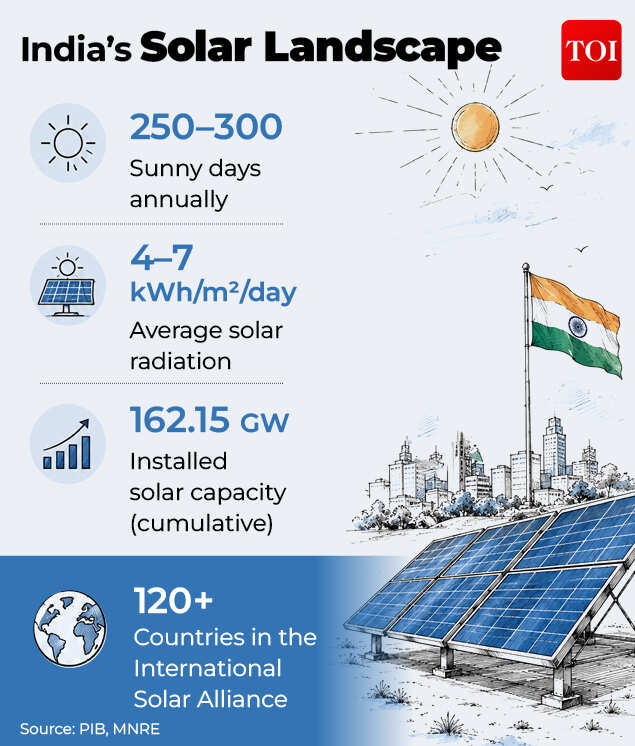
Solar has emerged as the largest contributor within India’s renewable energy portfolio, overtaking other clean energy sources in installed capacity, according to the Press Information Bureau (PIB).The country now ranks third globally in installed solar capacity, according to the Renewable Energy Statistics 2026, reflecting how rapidly India has scaled deployment.This growth has helped transform India’s wider electricity system.As of October 2025, non-fossil fuel sources accounted for more than half of India’s installed electricity capacity, another milestone highlighted by the PIB.The expansion also underpins India’s Panchamrit commitments announced at COP26, including achieving 500 GW of non-fossil electricity capacity by 2030 and ultimately reaching net-zero emissions by 2070.Yet the country’s greatest solar success has also exposed its weakest link.
The paradox
The warning signs are becoming increasingly difficult to ignore.According to a written reply in Parliament by minister of state for Renewable Energy Shripad Yesso Naik, India curtailed 8,133 gigawatt-hours (GWh) of solar electricity during the April–June period because the grid could not absorb all the renewable power being generated.
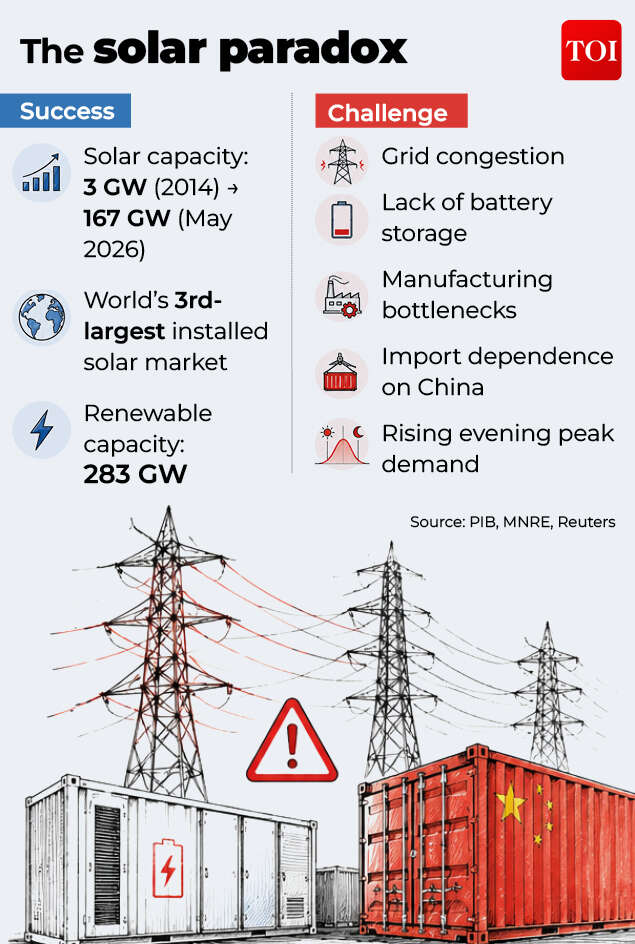
Solar generation peaks around midday, when sunshine is strongest.Electricity demand, however, often reaches its highest point after sunset, precisely when solar output begins to fall.The result is a widening mismatch between when electricity is generated and when it is most needed.The EAC-PM working paper argues that India’s electricity challenge has fundamentally changed. “The active constraint for the grid has shifted from generation capacity to flexibility,” the report says.The paper describes India’s increasingly pronounced “duck curve,” a phenomenon seen in many high-renewable electricity systems where solar generation creates a deep trough in daytime demand from conventional power plants, followed by a steep evening surge once the sun sets.The transformation has been rapid.Between May 2023 and May 2026, the evening net-load ramp nearly doubled, from about 36 GW to 74 GW, while the morning decline as solar flooded the grid almost tripled, from 18 GW to 53 GW, according to the EAC-PM analysis.
What is driving it
The surge has been driven by a combination of ambitious policy support and falling solar costs.Government flagship programmes such as PM Surya Ghar: Muft Bijli Yojana aim to install rooftop solar systems in one crore households. By December 2025, 23.9 lakh households had already installed rooftop systems with around 7 GW of capacity, while more than Rs 13,464 crore had been released as subsidies, according to the PIB.Meanwhile, the Production Linked Incentive (PLI) scheme for high-efficiency solar PV modules, with a total outlay of Rs 24,000 crore, seeks to build domestic manufacturing capacity and reduce import dependence.India has also accelerated utility-scale solar parks and expanded renewable procurement through competitive bidding.
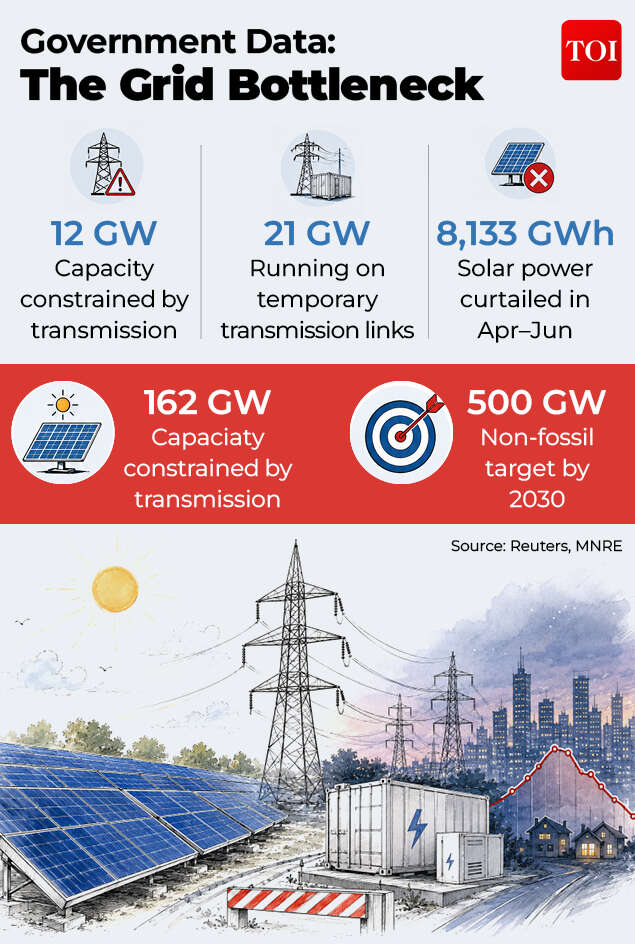
The result has been unprecedented capacity addition. According to NITI Aayog’s India Climate and Energy Dashboard, renewable energy capacity increased from 58 GW in 2020–21 to around 283 GW by May 2026, with solar alone contributing approximately 157 GW.
The grid is changing fast
Electricity demand itself is rising at remarkable speed.According to the Central Electricity Authority (CEA), peak demand increased from 190 GW in 2020–21 to around 250 GW in 2024–25, while annual electricity requirement rose from 1,276 billion units to 1,694 billion units over the same period.The trend has continued.On May 21, 2026, India’s grid recorded its highest-ever demand, touching 270.8 GW, according to the EAC-PM.Yet that same day revealed another striking reality.Electricity traded on the Indian Energy Exchange cleared at just Rs 1.56 per unit at 1 pm, when solar generation flooded the grid. By 6.30 pm, after sunset, prices had surged to the market ceiling of Rs 10 per unit.India is not short of electricity during the day. It is short of flexibility after dark.Another hurdle lies in India’s domestic manufacturing ecosystem. Even as the government pushes for self-reliance in solar equipment, manufacturers are struggling with shortages of locally made solar cells.According to Reuters, nearly one-third of India’s small and medium-sized solar module manufacturers have halted production, while others have cut operating days because of waiting periods of up to eight months for domestic cells. With India still relying on China for around 95% of its solar cell imports, the supply crunch threatens to slow capacity expansion and raise production costs, exposing the gap between policy ambition and manufacturing readiness.
Will the boom continue?
Almost certainly.
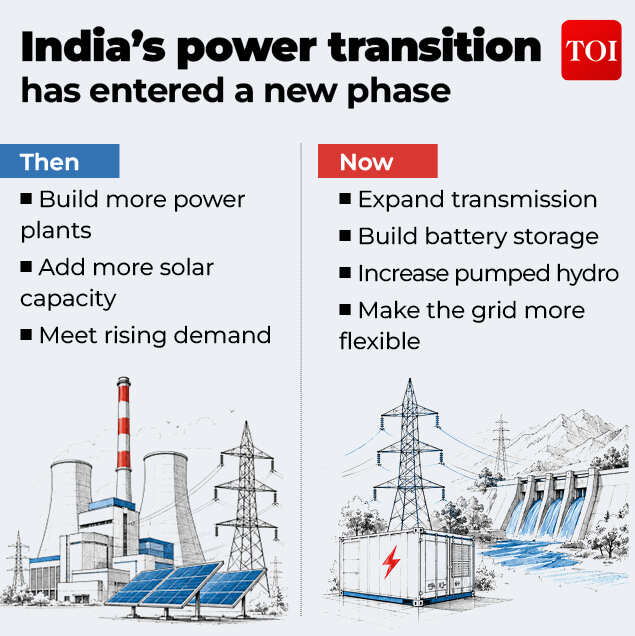
India’s clean energy targets remain among the world’s most ambitious, and policy momentum shows little sign of slowing. The challenge, however, is shifting from building generation assets to building an electricity system capable of handling them.Flattening even half of a typical summer evening demand ramp would require around 130 GWh of battery discharge, far exceeding India’s present storage capability.While pumped hydro projects have advanced steadily, battery deployment remains well behind projections. Recent additions have raised battery energy storage capacity to around 2.7 GW, but a substantial gap remains.
Join conversation
Share your thoughts in the comments
Be respectful · TOI community guidelines
Recognising this, proposed amendments to the Electricity Act and consumer rules seek to formally integrate energy storage into India’s power system, deepen electricity markets, strengthen non-fossil obligations and accelerate time-of-day tariffs, all intended to improve grid flexibility.
The next chapter
India’s solar journey is, in many ways, a victim of its own success.The next decade of India’s energy transition will be defined less by the number of panels installed than by the intelligence of the grid behind them. Transmission lines, batteries, storage technologies, flexible markets and smarter demand management will determine whether India’s abundant sunshine translates into reliable clean power. Go to Source