
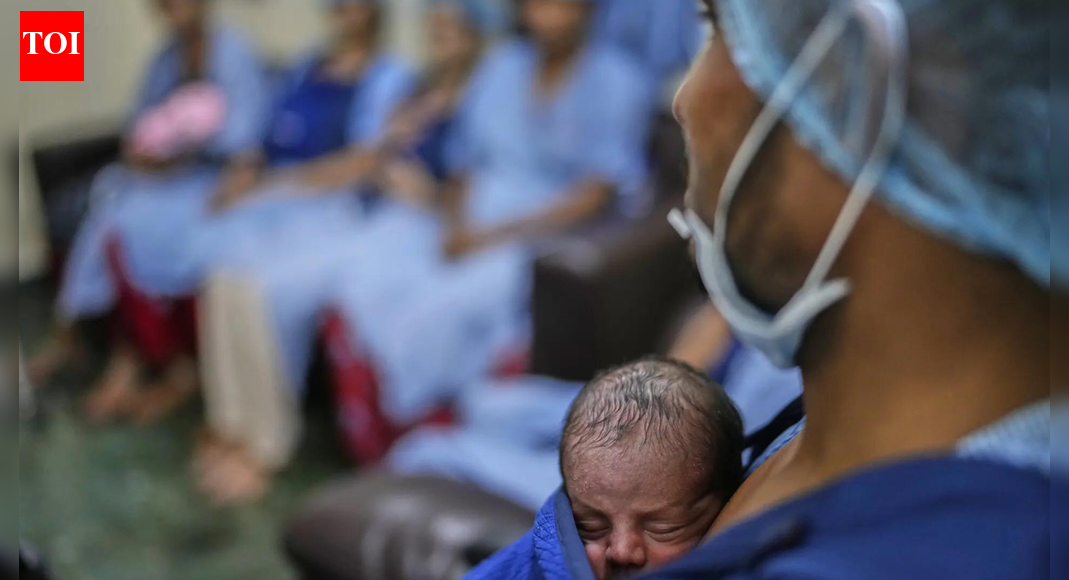


Representative image (Photo credit: AP)
NEW DELHI: India continues to fall short of basic global healthcare capacity standards, the Union Health Ministry told Parliament, acknowledging that the country remains well below the WHO benchmark for hospital beds even as patient load keeps rising nationwide.Responding to a question in the Rajya Sabha, Minister of State for Health Prataprao Jadhav said that while IPHS 2022 mandates at least 1 bed per 1,000 people, several states still cannot meet even this minimum requirement — and remain far from the WHO norm of 3.5 beds per 1,000 population. State-wise data published in the government’s annual Rural Health Statistics and the latest Health Dynamics of India report shows large disparities, with populous states carrying some of the deepest deficits.On staffing, Jadhav said India has 13.86 lakh registered allopathic doctors and 7.51 lakh AYUSH practitioners; assuming 80% availability, the doctor–population ratio stands at 1:811. The nursing workforce has reached 42.94 lakh, with 5,253 institutions producing nearly 3.87 lakh nurses annually, yet significant vacancies remain across government hospitals.Despite a decade of expansion — medical colleges rising from 387 to 818, MBBS seats from 51,348 to 1,28,875, and postgraduate seats from 31,185 to 82,059 — many states continue to struggle with shortages of doctors, nurses and paramedics on the ground. The government has set up State Cancer Institutes, Tertiary Cancer Centres and oncology services in all new AIIMS campuses, but Jadhav admitted that India’s public-health capacity remains uneven, with rural districts and smaller states still far from meeting IPHS norms.He said filling vacancies, strengthening district and CHC infrastructure, and ensuring states comply with national standards will be critical as India works to close one of the world’s largest healthcare infrastructure gaps.