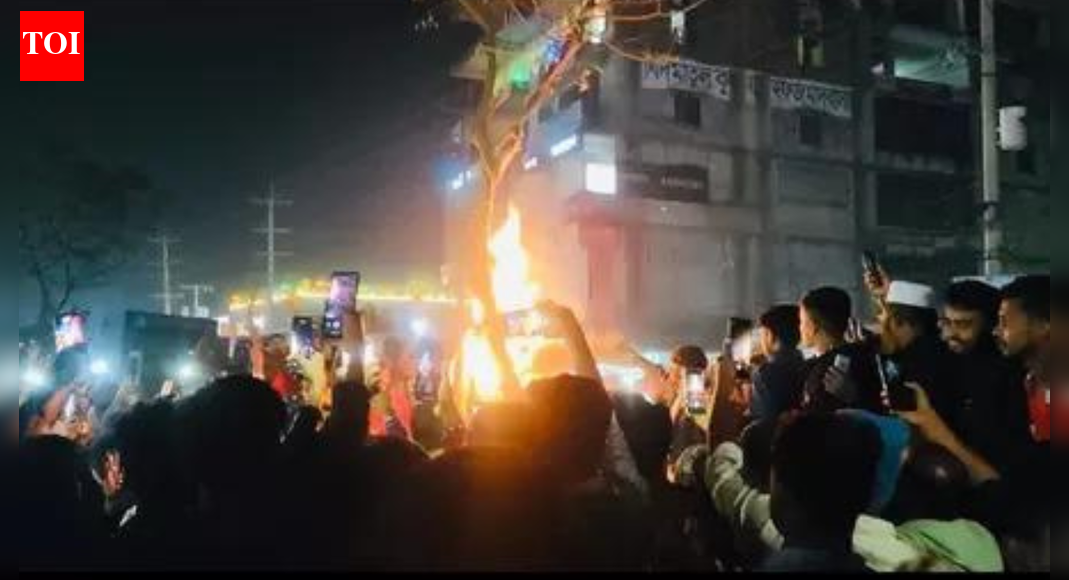

Image: IANS
NEW DELHI: India hit out at Bangladesh and suspended visa operations at its mission in Chittagong on Sunday, amid a wave of protests there with an anti-India hue sparked by the death of radical activist Sharif Osman Hadi, which has seen the lynching of a Hindu man.Describing as “horrend-ous” the killing of 25-year-old Dipu Chandra Das, a garment factory worker beaten to death by a mob and set ablaze for alleged blasphemy, MEA slammed attempts in Bangladesh to draw false equivalence between protests targeting its facilities in that country and the one outside the Bangladesh mission in Delhi.India’s assistant high commission in Chittagong suspended visa operations over concern for safety of the centre’s staff and premises in view of angry protests, which saw demonstrators come close to the diplomatic facility on Thursday despite presence of Bangladesh security personnel.
Bring to justice perpetrators of Dipu’s ‘barbaric killing’, New Delhi tells Dhaka
Due to the recent security incident, Indian visa oper-ations at IVAC Chittagong will remain suspended from Dec 21, 2025, until further notice, the Indian Visa Appli-cation Centre (IVAC) said in a statement.
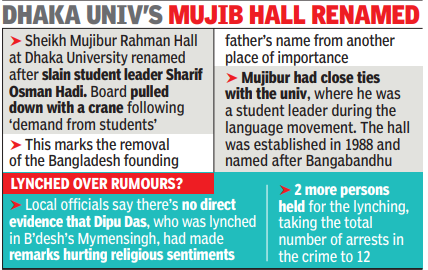
MEA spokesperson Randhir Jaiswal in Delhi urged the interim govt in Dhaka to bring to justice the perpetrators of the “barbaric killing” of Dipu, leading Bangladesh to protest.“The incident should not be conflated with the security of minorities,” foreign affairs adviser Md Touhid Hossain said in Dhaka, adding, “He was a Bangladeshi citizen who was killed, and Bangladesh took immediate action. Several arrests have already been made.”He also claimed that the protests in New Delhi left the “Bangladesh high commissioner and his family feeling threatened”.The assistant Indian high Commissioner’s residence in Chittagong was pelted with stones by a mob on Thursday, the day Hadi died days after being shot in head by masked gunmen. Thursday also saw massive “anti-India” protests outside the assistant Indian high commissions in Khulna and Rajshahi, and on Wednesday, around the high commission in Dhaka.In an apparent attempt to suggest that the Bangladesh high commission in New Delhi faced a security threat of similar severity, media reports Bangladesh said a demonstration by “Hindu extremists” outside the facility over Dipu’s death in Mymensingh threatened its security, drawing a sharp rejoinder from the MEA.India trashed such claims as “misleading propaganda”. There was “no attempt to breach the fence or create a security situation at any time,” the MEA said, adding police dispersed the group after a few minutes and visual evidence of these events is publicly available. “We have noted misleading propaganda in sections of the Bangladesh media on the incident,” Jaiswal said.The MEA said about 20-25 youths had gathered outside the Bangladesh high commission on Saturday and raised slogans in protest against the “horrendous killing” of Dipu.“India continues to keep a close watch on the evolving situation in Bangladesh. Our officials remain in touch with Bangladesh authorities and have conveyed to them our strong concerns at the attacks on minorities,” Jaiswal said.Pictures of the two protests pointed out the contrast as angry protesters came in close proximity to the Indian facility in Chittagong, while a much smaller crowd stood in protest at a safe distance from the Bangladesh high commission.Exiled Bangladeshi author Taslima Nasreen had on Saturday introduced another dimension to the horrific killing of Dipu, claiming on X that police had initially rescued him from the mob and asked if police with sympathies for extremists handed him back to the violent crowd determined to kill or they were overpowered. “They held a full-blown celebration — beating Dipu, hanging him, burning him — a jihadist festival,” she said.On Sunday, two more persons were held in the Mymensingh lynching case, taking the total arrests to 12.Internal situation has deteriorated in Bangladesh after the death of Haidi, a prominent face in 2024 anti-govt protests that led to then PM Sheikh Hasina abdicating & fleeing to India. Known for his anti-India utterances, he was a leader of radical group Inquilab Mancho & had shared a map of greater Bangladesh that showed India’s north east as part of his country. Go to Source